テオのアパートの眺め
Vincent van Gogh · 1887
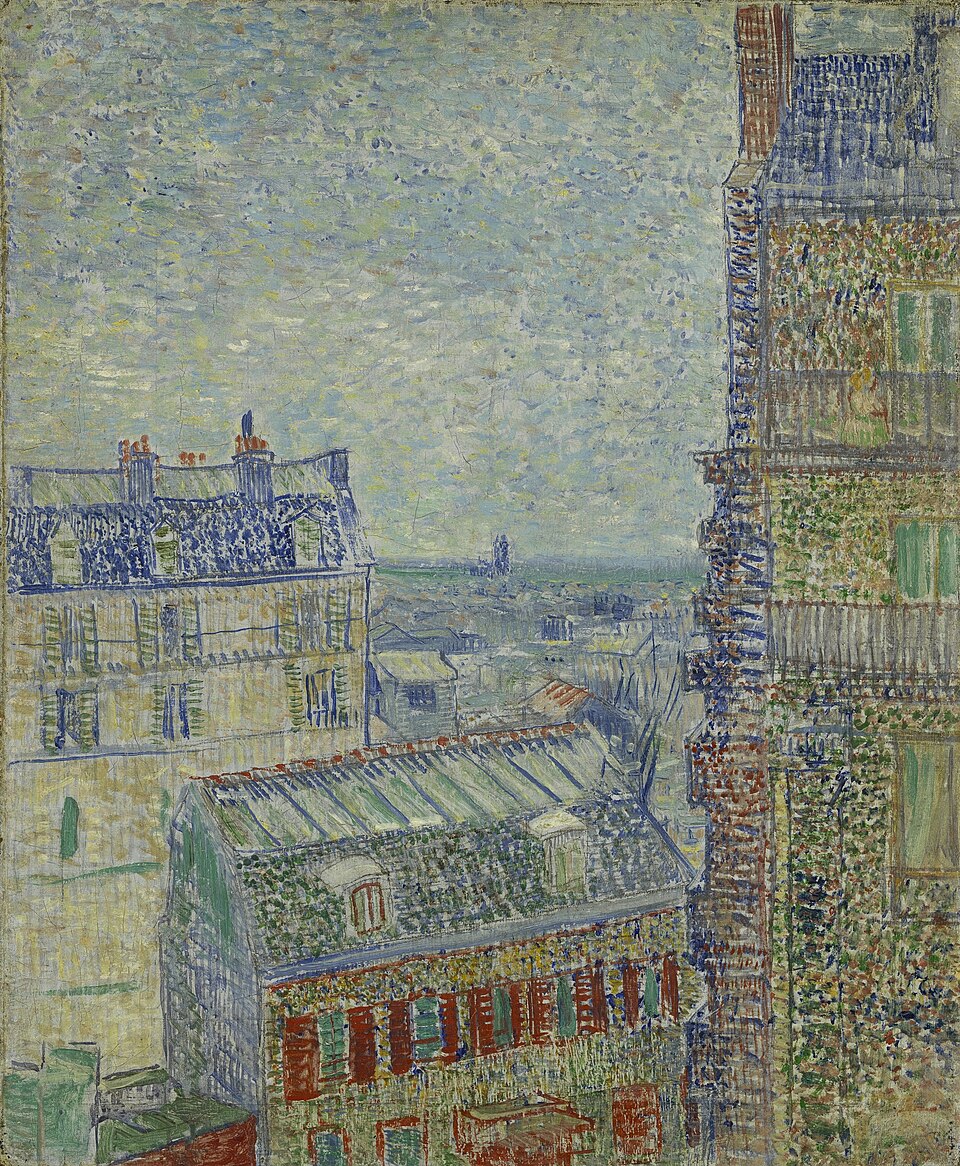
From a fourth-floor window in Montmartre, Van Gogh looked out over the rooftops of Paris, and in doing so watched his own palette change from Dutch gloom to bright, broken colour.
The story behind the painting
In March 1886 Vincent van Gogh left the Netherlands for Paris to live with his brother Theo, an art dealer. The brothers shared a fourth-floor apartment on the Rue Lepic in Montmartre, then known as an artists' quarter, and its windows opened onto a vast view of the city. Vincent loved it. In October 1886 he wrote to his friend Horace Mann Livens that the French air clears up the brain and does one good. The Paris years, 1886 to 1888, were the most prolific of his life, with roughly 230 paintings. This canvas, dated 1887 and known in Wikidata as View from Theo's apartment, belongs to a small group of views from those windows that Wikipedia gathers under the title View of Paris from Vincent's Room in the Rue Lepic. The sources describe the group as a whole, so the details below refer to the series rather than to this canvas alone.
What to look for
According to the accounts of the series, the foreground is a jumble of city blocks: buildings with brightly coloured shutters and a crowd of rooftops. Beyond them Paris opens out toward its centre, with the cathedral of Notre-Dame under a sky of blue and green. Notice the upright format. Van Gogh first tried a horizontal composition in a drawing, found that a building on the right was far too large, and started again in a vertical format from the living-room window, where that building took less space. In one version he added a girl on the top balcony to bring the scene to life. Look closely at the surface, too: loose strokes and small dots of contrasting blue, green, red and yellow, a sign that he was trying out Pointillist touches he had seen in Paris.
Meaning and intent
These views record a painter in transformation. Not long before, in a view from the same apartment, Van Gogh had used mostly greys and browns, the sombre colours of his earlier realist work in Holland. Here the palette brightens and the brushwork breaks into flecks. The sources name his influences: the Impressionists and Neo-Impressionists, young artists such as Camille Pissarro, Paul Gauguin and Henri de Toulouse-Lautrec, and the critic Charles Blanc, all of whom encouraged him to use colour for its luminous and emotional effect. Japanese prints mattered as well. They often set large objects in the foreground against a distant view, and Van Gogh borrowed that structure, letting the nearby roofs frame the city and the sky far behind. The window itself becomes a metaphor: a newcomer looking out at the capital that was reshaping him.
Legacy
The painting belongs to the Van Gogh Museum in Amsterdam, the institution built around the works the artist left to his family. Within his story it marks a hinge. The dark Dutch manner of the Potato Eaters years gives way here to the colour that would explode in Arles a year later, and you can almost see the change happening stroke by stroke. The series is also a small lesson in how Van Gogh worked: a drawing, a rejected composition, a move to another room, and repeated attempts at the same view until the picture held together. For anyone who knows only the sunflowers and starry nights, these quiet rooftops are worth seeking out, because they show where that later brilliance was learned, looking out of his brother's window.
豆知識
- Van Gogh painted about 230 works during his two years in Paris, the most prolific period of his life.
- The apartment he shared with Theo was on the fourth floor in Montmartre, on the Rue Lepic.
- He switched from a horizontal to a vertical format and moved to the living-room window to fix the composition.
- The series shows early use of Pointillist dots of colour.
画家について
Vincent van Gogh (1853-1890)
同じ画家の作品: Vincent van Gogh
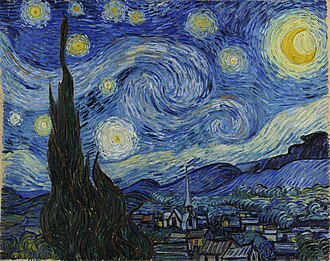 星月夜 - Vincent van Gogh (1889)
.jpg) 夜のカフェテラス - Vincent van Gogh (1888)
夜のカフェテラス - Vincent van Gogh (1888)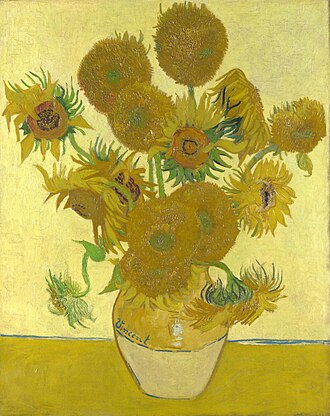 ひまわり - Vincent van Gogh (1888)
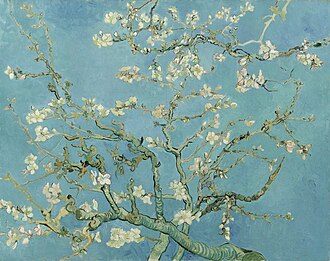 花咲くアーモンドの木の枝 - Vincent van Gogh (1890)
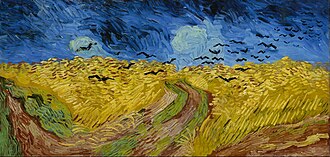 カラスのいる麦畑 - Vincent van Gogh (1890)
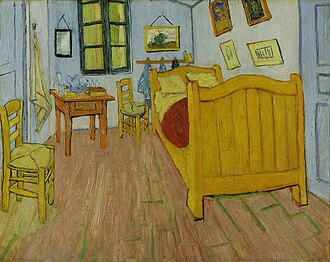 アルルの寝室 - Vincent van Gogh (1888)
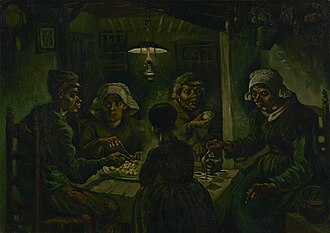 ジャガイモを食べる人々 - Vincent van Gogh (1885)
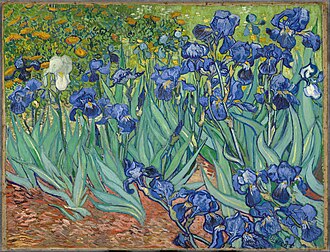 アイリス - Vincent van Gogh (1889)
関連する画家の作品
 我々はどこから来たのか 我々は何者か 我々はどこへ行くのか - Paul Gauguin (1897-1898)
%201889.jpg) 黄色いキリスト - Paul Gauguin (1889)
黄色いキリスト - Paul Gauguin (1889) 草上の昼食 - Édouard Manet (1863)
 オランピア - Édouard Manet (1863)