ヴィーナスの化粧
フランソワ・ブーシェ · 1751
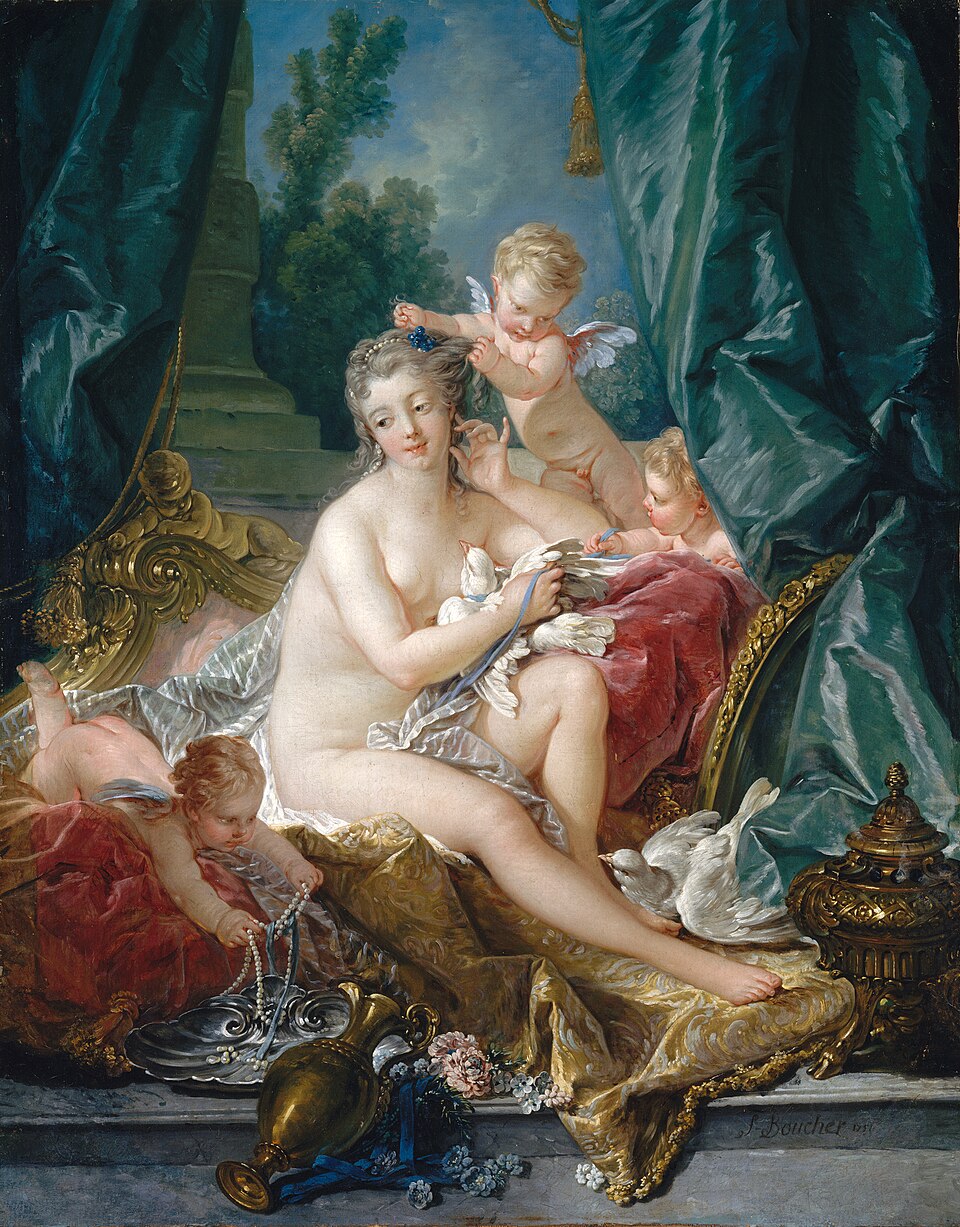
Venus lounges on a pink velvet sofa while three little putti fuss over her hair, ribbons and pearls. Boucher painted her in 1751 for the bathroom of Madame de Pompadour's country retreat.
The story behind the painting
François Boucher completed The Toilet of Venus in 1751. It was commissioned by Madame de Pompadour, the official mistress of Louis XV and a constant patron of Boucher, for the bathroom of the Château de Bellevue, the retreat she shared with the king. It was conceived as a pendant to Boucher's Bath of Venus. Boucher often painted mythology, and here the Roman goddess of love and beauty carries subtle allusions to Pompadour herself. In February 1750, a year before the painting was finished, Pompadour had played Venus in a ballet scene called La Toilette de Vénus.
What to look for
The nude goddess sits on a Rococo canapé draped in pink velvet in a lavish interior. Blue curtains are drawn aside to reveal greenery beyond. Three putti help with her toilette: one arranges her hair, another hands her a ribbon, a third lifts a tangled pearl necklace. Venus ties a ribbon around the neck of one of two doves, while the other sits at her feet. A pitcher tips over, and a silver shell-shaped tray and loose flowers lie about. At lower right stands a cassolette, a perfume burner with small deer-hoof feet and acanthus mouldings.
Meaning and intent
The pastel colours, lively composition and sensual textures of fabric and gilding are key marks of the Rococo. Yet the cassolette hints at the Classical world, an interpretation à la grecque that foreshadows the Neoclassical athénienne, invented in 1773. Boucher worked on stage design with his friend Charles Simon Favart, and Alastair Laing has suggested that the painting borrows elements from stage sets of the time. Hung in a bathroom with erotic associations and linked to Pompadour's stage role, it is seen as a deliberate allusion to her place as the king's mistress.
Legacy
Pompadour kept the painting until her death in 1764, when it was found with The Bath of Venus in her Paris house, today the Élysée Palace. Her brother Abel-François Poisson inherited both, and after his death in 1781 they were sold and the pair separated. In 1782, while the painting was on the market, Jean-François Janinet engraved it, with a dedication to Madame de Coislin, once Pompadour's rival for the king, perhaps ironically. It passed through private collections until the Vanderbilt family bequeathed it to the Metropolitan Museum of Art in 1920.
豆知識
- Commissioned by Madame de Pompadour, completed 1751.
- Painted for the bathroom of the Château de Bellevue.
- Pendant to Boucher's Bath of Venus, now separated.
- Bequeathed to the Metropolitan Museum in 1920.
画家について
フランソワ・ブーシェ (1703-1770)
神話画 · メトロポリタン美術館 · ウェヌス · ヌード
同じ画家の作品: フランソワ・ブーシェ
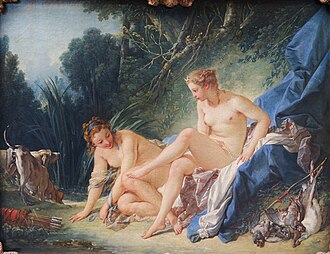 水浴のディアナ - François Boucher (1742)
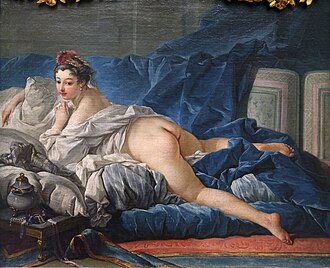 オダリスク - François Boucher (1740s)
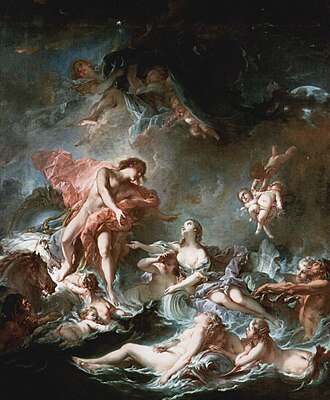 日の入り - François Boucher (1752)
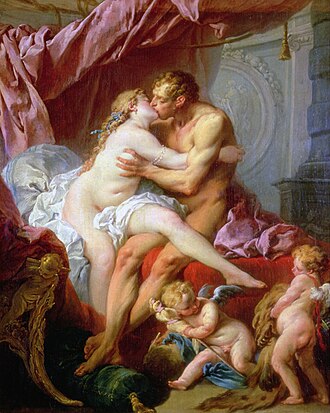 ヘラクレスとオンファレ - François Boucher (1730s)
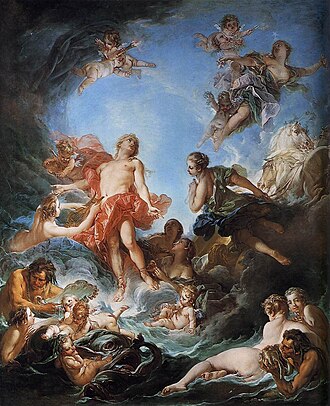 日の出 - François Boucher (1753)
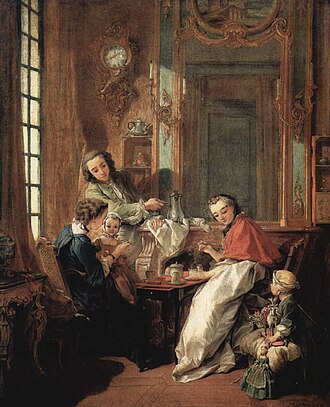 朝食 - François Boucher (1739)
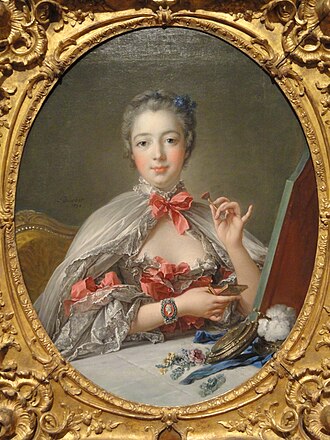 Jeanne-Antoinette Poisson, Marquise de Pompadour - François Boucher (1750)
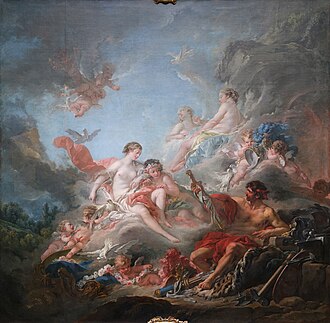 アイネイアースのためにヴィーナスに武器を授けるウルカヌス - François Boucher (1757)
 シテール島の巡礼
 ピエロ
ピエロ ぶらんこ
ぶらんこ 読書する娘
読書する娘 1808年5月3日
.jpg) 裸のマハ
裸のマハ