Jeanne-Antoinette Poisson, Marquise de Pompadour
フランソワ・ブーシェ · 1750
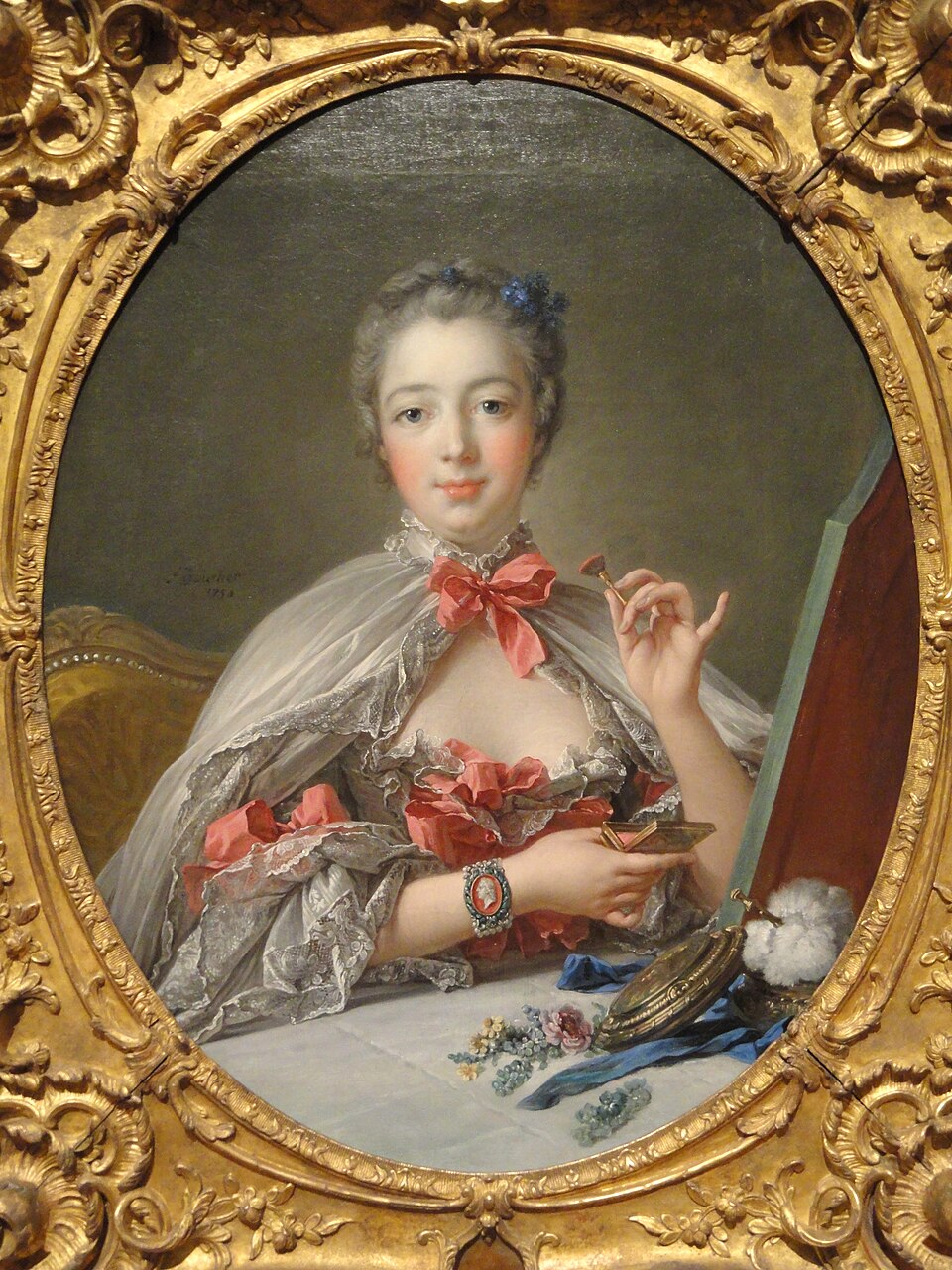
The king's favourite holds a tin of rouge in one hand and a brush in the other, about to paint her own cheek. Boucher's portrait began as a small bust and grew, strip by strip, into a scene about who controls an image.
The story behind the painting
Boucher painted Madame de Pompadour, mistress of King Louis XV, in 1750, when she was 37. The painting is known in English as Pompadour at Her Toilette. At the time she suffered from migraines, fevers, seizures and other illnesses; she had grown thin and bony, and her skin had become jaundiced and wrinkled. The healthy figure and smooth white skin of the portrait therefore show her past youth and beauty, the beauty that had won her place as the king's favourite, more than the woman of 1750. She often commissioned portraits from Boucher in a long artistic partnership.
What to look for
The canvas changed shape several times. It began as a small rectangular bust cropped tightly around her face. Boucher later enlarged it with several rectangular strips, adding the dressing table scene around her, and in the late eighteenth century it was adjusted again into an oval. In one hand she holds a small rectangular tin of rouge, in the other a brush freshly dipped in colour. Pale pink and white dominate, the most fashionable cosmetic colours of the day, set off by blue flowers in her hair and blue ribbons by the mirror. The light, feathery brushstrokes look almost like powder being dusted onto skin.
Meaning and intent
Art historians read the makeup and the many changes to the composition as a study of Pompadour shaping her own image. Her act of applying rouge mirrors Boucher applying oil paint, blurring the line between painter and sitter, and while he held the brush she guided how she would be shown, as an important and wealthy woman. Rouge then heightened pale skin and marked high status and courtly elegance. When she was made lady-in-waiting to the queen in 1756, people expected her to give up rouge and frivolous gowns; instead she appeared more lavishly made up than ever.
Legacy
Boucher's delicate brushwork, pastel colours and sensuous subjects are typical of the Rococo, and his palette was both admired and criticised in his time. This portrait is considered novel for its double approach to self-representation: the subject is shown as an author of her own image, not only as its model. Her open display of French-made rouge has also been read as support for French products and a sign of fashionable taste. Wikidata records the painting in the Fogg Museum of the Harvard Art Museums.
豆知識
- Painted in 1750, when Pompadour was 37, with later additions.
- Began as a small bust, enlarged with strips, later made oval.
- She holds a tin of rouge and a brush.
- Recorded in the Fogg Museum, Harvard Art Museums.
画家について
フランソワ・ブーシェ (1703-1770)
同じ画家の作品: フランソワ・ブーシェ
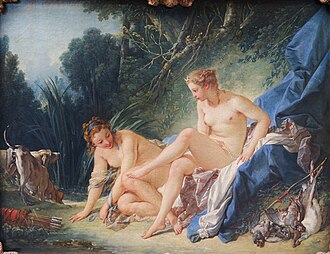 水浴のディアナ - François Boucher (1742)
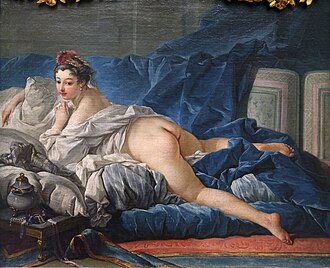 オダリスク - François Boucher (1740s)
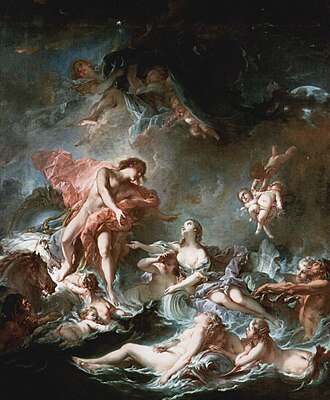 日の入り - François Boucher (1752)
 ヘラクレスとオンファレ - François Boucher (1730s)
 日の出 - François Boucher (1753)
 朝食 - François Boucher (1739)
 ヴィーナスの化粧 - François Boucher (1751)
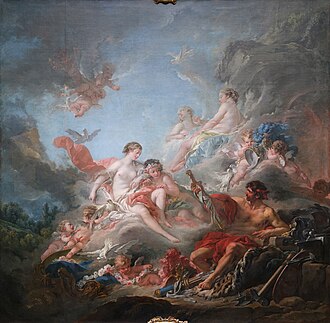 アイネイアースのためにヴィーナスに武器を授けるウルカヌス - François Boucher (1757)
 シテール島の巡礼
 ピエロ
ピエロ ぶらんこ
ぶらんこ 読書する娘
読書する娘 1808年5月3日
.jpg) 裸のマハ
裸のマハ