The Railway Bridge, Pontoise
カミーユ・ピサロ · 1873
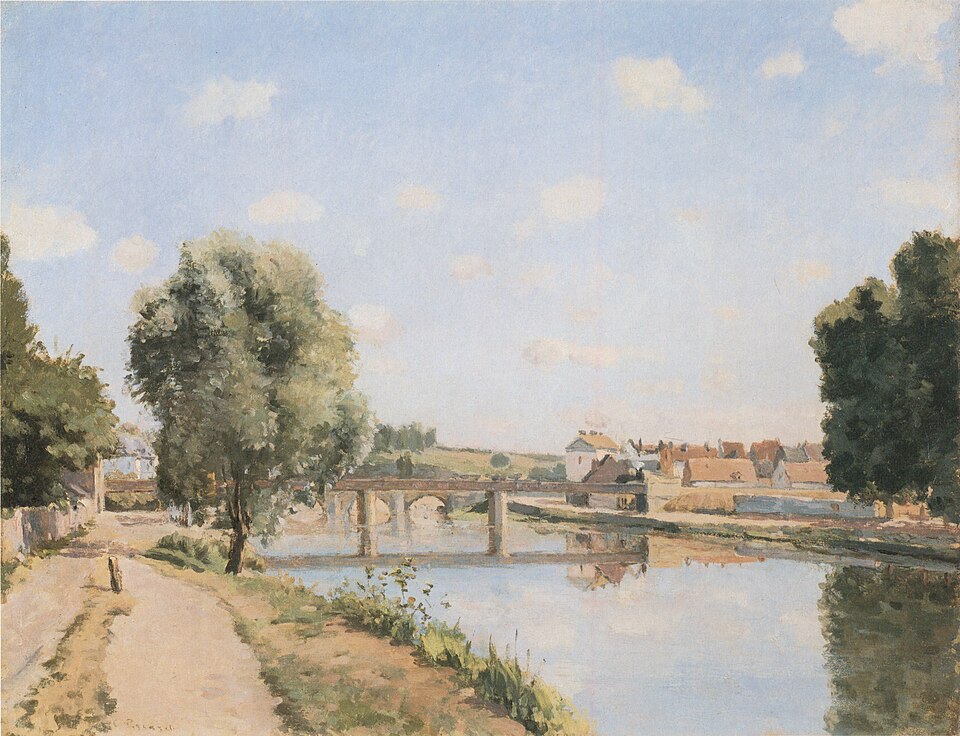
A big leafy tree all but hides the bridge, and a tiny locomotive puffs across it almost unseen. Painted around 1873, this is the only time Pissarro made the railway bridge at Pontoise the title of a painting, and even then the river wins.
The story behind the painting
Between 1866 and 1883 Pissarro made more than 300 paintings and countless drawings in and around Pontoise, about 30 km northwest of Paris. Around 1873 and 1874 he turned more often to the railway line through the town, yet this canvas is his only painting of the bridge itself. The other two pictures of this group are The Road beside the Railway, Snow Effect (1873) and The Railway Barrier at Les Pâtis, near Pontoise (1873 to 1874). The bridge he painted, built in 1860 over the Oise between Pontoise and Saint-Ouen-l'Aumône, no longer exists. It was replaced in 1932, 1946 and 1998.
What to look for
The canvas, 50 by 65 cm, looks upstream across the Oise on an almost cloudless sunny day, with the sky taking up about half the picture. On the right, red roofs crowd behind the embankment and reflect in the water. A large leafy tree dominates the left half and hides much of the bridge that runs across the lower third. Look closely and you find a small locomotive with no carriages, puffing white smoke towards Saint-Ouen-l'Aumône. Behind the bridge the old medieval stone bridge that gave Pontoise its name is partly visible. There are no people and no boats, only flowers and a lonely post by the empty path.
Meaning and intent
For Pissarro the Oise was a working river. Its port was, after farming, the town's most important economic activity, linking Belgium with the Paris region. Unlike Monet's Seine, a place of pleasure full of sailboats and strollers, Pissarro's Oise carries barges and steamboats past farms and factories, and he always stands on the bank, never on the water. The source sums up the contrast: Monet's railway bridges are always the main subject, while for Pissarro it is always the river. Here too he does not put technology in front, but stays faithful to the tradition of the idyllic landscape.
Legacy
River landscapes only became a typical subject of French painting from the late 1860s and the 1870s. Before that, painters such as Corot, Millet, Rousseau and Diaz mostly showed small streams and ponds. The Impressionists drew on illustrated travel guides and on 17th-century Dutch painters such as Salomon van Ruysdael and Jan van Goyen, a path opened by Daubigny and Jongkind. This quiet canvas shows Pissarro's place in that story: a painter of the modern world who let a tree, a path and a bunch of flowers matter as much as the engine crossing the river.
豆知識
- Painted around 1873, oil on canvas, 50 x 65 cm.
- Pissarro's only painting of the railway bridge at Pontoise.
- The bridge, built in 1860, was replaced in 1932, 1946 and 1998.
- A small locomotive is hidden on the bridge behind a large tree.
画家について
カミーユ・ピサロ (1830-1903)
同じ画家の作品: カミーユ・ピサロ
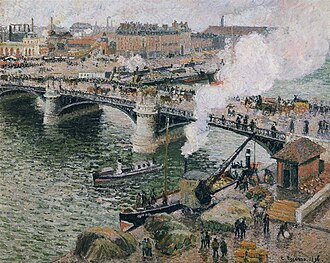 Pont Boieldieu in Rouen, Rainy Weather - Camille Pissarro (1896)
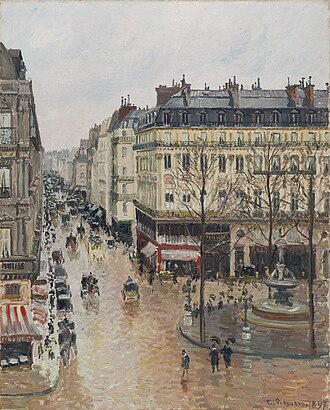 Rue Saint-Honoré in the Afternoon. Effect of Rain - Camille Pissarro (1897)
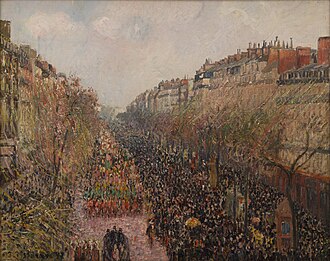 Boulevard Montmartre, Mardi Gras - Camille Pissarro (1897)
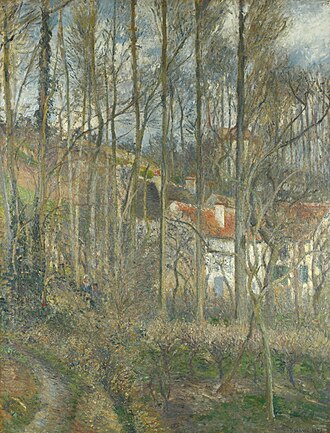 The Côte des Bœufs, Pontoise - Camille Pissarro (1877)
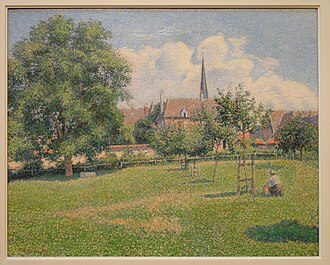 The House of the Deaf Woman and the Belfry at Eragny - Camille Pissarro (1886)
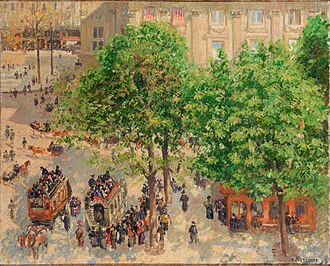 Place du Theatre-Francais in Spring - Camille Pissarro (1898)
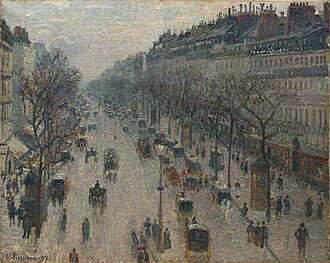 The Boulevard Montmartre on a Winter Morning - Camille Pissarro (1897)
 The Nap, Peasant Woman Lying in the Grass, Pontoise - Camille Pissarro (1882)
関連する画家の作品
 印象・日の出 - Claude Monet (1872)
 睡蓮 - Claude Monet (1906)
 草上の昼食 - Édouard Manet (1863)
 オランピア - Édouard Manet (1863)
 ムーラン・ド・ラ・ギャレットの舞踏会 - Pierre-Auguste Renoir (1876)
 舟遊びの昼食 - Pierre-Auguste Renoir (1881)
 ゆりかご - Berthe Morisot (1872)
 Summer's Day - Berthe Morisot (1879)
 アブサントを飲む人 - Edgar Degas (1875)
 The Bellelli Family - Edgar Degas (1858)
 The Canal du Loing at Moret - Alfred Sisley (1892)
 The Watering Pond at Marly with Hoarfrost - Alfred Sisley (1876)