The Quattrocento in Rome and in Venice
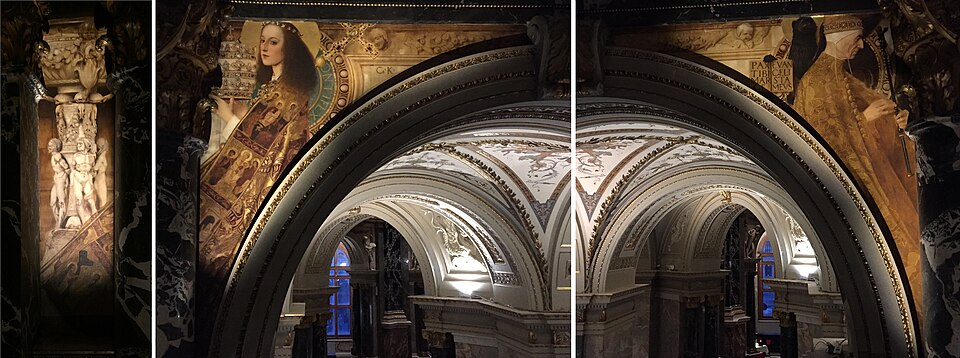
High on a staircase wall in Vienna, a gold-robed woman with a halo glances back at us while a Venetian doge looks quietly down. The two stand back to back. Klimt painted them in 1891 for the grand staircase of the Kunsthistorisches Museum.
The story behind the painting
This picture is a pair of paintings, one in a spandrel and one between columns, on the north wall of the grand staircase of the Kunsthistorisches Museum in Vienna, dated 1891. It is part of a larger decoration: Klimt also painted other spandrel and intercolumniation pictures on the same staircase, among them Ancient Greece and Egypt, Old Italian Art, and Florentine Cinquecento and Quattrocento. The designs for these pictures were made in 1890, the same year as Klimt's painting Two Girls with Oleander. Wikidata gives no date for the work, so the year comes from the German Wikipedia article.
What to look for
Klimt treats the figures like profile portraits of the early Italian Renaissance, each in front of a roundel and egg-and-dart moulding, painted mostly in gold with ochre and brown. Rome is a woman, Ecclesia, the Church, with a halo and a richly embroidered cope whose red hem spills into the neighbouring panel, where a Renaissance font shows bound men on its base. She holds a papal tiara, a processional cross leans on her shoulder, and the roundel reads Pontifex. Venice is a doge in pure profile in gold brocade, with a winged lion of Saint Mark holding a book inscribed PAX TIBI MARCE EVANGELISTA MEUS.
Meaning and intent
Ecclesia's sideways glance can seem girlishly shy, or, because of the turn of her head, like a threat. Her cloak spreading into the next panel probably stands for the wide reach of the Church, and the bound men on the font for souls freed by baptism. That the Church and the doge turn their backs on each other probably refers to the rivalry between Rome and Venice in the 15th century. The dominant gold stands for spiritual and worldly power. The doge's features and dress recall Giovanni Bellini's portrait of Leonardo Loredan, and the lion the famous statue on the Piazzetta in Venice.
Legacy
Other details show how carefully Klimt studied real objects. The processional cross resembles the Heinrich Cross from the Basel Cathedral treasury, and the tiara a papal crown given to Pius IX in 1877. Ecclesia's face closely resembles one of the girls in Two Girls with Oleander. The staircase pictures remain in place in the museum, and in 2012 the Kunsthistorisches Museum built a temporary bridge, the Klimt Bridge, so that visitors could see them up close, as press articles cited in the source describe. For many, this wall is the place to meet Klimt before he became Klimt.
豆知識
- Painted in 1891 for the staircase of the Kunsthistorisches Museum, Vienna.
- Rome appears as Ecclesia, the Church; Venice as a doge.
- The two figures stand back to back, probably for the rivalry of the two cities.
- Shown up close on the museum's temporary Klimt Bridge in 2012.
画家について
Gustav Klimt (1862-1918)
同じ画家の作品: Gustav Klimt
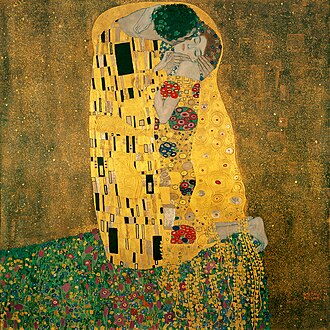 接吻 - Gustav Klimt (1907-1908)
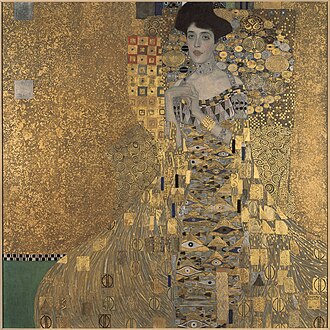 アデーレ・ブロッホ=バウアーの肖像 I - Gustav Klimt (1907)
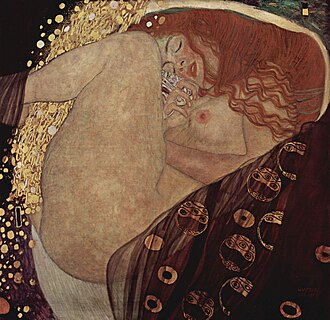 ダナエ - Gustav Klimt (1907)
 ユディト - Gustav Klimt (1901)
 The Three Ages of Woman - Gustav Klimt (1905)
 扇を持つ女 - Gustav Klimt (1917)
 Adele Bloch-Bauer II - Gustav Klimt (1912)
 婦人の肖像 - Gustav Klimt (1910s)