ダナエ
Gustav Klimt · 1907
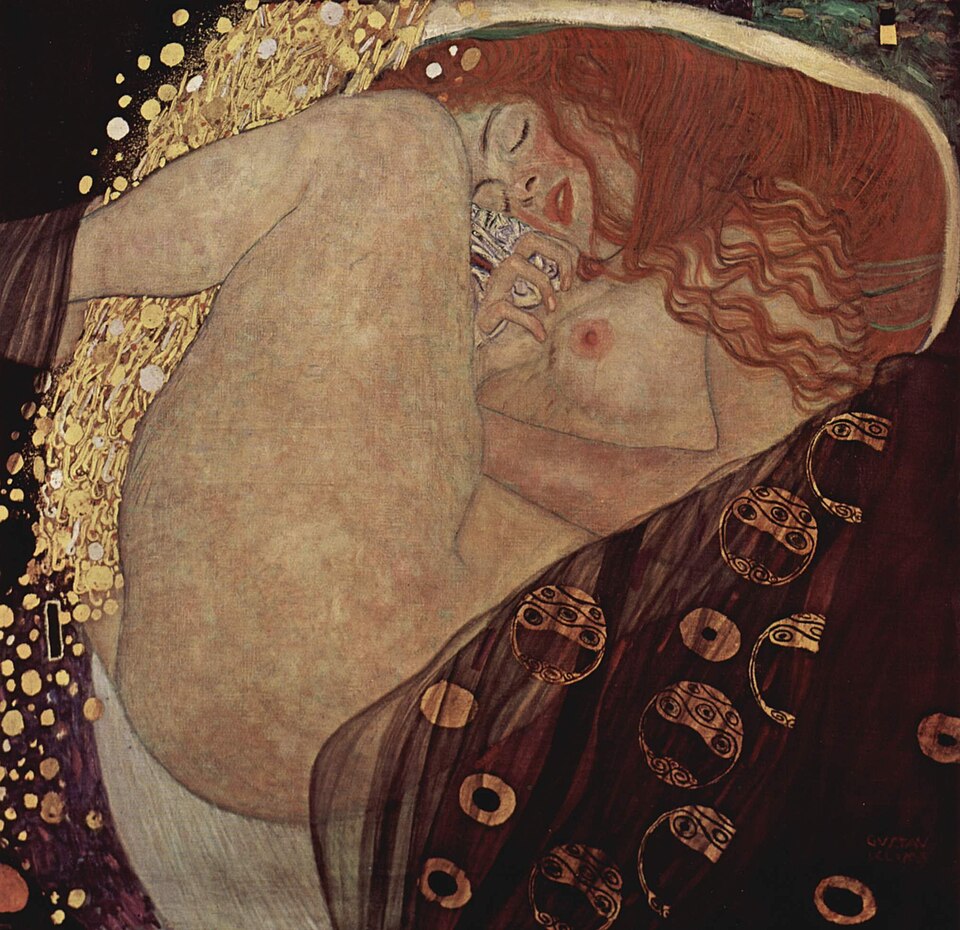
A young woman lies curled into herself, wrapped in purple, while a stream of gold pours toward her. In 1907 Gustav Klimt turned an ancient myth into one of the most intimate images of his career.
The story behind the painting
Gustav Klimt painted Danaë in Vienna in 1907, in oil on a canvas of 77 by 83 centimetres. He was working within Symbolism, and he chose a subject that many artists of the early 1900s were drawn to. In those years Danaë had become the quintessential symbol of divine love and transcendence. The myth tells of a princess imprisoned by her father Acrisius, King of Argos, in a tower of bronze, and visited there by Zeus. Klimt was not alone in treating the story with open sensuality: many early portrayals of Danaë were erotic, and his own Medicine (1900-1907) and Water Snakes I (1904-1907) were completed in a similar style during the same period.
What to look for
Begin with the shape. The nearly square canvas is filled by a single body folded into a curled, almost fetal pose, as if the whole picture were holding her. Her red hair flows long, and her face, eyes closed, tells us she is caught up in the moment. Now find the gold. Zeus arrives not as a man but as a golden rain, a stream flowing between her legs. Then notice the cloth: Danaë is wrapped in a royal purple veil. Let your eye move between these three things - the warm skin, the purple, the pouring gold - and you will see how Klimt builds the scene from colour and curve rather than from a room, a tower or any setting at all.
Meaning and intent
The purple veil is a sign of rank, a reference to Danaë's royal lineage as a king's daughter. The golden rain is the god himself, a visitation from the heavens. Klimt makes the encounter private and inward: there is no tower, no guard, no father, only the woman and the gold. The source notes that her face shows she is aroused by the golden stream, which places the painting firmly in the erotic tradition of the subject. The myth also points beyond the picture. Some time after this celestial visit, Danaë gave birth to a son, Perseus, the hero who would later slay the Gorgon Medusa and rescue Andromeda. In this quiet, enclosed moment, a legend is beginning.
Legacy
Danaë is counted as an example of Klimt's Symbolism and stands beside works such as Medicine and Water Snakes I. Its later history is told differently by our two sources, and it is worth stating plainly. According to Wikipedia, the painting was at the Galerie Würthle in Vienna until that gallery closed in 1995; it belongs to the art collection of Hans Dichand (1921-2010) and is today in the possession of his three children. Wikidata, however, lists the Leopold Museum in Vienna as its collection. Whichever wall it hangs on when you meet it, the picture keeps its power: a myth reduced to one body, one colour of royalty and one shining stream of gold.
豆知識
- Oil painting, 1907, 77 × 83 cm (Wikidata, Wikipedia)
- Movement: Symbolism (Wikidata)
- Zeus is shown as golden rain; Danaë wears a royal purple veil (Wikipedia)
- Location conflict: Wikidata lists the Leopold Museum; Wikipedia says it is owned by Hans Dichand's heirs
同じ画家の作品: Gustav Klimt
 接吻 - Gustav Klimt (1907-1908)
 アデーレ・ブロッホ=バウアーの肖像 I - Gustav Klimt (1907)
.jpg) ユディト - Gustav Klimt (1901)
ユディト - Gustav Klimt (1901)