サーカスの客寄せ
Georges Seurat · 1888
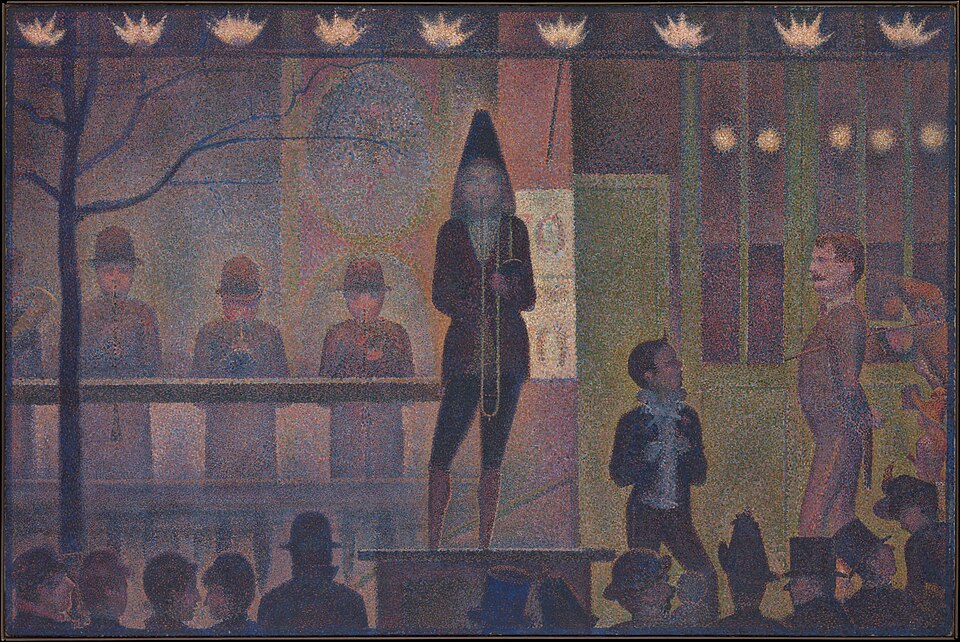
Under the unreal glow of gas jets, a row of musicians stands frozen in front of a circus tent while silhouetted onlookers wait in the dark. Seurat's first night scene was one of his least admired works, and perhaps his most mysterious.
The story behind the painting
Itinerant fairs in temporary structures made seasonal stops along the boulevards of Paris, and Seurat studied them for years, drawing café-concert performers and acrobats. This canvas shows the parade, the free sideshow used to tempt passers-by, of the Circus Corvi at place de la Nation, a working-class quarter in eastern Paris; the name Fernand Corvi appears on his small sketch of the ticket window. He worked on the theme for nearly six years. Wikipedia dates the painting 1887 to 1888, and Wikidata gives 1888, the year it was first shown at the Salon des Indépendants in Paris, catalogue number 614.
What to look for
Everything is built from horizontals and verticals, like the rhythm of Egyptian reliefs. Violet-grey, blue-grey, orange and green dots make up the scene. Figures in front, such as the trombonist on his pedestal, are unlit and painted in dark blue, while those on the platform glow under nine gas jets, each with a blue-violet aura. Five yellow-white lamps shine through the ticket windows, where a man and woman sell tickets at lower right. A boy in a ruffled collar performs at the top of the central stairs. When the Met examined the canvas in 1990 under gaslight-coloured light, orange faces turned to flesh and the whole picture seemed lit from behind.
Meaning and intent
Robert Herbert called it a brooding masterpiece that reveals its meaning reluctantly, a simple geometric scheme concealing a complex space. Its first critic, Gustave Kahn, found it willfully pallid and sad. John Russell proposed a literary source, Rimbaud's poem Parade of 1886, and wrote that no amount of geometry can hide that the picture criticises society, though as a poet would rather than a politician. Herbert answers that the message remains unclear, since the performers and spectators are ordinary people, not caricatures, and he suggests Jules Laforgue's sad carnival poem as another possible inspiration. The canvas's ratio echoes simple divisions noted from Charles Henry, though historians now doubt Seurat used the golden section.
Legacy
At the 1888 Indépendants the picture was overshadowed by the much larger Models, and Seurat himself later neglected it, leaving it off his list of large canvases in 1890. Yet Alfred H. Barr Jr. ranked it among his most important works, the most geometric in design and the most mysterious in sentiment of his major canvases. As his first nocturnal scene and first painting of popular entertainment, it opened the path to Chahut and Circus, and it influenced the Fauves, Cubists, Futurists and Orphists. It came to the Metropolitan Museum of Art in New York with the bequest of Stephen C. Clark in 1960.
豆知識
- Shows the sideshow of the Circus Corvi at place de la Nation, Paris.
- First exhibited at the 1888 Salon des Indépendants.
- Seurat's first night scene and first painting of popular entertainment.
- Bequest of Stephen C. Clark to the Met, 1960.
女性 · 風俗美術 · 男性 · メトロポリタン美術館 · 音楽家
同じ画家の作品: Georges Seurat
 グランド・ジャット島の日曜日の午後 - Georges Seurat (1884-1886)
 アニエールの水浴 - Georges Seurat (1884)
 The Circus - Georges Seurat (1891)
%20-%20BF811%20-%20Barnes%20Foundation.jpg) ポーズする女たち - Georges Seurat (1886)
ポーズする女たち - Georges Seurat (1886) Young Woman Powdering Herself - Georges Seurat (1889)
 Le Chahut - Georges Seurat (1889)
 The Channel of Gravelines, Petit Fort Philippe - Georges Seurat (1890)
 星月夜
星月夜.jpg) 夜のカフェテラス
夜のカフェテラス