The Circus
Georges Seurat · 1891
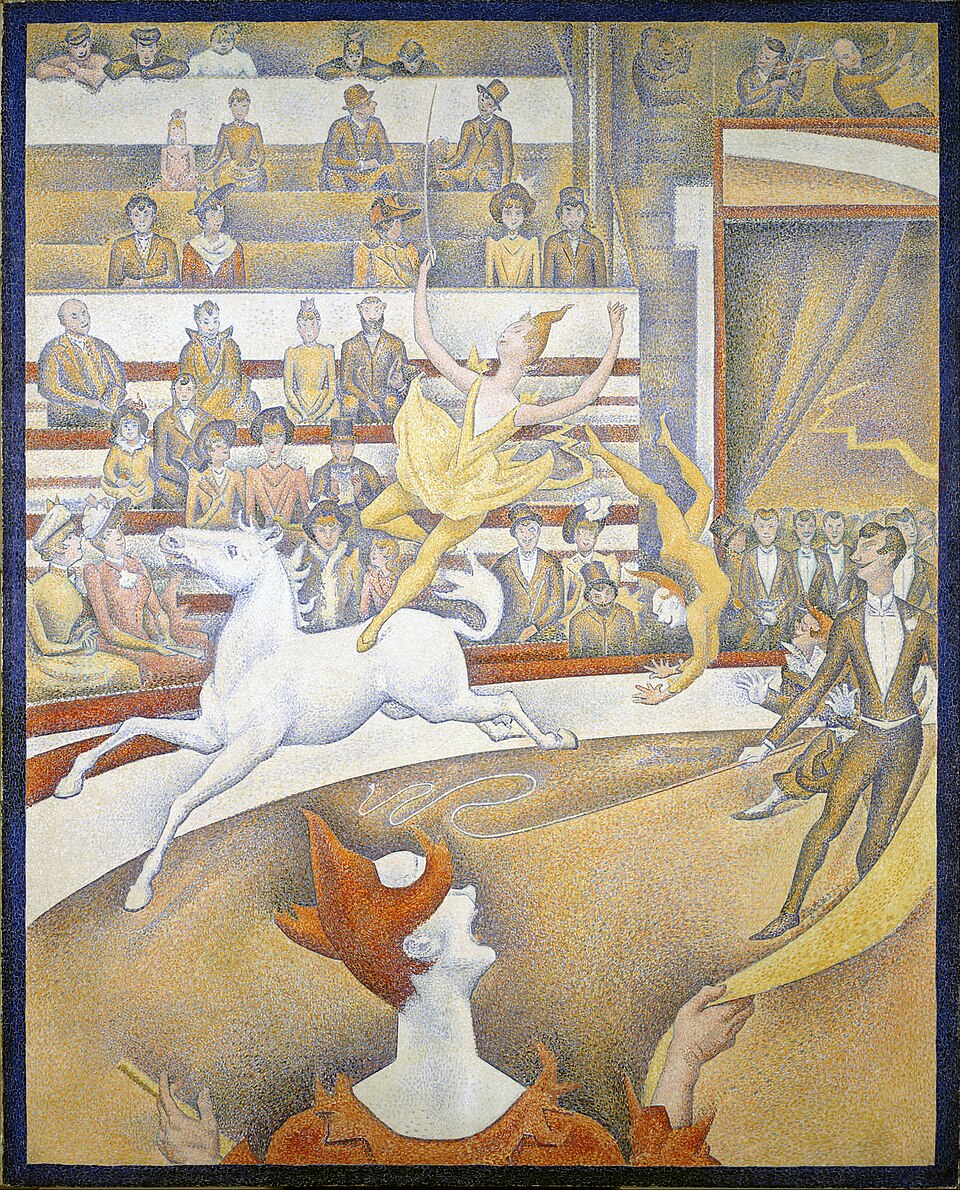
A rider balances on a galloping horse, a clown somersaults, and the crowd sits in neat rows by class. The Circus was Georges Seurat's last painting, still unfinished when he died in March 1891.
The story behind the painting
Le Cirque was Seurat's third major circus picture, after Parade of 1887 to 1888 and Le Chahut of 1889 to 1890. It shows a female performer standing on a horse at the Circus Fernando, renamed the Circus Medrano in 1890 after its most famous clown. The circus stood at the corner of the Rue des Martyrs and the Boulevard de Rochechouart, close to Seurat's studio, and Renoir, Degas and Toulouse-Lautrec had all painted there in the 1880s. Seurat worked on it in 1890 and 1891 and showed it, unfinished, at the Salon des Indépendants in March 1891. He died a few days later.
What to look for
The canvas measures 185 by 152 cm, and with the frame Seurat painted himself, 232 by 198.5 cm. It is built from pointillist dots, dominated by white and the primaries: mostly red and yellow, with blue shading, and a deeper blue border that runs into a flat blue frame. The performers fill the lower right with curves and spirals; the audience is locked into benches at the upper left. In the front row, in a top hat, sits Seurat's friend the painter Charles Angrand, while the poorer public crowds the gallery at the back. A whiteface clown seen from behind opens the space, and two more clowns tumble behind the ringmaster. In places the white ground and a grid of blue lines still show.
Meaning and intent
Seurat drew on Charles Henry's theories about the emotional and symbolic meaning of lines and colours, and on the colour studies of Chevreul and Ogden Rood. Japanese prints and the posters of Jules Chéret also shaped it, and it resembles a chromolithograph, Au cirque by Karl Gampenrieder, though it is not clear Seurat knew it. He made few preparatory studies, concentrating on dynamic lines and few colours. The rising lines carry the energy of the ring, while the stacked rows of spectators show a society sorted by rank, watching the same spectacle from very different seats.
Legacy
Early critics complained that the figures were stiff, like automatons; others later saw the picture as a forerunner of Cubism. After the 1891 exhibition it went back to Seurat's mother, who hung it in the room on the Boulevard de Magenta where he had died. Paul Signac acquired it around 1900, and later the American collector John Quinn, who gave it to the Louvre in 1927. It hung at the Musée du Luxembourg, the Musée National d'Art Moderne and the Jeu de Paume before reaching the Musée d'Orsay in 1977, where it remains.
豆知識
- Seurat's last painting, unfinished at his death in March 1891.
- Shown at the Salon des Indépendants in March 1891.
- 185 by 152 cm, with a frame painted by the artist.
- In the Musée d'Orsay since 1977.
女性 · 風俗美術 · オルセー美術館 · 音楽家 · サーカス
同じ画家の作品: Georges Seurat
 グランド・ジャット島の日曜日の午後 - Georges Seurat (1884-1886)
 アニエールの水浴 - Georges Seurat (1884)
%20-%20BF811%20-%20Barnes%20Foundation.jpg) ポーズする女たち - Georges Seurat (1886)
ポーズする女たち - Georges Seurat (1886) Young Woman Powdering Herself - Georges Seurat (1889)
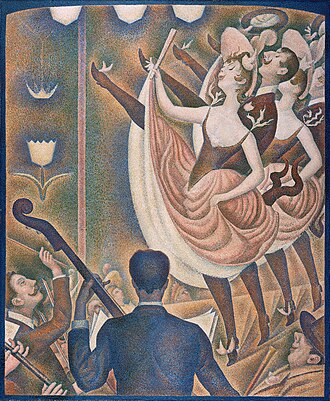 Le Chahut - Georges Seurat (1889)
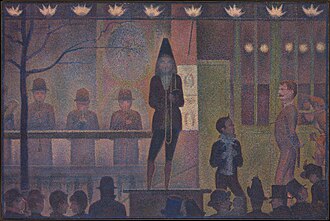 サーカスの客寄せ - Georges Seurat (1888)
 The Channel of Gravelines, Petit Fort Philippe - Georges Seurat (1890)
 Bridge of Courbevoie - Georges Seurat (1880)
 星月夜
星月夜.jpg) 夜のカフェテラス
夜のカフェテラス