Still life with a plate of onions
Vincent van Gogh · 1889
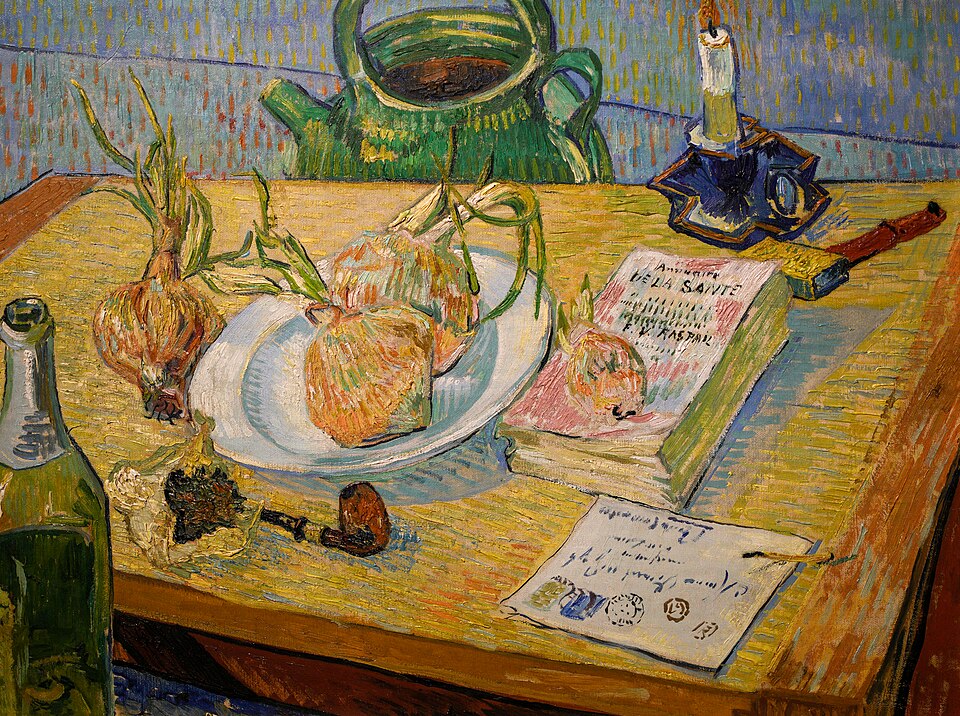
A plate of onions, a pipe, a burning candle and a letter from his brother. Days after leaving hospital in Arles, Van Gogh painted the things that kept him alive.
The story behind the painting
On 23 December 1888 Van Gogh suffered an attack of madness in Arles and cut his ear. He entered the town hospital on 25 December and came out on 7 January 1889. In the respite that followed, he told his brother Theo in his letters that he had gone back to painting still lifes, and this one, from January 1889, was the first of them. He was then in the last full year before his death in July 1890. The painting is in the Kröller-Müller Museum in Otterlo.
What to look for
On a table Van Gogh set a plate of onions on a drawing board. Around it are an empty bottle and a full jug, of wine or coffee, a candle burning down, a box of matches and sealing wax, a stamped envelope, a pipe and tobacco, and a book: the health handbook of François-Vincent Raspail. Notice the play of colour: the yellow of the drawing board in horizontal strokes against green and blue, as in the tiles, in vertical ones. The contrasts are calmer and more controlled than in his work of summer and autumn 1888 alongside Gauguin.
Meaning and intent
The picture is often read as a self-portrait made of objects. The lit candle, in the tradition of vanitas painting, stands for passing time and the time he had left. The empty bottle, probably absinthe, seems replaced by wine or coffee, pipe and tobacco. His life also seems to depend on onions, the food of the poor, on his letters with Theo, and on Raspail's handbook, whose advice he followed. The envelope has been studied closely: a registered letter posted at the Place des Abbesses in Montmartre, thought to be Theo's letter of 23 December 1888.
Legacy
That reading turns a humble tabletop into a quiet record of recovery: food, smoke, light, medicine and a brother's support, laid out in plain sight just after a crisis. The painting stayed a key work in the story of Van Gogh's final years. Michel Butor included it among the 105 decisive works of Western painting that make up his imaginary museum. Today it hangs in the Kröller-Müller Museum in Otterlo, in the Netherlands, among the large group of Van Gogh's paintings kept there.
豆知識
- Painted in January 1889, after Van Gogh left hospital in Arles.
- His first still life after the crisis of December 1888.
- Includes Raspail's health handbook and a letter likely from Theo.
- Kept in the Kröller-Müller Museum, Otterlo.
画家について
Vincent van Gogh (1853-1890)
静物画 · クレラー・ミュラー美術館 · パイプ · 玉ねぎ
同じ画家の作品: Vincent van Gogh
 星月夜 - Vincent van Gogh (1889)
 夜のカフェテラス - Vincent van Gogh (1888)
 ひまわり - Vincent van Gogh (1888)
 花咲くアーモンドの木の枝 - Vincent van Gogh (1890)
 カラスのいる麦畑 - Vincent van Gogh (1890)
 アルルの寝室 - Vincent van Gogh (1888)
 ジャガイモを食べる人々 - Vincent van Gogh (1885)
 アイリス - Vincent van Gogh (1889)
関連する画家の作品
 大水浴図 - Paul Cézanne (1900s)
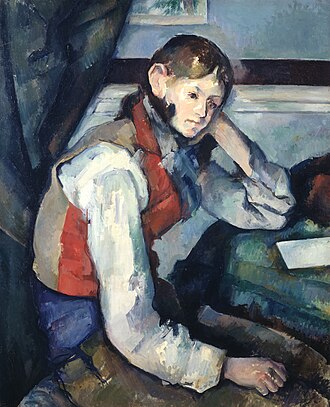 赤いチョッキの少年 - Paul Cézanne
 我々はどこから来たのか 我々は何者か 我々はどこへ行くのか - Paul Gauguin (1897-1898)
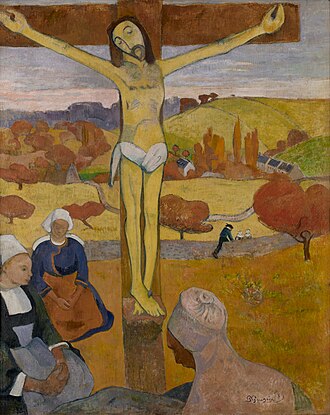 黄色いキリスト - Paul Gauguin (1889)
 キリスト昇架 - Peter Paul Rubens (1609)
 レウキッポスの娘たちの略奪 - Peter Paul Rubens (1618)
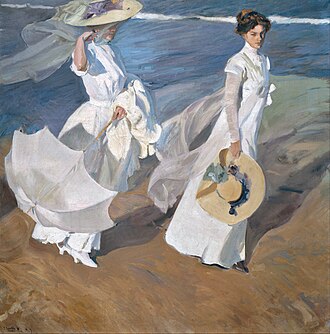 Walk on the mountain - Joaquín Sorolla (1909)
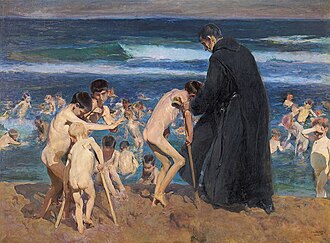 Sad Inheritance - Joaquín Sorolla (1898)
 ムーラン・ド・ラ・ギャレットの舞踏会 - Pierre-Auguste Renoir (1876)
 舟遊びの昼食 - Pierre-Auguste Renoir (1881)
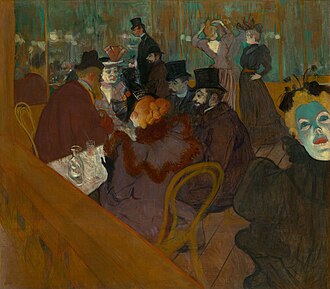 ムーラン・ルージュ - Henri de Toulouse-Lautrec (1892)
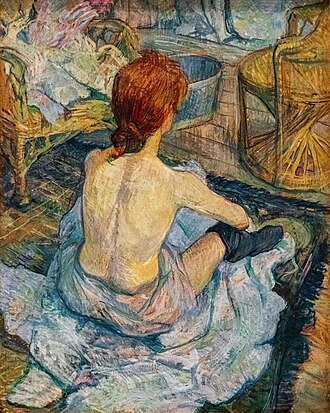 La Toilette - Henri de Toulouse-Lautrec (1896)