Separation
Edvard Munch · 1896
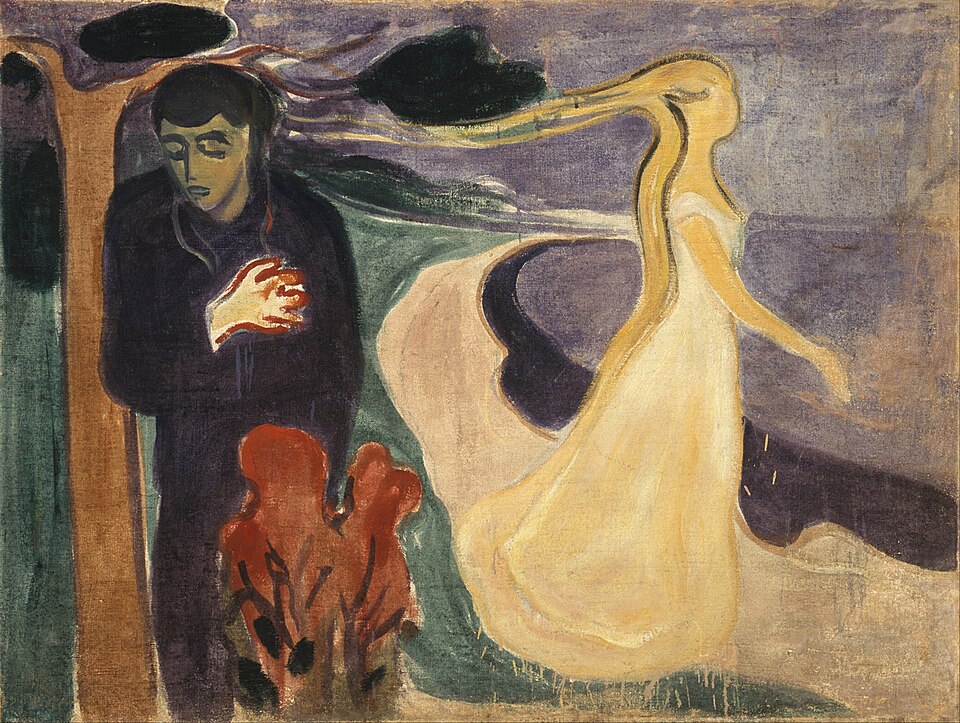
On a violet shore a woman in white walks toward the sea, while a man in black turns away, hand pressed to his bleeding heart. Yet her long golden hair still winds around him. Munch called the picture Separation.
The story behind the painting
Munch painted Separation in 1896 as part of his Frieze of Life, a cycle about love from first attraction to the pain of parting. He returned to the theme often: a first watercolour in 1893, a first oil in Berlin in 1894 that survives only in damaged, overpainted form, two lithographs in 1896 and another painted study in 1906 to 1907. The motif grew out of his 1894 painting Sphinx, which already shows the fair woman by the sea and a man in the shadows. The closely related motif Attraction also binds a couple with a woman's hair.
What to look for
The canvas, 96 by 127 cm, is simple and direct, as Frank Høifødt notes. On the right a young blonde woman in a long white dress walks almost solemnly toward the sea, her face without features. On the left a man in black with a greenish face stands bent, head lowered, his right hand clutching his chest. Look at the blood-red plant at his feet: the same red outlines his hand, as if his heart is bleeding. Her hair runs in long horizontal lines across to wrap his head and chest. The paint is laid very thin on unprimed canvas, so the weave shows through, and a shoreline cuts the picture in two.
Meaning and intent
In Munch's notes a woman's blood-red hair wound around him like snakes, its fine threads caught in his heart; as she moved away over the sea, his heart bled because the threads could not be cut. Uwe M. Schneede stresses that such texts record feelings that later sparked pictures, not explanations of them. Høifødt asks whether the man mourns a real woman or his illusion of ideal femininity. Reinhold Heller and Arne Eggum also see the artist here, his heart's blood feeding the flower of the artwork. Munch himself wrote that art is a person's heart's blood.
Legacy
The critic Franz Servaes described a strand of hair that grows into the man's heart with a thousand roots, binding him to the fleeing woman while his hand presses in vain on his heart. Long hair recurs across Munch's work, as in Vampire and Salome, as a sign of female power and of a bond between the sexes that both drew and threatened him. The painting is shown at the Munch Museum in Oslo.
豆知識
- Painted in 1896 for Munch's Frieze of Life.
- The woman's hair still binds the man as she leaves.
- Related versions: 1893 watercolour, 1894 oil, 1896 lithographs.
- Held by the Munch Museum, Oslo.
Wikipedia · Wikidata · Wikipedia
画家について
Edvard Munch (1863-1944)
同じ画家の作品: Edvard Munch
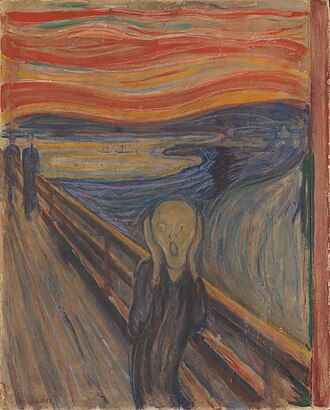 叫び - Edvard Munch (1893)
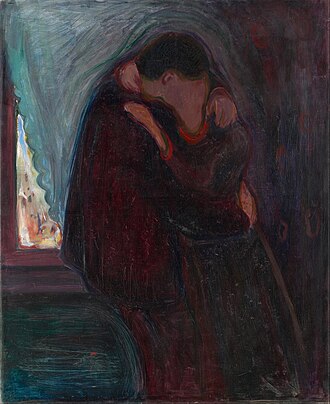 The Kiss - Edvard Munch (1897)
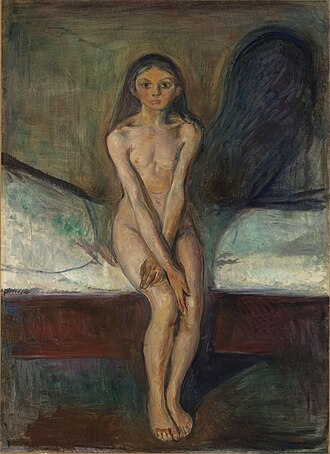 思春期 - Edvard Munch (1895)
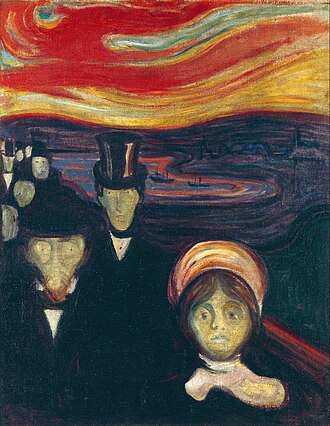 不安 - Edvard Munch (1894)
.jpg) 浜辺のインゲル - Edvard Munch (1889)
浜辺のインゲル - Edvard Munch (1889).jpg) Evening on Karl Johan - Edvard Munch (1892)
Evening on Karl Johan - Edvard Munch (1892)%2C%20NG.M.01111.jpg) Night in Saint-Cloud - Edvard Munch (1890)
Night in Saint-Cloud - Edvard Munch (1890)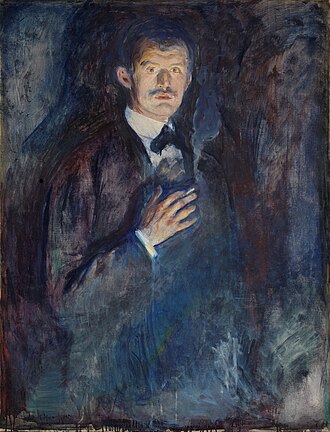 Self-Portrait with Cigarette - Edvard Munch (1895)