Night in Saint-Cloud
Edvard Munch · 1890
%2C%20NG.M.01111.jpg)
A man in a top hat sits in a dark room by a window, looking out at the Seine under a full moon. Munch painted it the winter after he learned of his father's death, and the room seems to hold its breath with him.
The story behind the painting
Edvard Munch painted Night in Saint-Cloud in 1890 at Saint-Cloud, just outside Paris. He had arrived in Paris in 1889, and shortly afterwards he learned that his father had died. According to the critic Dieter Buchhart, the painting expresses a melancholy somewhere between dejection, sadness and depressed mood, and reflects what Munch felt after that loss. Reinhold Heller likewise reads its bluish atmosphere of death as a picture of the father's death and the artist's deep sorrow in the winter of 1890. The work holds a key place in Munch's move towards Symbolism, the moment when he began to paint not things as they are but the moods they carry.
What to look for
A man wearing a top hat sits at the window of his room at night, looking out at the river. He is pushed to the edge, almost dissolving into the shadows. Strong horizontal and vertical lines organise the space, and a curtain on the left frames the scene. On the right you can just make out the outline of a table. The room is dominated by dark blues and violets. Warm yellows, oranges and reds appear only outside, with one exception: a lit cigarette. The full moon lays a pale blue light on the sofa and the floor and throws the shadow of the double cross of the window frame into the empty room.
Meaning and intent
Critics read every element as a sign. The emptiness, the darkness, the shadowed man and the cross-shaped shadow of the window have been called symbols of death, sadness and loneliness. The room becomes a mirror of the soul, cut off from the outside world by glass, a separation that returns in Munch's The Kiss and The Sick Child. Ulrich Bischoff described it as a prison, a glass cage. For Tone Skedsmo and Arne Eggum, the man seems outside space and time, held by memories. For the first time in Munch's work, death appears as an empty space. Hans Dieter Huber writes that the room and the man's solitude become one. The cool colours may echo Charles Henry's theory linking blue and violet with melancholy.
Legacy
Munch first showed the picture, then simply called Night, at the autumn exhibition in Tivoli in Kristiania, now Oslo, from 6 October to 9 November 1890. The doctor, geologist and collector Fredrik Arentz bought it for a third of the asking sum. In 1917 the National Museum of Art, Architecture and Design in Oslo acquired it from Arentz's estate, and it remains there. Scholars still debate its sources: Bischoff sees a kinship with James McNeill Whistler's Nocturnes, while Rodolphe Rapetti argues that Munch could not have seen them and points instead to the interiors of Edgar Degas. Either way, the quiet room opened the door to the Munch the world knows.
豆知識
- Painted in 1890 at Saint-Cloud, near Paris.
- Linked to the death of Munch's father, learned of after he arrived in Paris in 1889.
- First shown in Kristiania in 1890 under the title Night.
- Acquired by the National Museum in Oslo in 1917.
画家について
Edvard Munch (1863-1944)
同じ画家の作品: Edvard Munch
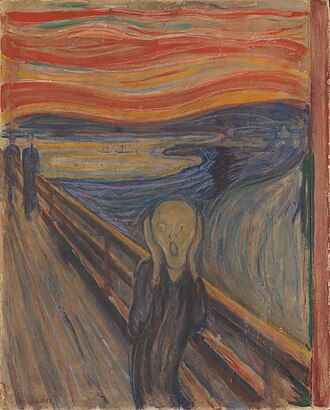 叫び - Edvard Munch (1893)
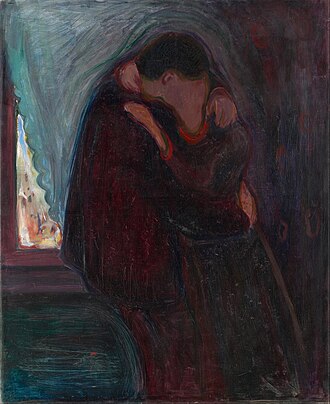 The Kiss - Edvard Munch (1897)
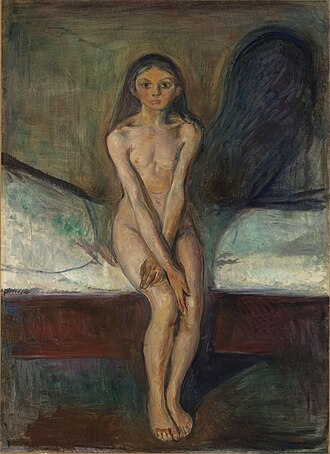 思春期 - Edvard Munch (1895)
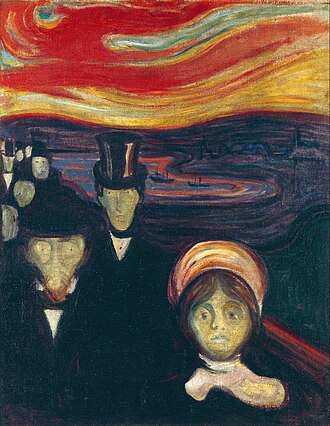 不安 - Edvard Munch (1894)
.jpg) 浜辺のインゲル - Edvard Munch (1889)
浜辺のインゲル - Edvard Munch (1889).jpg) Evening on Karl Johan - Edvard Munch (1892)
Evening on Karl Johan - Edvard Munch (1892) Self-Portrait with Cigarette - Edvard Munch (1895)
%2C%20Kunsthalle%20Bremen.jpg) Death and the Child - Edvard Munch (1899)
Death and the Child - Edvard Munch (1899)