Self-Portrait With a Bottle of Wine
Edvard Munch · 1906
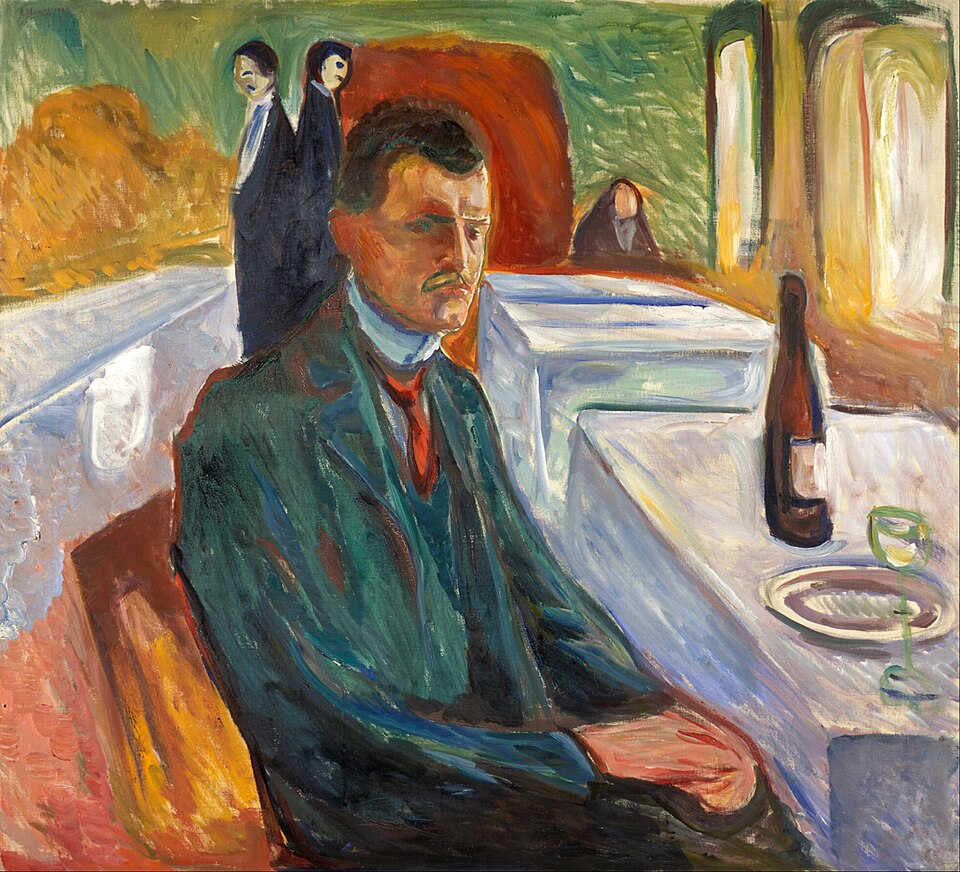
An almost empty restaurant in Weimar, a bottle, a glass, an empty plate, and Munch hunched alone while two waiters stand back to back behind him. He later called it one of his most successful self-examinations in difficult years.
The story behind the painting
Munch painted this picture in Weimar in 1906. Since 1902, when a revolver went off during a dramatic quarrel with his lover Tulla Larsen and he lost the top joint of a finger on his painting hand, his life had been divided. His fame grew, above all in Germany, and portrait commissions poured in, but he lived in hotels, moved constantly, had no secure income and drank more and more. He wrote that from the winter of 1904 to 1905 he slipped into a nervous illness, and that the craving to drink grew stronger. In 1908 he broke down and spent months in a Copenhagen clinic.
What to look for
Munch sits close to us, alone at a table with a wine bottle, a glass and an empty plate, in a room that rushes steeply into depth. Reinhold Heller identifies it as the restaurant of the Grand Hotel Russischer Hof in Weimar. He leans forward, hands resting on each other, limp, while his head in half profile seems to brood. Behind his shoulders two waiters stand back to back, and far off in a corner sits one other guest, an old woman according to Ulrich Bischoff. Strong reds and greens dominate: orange rises behind him like tongues of flame, and the red of his tie returns in a blood-red patch behind his head.
Meaning and intent
The picture is generally read as an image of the loneliness and tension Munch lived with, which he tried to numb with alcohol. Iris Muller-Westermann sees the two waiters, who seem to grow out of his body and look different ways, as a metaphor for warring forces in his mind; Munch wrote to Max Linde that his soul was split into a reflective state and an instinctive one, good together but dangerous apart. Heller sees the rows of tables as coffins, the man trapped as if in a snare. Munch himself noted that thought heightens sensitivity but lessens feeling, while wine heightens feeling and lowers sensitivity.
Legacy
The painting is based on a photograph Munch took of himself in 1904 at Asgardstrand, and its steep perspective and clashing colours return to his style of the 1890s, especially The Scream, whose blood-red sky echoes in the patch behind his head. It remains his best known self-portrait of the years 1902 to 1906 and one of his major works after 1900; Matthias Arnold calls it one of his most suggestive autobiographical testimonies. In 1930 Munch made a mirror-image lithograph of the motif. The painting belongs to the Munch Museum in Oslo.
豆知識
- Painted in Weimar in 1906, in a hotel restaurant.
- Based on a photograph Munch took of himself in 1904.
- Read as an image of loneliness, tension and drinking before his 1908 breakdown.
- Owned by the Munch Museum, Oslo.
画家について
Edvard Munch (1863-1944)
同じ画家の作品: Edvard Munch
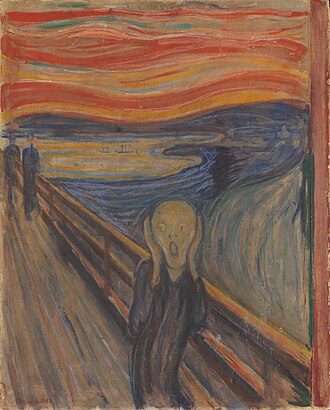 叫び - Edvard Munch (1893)
 生命のダンス - Edvard Munch
 The Kiss - Edvard Munch (1897)
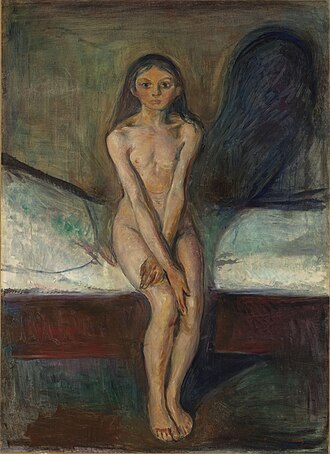 思春期 - Edvard Munch (1895)
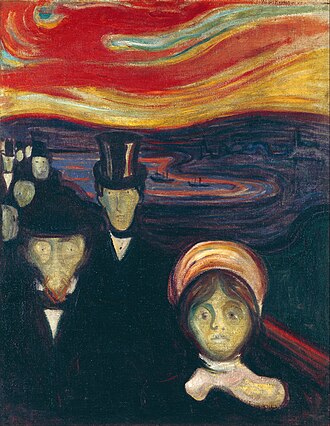 不安 - Edvard Munch (1894)
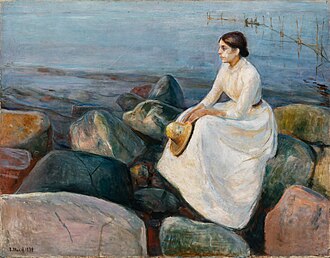 浜辺のインゲル - Edvard Munch (1889)
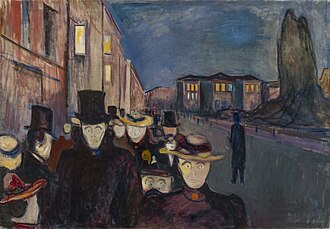 Evening on Karl Johan - Edvard Munch (1892)
 Night in Saint-Cloud - Edvard Munch (1890)