洗礼者聖ヨハネの説教
パオロ・ヴェロネーゼ · 1562
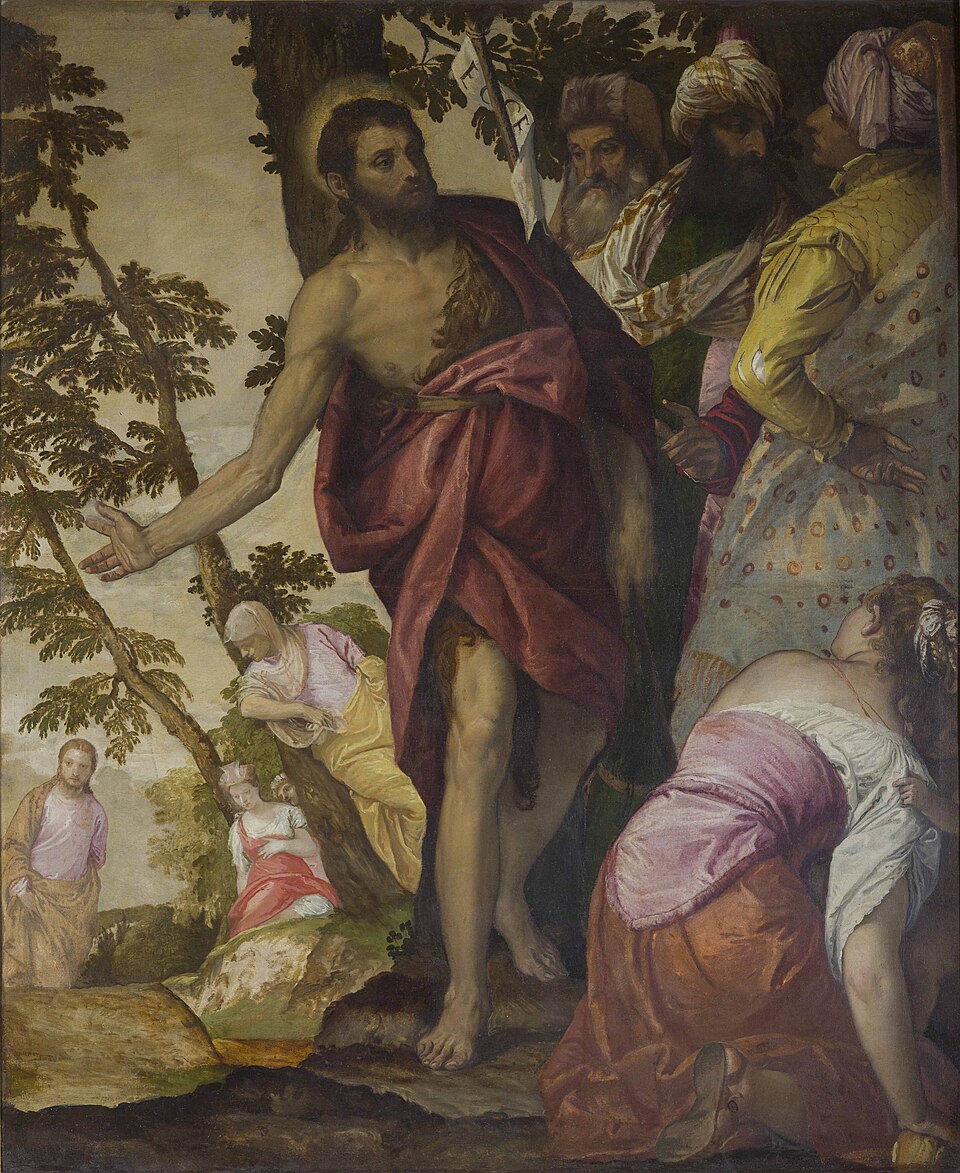
Barefoot in red robes and furs, John the Baptist points to Jesus with a banner that reads ECCE, behold. But his eyes are on three richly dressed men who answer him with doubt and contempt.
The story behind the painting
Veronese painted this sermon in 1562. In 1607 Francesco Barbaro, patriarch of Aquileia, gave it to Cardinal Scipione Borghese together with a second Veronese sermon, Saint Anthony Preaching to the Fish. Barbaro's letter mentions two paintings of sermons without much detail, and the Galleria Borghese has long owned these two. By 1613 both hung in Palazzo Torlonia, where the court poet Scipione Francucci described them in verse. In 1897 Giovanni Morelli contested the attribution to Veronese and gave the pair to Giovanni Battista Zelotti.
What to look for
John stands at the centre of a wilderness of spindly trees under a pinkish-yellow sky, as at dusk or dawn. His stick carries a white banner with the Latin word ECCE. His outstretched arm points to a bearded man in pink and gold entering from the lower left: Jesus, who looks off canvas almost as if lost. Three turbaned men fill the right third. One, head tilted back, hand on hip, wears gold and a sheer silk shawl; one interjects with thumb and finger pinched; a grey-bearded one rests his hand on his face. Below, a kneeling woman and child, and two women by the trees.
Meaning and intent
John acts here quite literally as a messenger announcing the coming of Jesus. The three turbaned figures likely represent rabbis or other Jewish elites, and their contrasting body language shows different reactions to his message: contempt and disbelief, argument, quiet thought. The kneeling woman looks up, one seated woman looks down, another looks back at Jesus. Veronese's lavish rendering of fabrics may also reflect on the quality of Venetian textiles, a theme found in the work of Palma Vecchio.
Legacy
The canvas, 205 by 169 cm, remains in the Galleria Borghese in Rome, still paired with the Saint Anthony sermon that arrived alongside it more than four centuries ago. Wikidata lists it under both the Borghese Collection and the Galleria Borghese. The doubt Morelli raised over its authorship is part of its story, but the painting remains a vivid scene of a single message received in many different ways by the people around it.
豆知識
- Painted by Paolo Veronese in 1562.
- Gift of Francesco Barbaro to Scipione Borghese in 1607.
- John's banner reads ECCE, Latin for behold.
- Oil on canvas, 205 by 169 cm.
画家について
パオロ・ヴェロネーゼ (1528-1588)
宗教美術 · 女性 · 男性 · イエス・キリスト · ヴェネツィア派 · 木 · ランドスケープ · 洗礼者ヨハネ · ボルゲーゼ美術館 · ボルゲーゼ・コレクション
同じ画家の作品: パオロ・ヴェロネーゼ
 カナの婚礼 - Paolo Veronese (1560s)
 レヴィ家の饗宴 - Paolo Veronese (1573)
 ヴィーナスとアドニス - Paolo Veronese (1580)
 美徳と悪徳の間の選択 - Paolo Veronese (1565)
 キューピッドによって結ばれるマルスとヴィーナス - Paolo Veronese (1570s)
 アレクサンドロス大王の前に出たダレイオスの家族 - Paolo Veronese (1565)
 マグダラのマリアの改宗 - Paolo Veronese (1548)
 バテシバの水浴 - Paolo Veronese (1575)
関連する画家の作品
 オルガス伯の埋葬 - El Greco (1586)
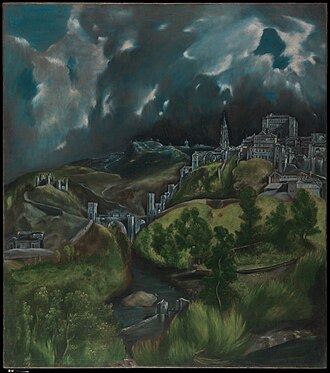 トレドの風景 - El Greco (1596)
 最後の晩餐 - Jacopo Tintoretto (1563)
 奴隷を解放する聖マルコ - Jacopo Tintoretto (1540s)
 ウルビーノのヴィーナス - Titian (1538)
 聖母被昇天 - Titian (1510s)
 エマオの晩餐 - Caravaggio (1601)
 聖マタイの召命 - Caravaggio (1609)
 大使たち - Hans Holbein the Younger (1533)
 墓の中のキリストの屍 - Hans Holbein the Younger (1520s)