Portrait de Madame Trabuc
Vincent van Gogh · 1889
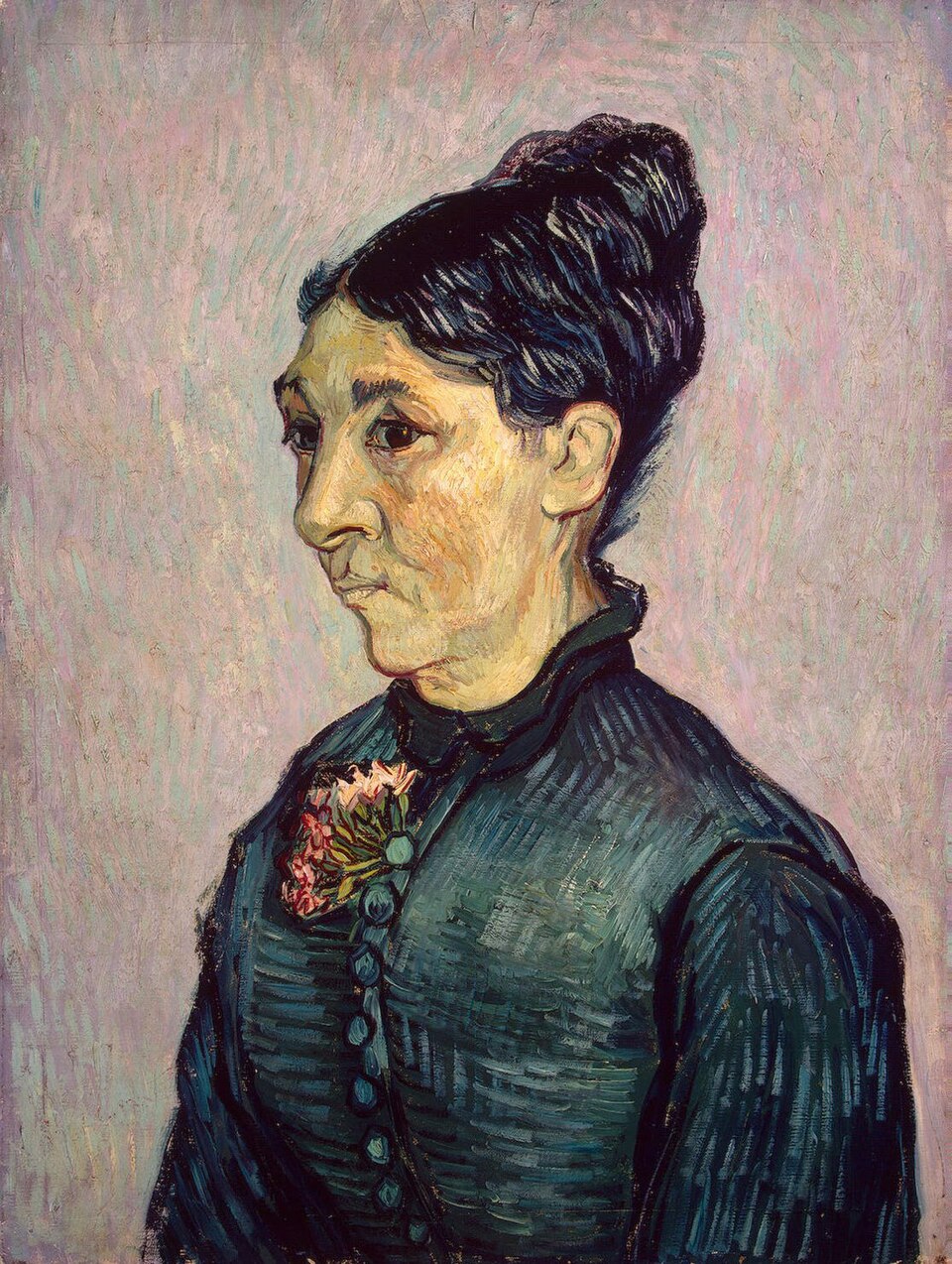
At the asylum of Saint-Rémy, Van Gogh painted the wife of the chief attendant. He found her gentle and unhappy, and painted her in black and pink.
The story behind the painting
Around 6 September 1889, Van Gogh wrote to his brother Theo that he urgently needed to work at his painting and feared another attack of madness. He said he had painted Trabuc, the attendant at the asylum, and was about to paint his wife. He found her gentle and unhappy. The Trabuc couple lived in a small house a few steps from the Saint-Paul asylum at Saint-Rémy-de-Provence. On 19 September he wrote again that the portrait of Madame Trabuc was finished.
What to look for
In that letter Van Gogh described the picture as done in tones of black and pink, and to his sister Willemina he wrote of a portrait of a woman dressed in black with an olive complexion. Look for that contrast between the dark dress and the skin. He also said he had made a copy, less successful than the original. Jeanne Trabuc, born Lafuis, was fifty-five when she posed. She was a woman of the people.
Meaning and intent
According to Pickvance, Madame Trabuc resembles the peasant figures in English prints of the 1870s that Van Gogh loved to collect, especially those from the weekly The Graphic. The portrait shows how, in a period of fear about his own health, Van Gogh turned to the people closest to him at the asylum and looked at them with sympathy. He thought Theo would like this painting, and his description of her as gentle and unhappy is the heart of the work.
Legacy
The portrait belonged to Johanna van Gogh, then was sold to the Thannhauser gallery in Berlin, where Otto Krebs acquired it. Like the rest of that collection, it was taken by the Red Army to the Hermitage in 1947 as reparation for war damage. It was shown to the Hermitage public for the first time in 1995, in an exhibition of French nineteenth and twentieth century painting from private collections in Germany. It remains in the Hermitage Museum in Saint Petersburg.
豆知識
- Painted in September 1889 at Saint-Rémy-de-Provence.
- The sitter, Jeanne Trabuc, was 55.
- Van Gogh described it as black and pink tones.
- First shown publicly at the Hermitage in 1995.
画家について
Vincent van Gogh (1853-1890)
女性 · 肖像 · エルミタージュ美術館 · Otto Krebs collection
同じ画家の作品: Vincent van Gogh
 星月夜 - Vincent van Gogh (1889)
 夜のカフェテラス - Vincent van Gogh (1888)
 ひまわり - Vincent van Gogh (1888)
 花咲くアーモンドの木の枝 - Vincent van Gogh (1890)
 カラスのいる麦畑 - Vincent van Gogh (1890)
 アルルの寝室 - Vincent van Gogh (1888)
 ジャガイモを食べる人々 - Vincent van Gogh (1885)
 アイリス - Vincent van Gogh (1889)
関連する画家の作品
 大水浴図 - Paul Cézanne (1900s)
 赤いチョッキの少年 - Paul Cézanne
 我々はどこから来たのか 我々は何者か 我々はどこへ行くのか - Paul Gauguin (1897-1898)
 黄色いキリスト - Paul Gauguin (1889)
 キリスト昇架 - Peter Paul Rubens (1609)
 レウキッポスの娘たちの略奪 - Peter Paul Rubens (1618)
 Walk on the mountain - Joaquín Sorolla (1909)
 Sad Inheritance - Joaquín Sorolla (1898)
 ムーラン・ド・ラ・ギャレットの舞踏会 - Pierre-Auguste Renoir (1876)
 舟遊びの昼食 - Pierre-Auguste Renoir (1881)
 ムーラン・ルージュ - Henri de Toulouse-Lautrec (1892)
 La Toilette - Henri de Toulouse-Lautrec (1896)