Polyptyque de Sant'Antonio
ピエロ・デラ・フランチェスカ · 1469
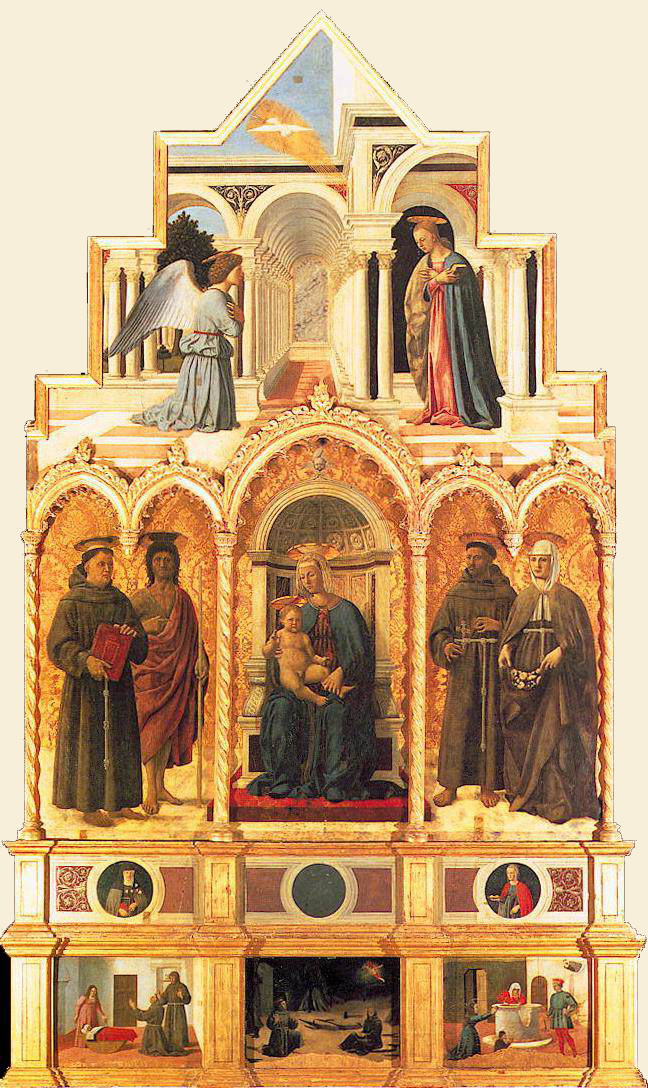
Below, saints on old-fashioned gold. Above, an Annunciation where a corridor of columns pulls the eye deep into space and stops at a marble slab. Piero della Francesca's Perugia altarpiece holds two worlds in one frame.
The story behind the painting
The Franciscan nuns of the convent of Sant'Antonio da Padova in Perugia asked Piero della Francesca to complete an altarpiece begun by a local painter: a Virgin and Child at the centre, two saints on each side, and an Annunciation in the gable above. Piero started around 1460, after his Misericordia polyptych in Borgo San Sepolcro, and having just returned from Rome, where he was influenced by Spanish paintings. He finished around 1470 with the Annunciation. Wikidata dates the work 1469, within that span. It is now in the National Gallery of Umbria in Perugia.
What to look for
The polyptych has nine panels. In the centre the Virgin and Child sit enthroned under a marble niche with a coffered dome; the Child blesses and holds a red flower, foreshadowing the blood of the Passion. On the left are St Anthony of Padua, with habit and book, and John the Baptist pointing to the Child; on the right St Francis showing his stigmata, and St Elizabeth of Hungary. Look at the haloes: they lie on top of the heads as flattened ellipses and seem to reflect. Below are two roundels and three predella scenes, painted by assistants.
Meaning and intent
The central part is archaic in style, surely at the patrons' request, with figures on precious gold patterned like rich fabric. The gable is different: a masterpiece of perspective. Gabriel and Mary face each other under a cloister, a dove above, and between them double rows of columns, each casting a thin shadow, lead the eye to a vanishing point hidden by a marble slab. That blocked passage stands for the enclosed garden, Mary's virginity, and a double column hides her from Gabriel, echoing the saying that the column is Christ.
Legacy
Because the gable and lower parts differ so sharply, some art historians suggest the gable was added much later. Others see a single structure, with an originally rectangular panel simply cut by Piero to form the peak. It is also possible that another artist began the lower part in archaic style and Piero had to continue it, while for the gable he had free hands. Either way, the steps of the Virgin's throne run from the central panel into the side panels, turning the frame into something that stands in front of one coherent space.
豆知識
- Commissioned by the nuns of Sant'Antonio da Padova in Perugia.
- Painted around 1460 to 1470; Wikidata gives 1469.
- The Annunciation in the gable is a masterpiece of perspective.
- Kept in the National Gallery of Umbria, Perugia.
画家について
ピエロ・デラ・フランチェスカ (1415-1492)
宗教美術 · Early Renaissance · 大アントニオス
同じ画家の作品: ピエロ・デラ・フランチェスカ
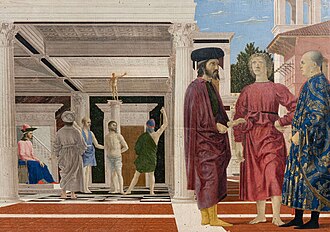 キリストの鞭打ち - Piero della Francesca (1450s)
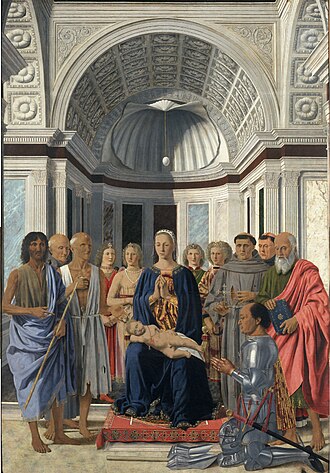 ブレラ祭壇画 - Piero della Francesca (1472)
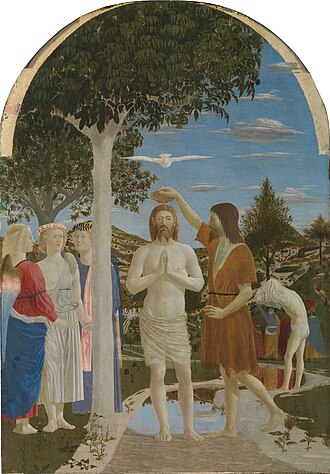 キリストの洗礼 - Piero della Francesca (1448)
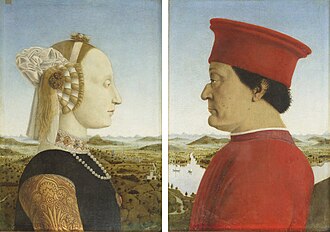 ウルビーノ公夫妻像 - Piero della Francesca (1465)
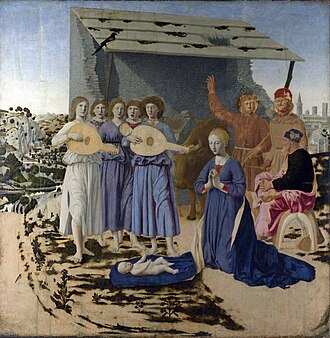 キリストの降誕 - Piero della Francesca (1480s)
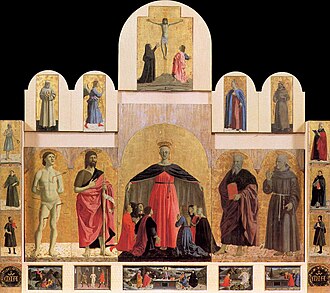 ミゼリコルディアの多翼祭壇画 - Piero della Francesca (1460s)
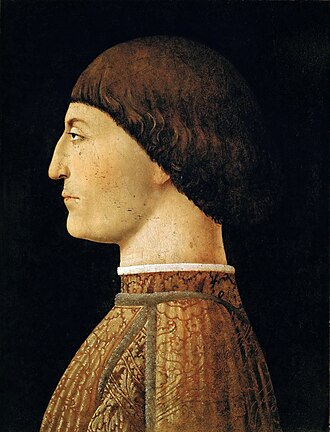 シジスモンド・パンドルフォ・マラテスタの肖像 - Piero della Francesca (1450s)
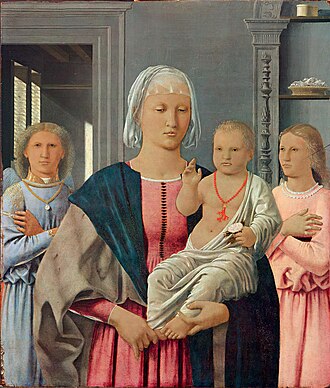 セニガッリアの聖母 - Piero della Francesca (1470s)
 ヴィーナスの誕生
 プリマヴェーラ
 モナ・リザ
 白貂を抱く貴婦人
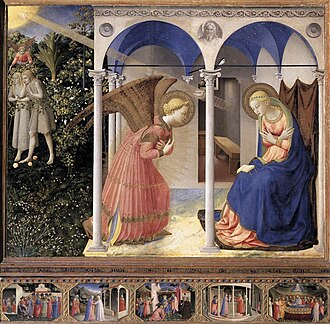 受胎告知
 東方三博士の礼拝
 死せるキリスト
 勝利の聖母