Peasant Woman Digging
カミーユ・ピサロ · 1882
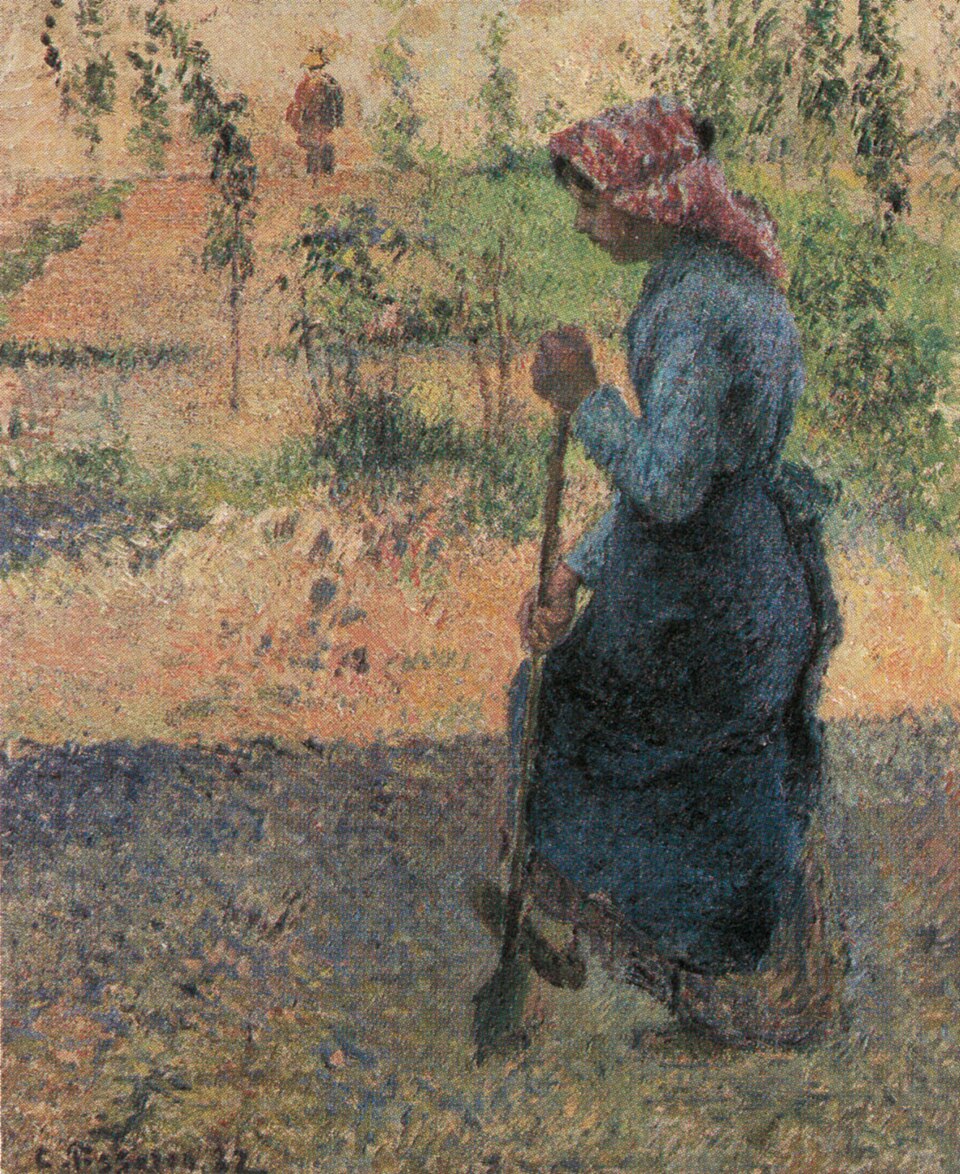
A young peasant woman pauses over her spade in a spring garden, her back already bent by work. In 1882 Pissarro turned from landscapes to people, and this quiet figure marks the change.
The story behind the painting
Pissarro painted this study in 1882 and signed it lower left: C.Pissarro.82. Together with three similar works, it marks a turning point in his art, from pure landscape painting to large figures of people. The early 1880s were a time of transition and experiment for him. He changed his technique from long, marked brushstrokes still reminiscent of Paul Cézanne to a more dabbing touch, and came to feel that beyond optical reality there was a higher one. The canvas is an upright oil, about 65 by 54 cm.
What to look for
A young peasant woman with a dark complexion, her black hair partly hidden under a colourful headscarf, wearing a blue blouse and a skirt with an apron, stops digging a spring garden bed to let Pissarro sketch her. Four almost horizontal lines of beds lead the eye into depth, toward berry bushes and newly planted fruit trees. Further back, slightly left of centre, walks a man in a yellow straw hat carrying a cloth of seed over his shoulder, seen from behind. She is shown in profile, slightly bent, her strong hands on the spade, her relaxed right foot not ready to push the blade into the dark soil.
Meaning and intent
Her serious face and hesitant pause suggest the start of exhaustion, and her back is already rounded by field work. The man walking away does not interact with her, but balances her in the composition. Critics compared these pictures with Jean-François Millet, who painted many peasants. In 1882 Ernest Chesneau called Pissarro Millet's equal and legitimate successor, while Joris-Karl Huysmans wrote that Pissarro had made something wholly new, free of Millet's way of thinking. Pissarro avoided the comparison and told his son Lucien that he painted country people without false grandeur, simply as he saw them.
Legacy
The painting stayed with Pissarro, then with his wife Julie, and after her death passed in 1921 to their daughter Jeanne Pissarro-Bonin. It later went through Durand-Ruel in Paris, the Graphisches Kabinett in Bremen, Fritz Gurlitt in Berlin and the textile manufacturer Richard Semmel, and was auctioned in Amsterdam in June 1933. It survived the Second World War at the Galerie Moos in Geneva, then moved through New York and Monaco and several auctions. It has been shown in Paris in 1921 and at the Orangerie in 1930, and in New York in 1945. Today it is in an anonymous private collection.
豆知識
- Signed and dated 1882 by Pissarro.
- Marks his turn from landscape to large figure painting.
- Critics compared it with Millet; Pissarro rejected false grandeur.
- Now in an anonymous private collection.
画家について
カミーユ・ピサロ (1830-1903)
同じ画家の作品: カミーユ・ピサロ
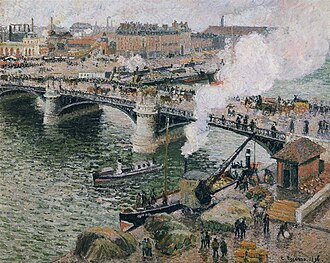 Pont Boieldieu in Rouen, Rainy Weather - Camille Pissarro (1896)
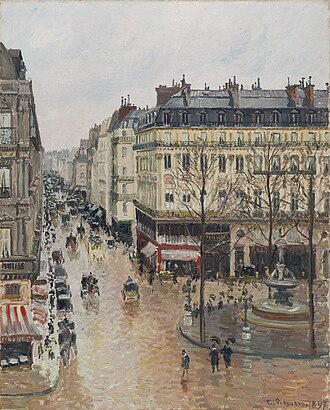 Rue Saint-Honoré in the Afternoon. Effect of Rain - Camille Pissarro (1897)
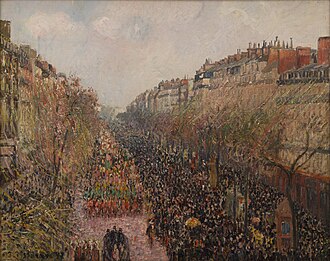 Boulevard Montmartre, Mardi Gras - Camille Pissarro (1897)
 The Côte des Bœufs, Pontoise - Camille Pissarro (1877)
 The House of the Deaf Woman and the Belfry at Eragny - Camille Pissarro (1886)
 Place du Theatre-Francais in Spring - Camille Pissarro (1898)
 The Boulevard Montmartre on a Winter Morning - Camille Pissarro (1897)
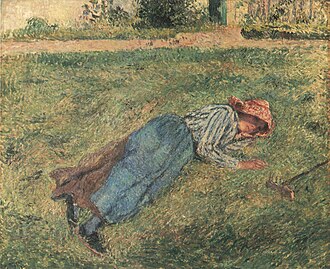 The Nap, Peasant Woman Lying in the Grass, Pontoise - Camille Pissarro (1882)
関連する画家の作品
 印象・日の出 - Claude Monet (1872)
 睡蓮 - Claude Monet (1906)
 草上の昼食 - Édouard Manet (1863)
 オランピア - Édouard Manet (1863)
 ムーラン・ド・ラ・ギャレットの舞踏会 - Pierre-Auguste Renoir (1876)
 舟遊びの昼食 - Pierre-Auguste Renoir (1881)
 ゆりかご - Berthe Morisot (1872)
 Summer's Day - Berthe Morisot (1879)
 アブサントを飲む人 - Edgar Degas (1875)
 The Bellelli Family - Edgar Degas (1858)
 The Canal du Loing at Moret - Alfred Sisley (1892)
 The Watering Pond at Marly with Hoarfrost - Alfred Sisley (1876)