Paule Gobillard peignant
ベルト・モリゾ · 1887
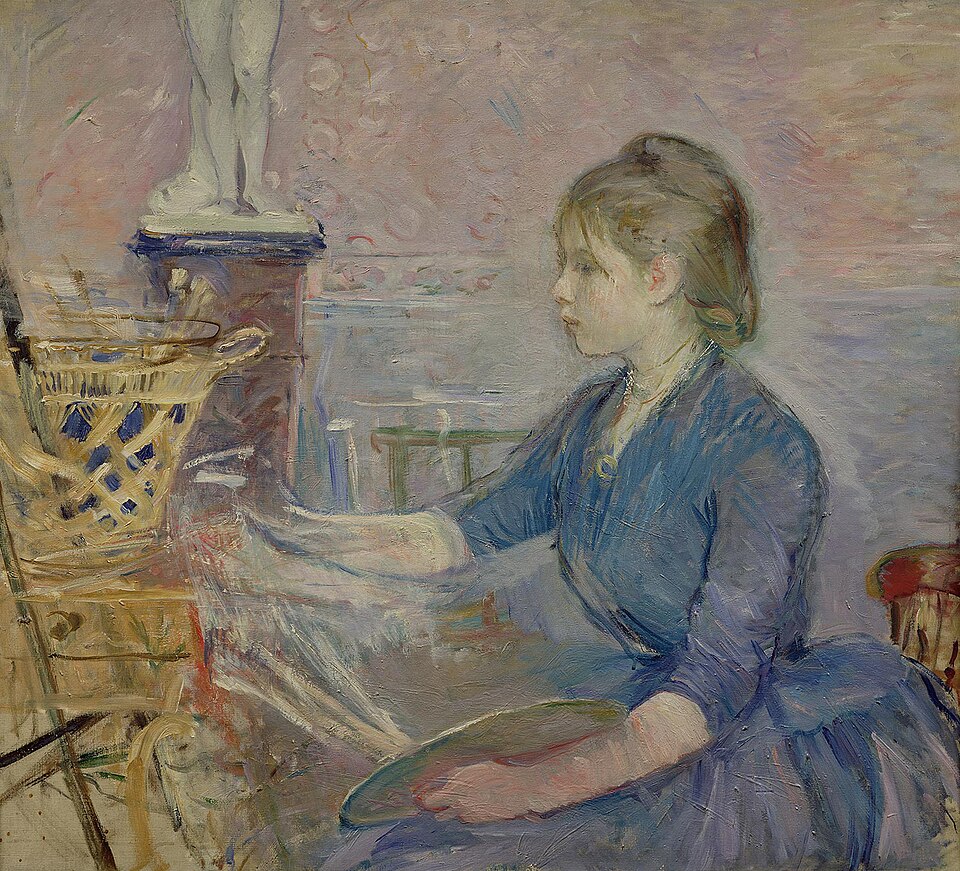
A young woman stands in profile with palette and brush, working at a canvas we barely see. Berthe Morisot painted her niece and most devoted pupil not as a society girl, but as a painter.
The story behind the painting
Berthe Morisot played an essential role in the artistic education of the young women around her. Among them, her niece Paule Gobillard, born in 1869 and the daughter of Morisot's sister Edma, was probably her most diligent and passionate pupil. Paule first worked as a copyist at the Louvre under her aunt's guidance, and in 1886 she obtained her own official copyist's card. The painting, made in 1887, seems to celebrate exactly this step in her training: the moment a student begins to stand on her own as an artist.
What to look for
Paule, then about twenty, poses as a painter in the drawing room on the rue de Villejust. She is seen in profile, a palette in one hand and a brush in the other, sketching on a canvas whose edge we can just make out at the left border of the picture. The oil on canvas measures 86 by 94 cm. Look at what is missing as much as what is there: no ball gown, no social setting, only a young woman absorbed in work. The canvas is not signed, a small sign of how private this picture was meant to be.
Meaning and intent
This image breaks with the many society portraits Morisot made of Paule, where she often appears in ball dress. Here she is shown at work, as a fellow artist. The picture was conceived as an intimate gift, at once from an aunt to her niece and from a master to her pupil. Morisot also painted another niece, Jeannie Gobillard, as a virtuoso pianist, and together these works show how the artistic talents of women were valued within the family circle. Paule is not decorated; she is taken seriously.
Legacy
Unlike Morisot's other portraits of Paule, this one was never exhibited in the lifetime of the painter, nor in that of its model, who died in 1946. It stayed within the family circle until 1961, a keepsake rather than a public statement. It later passed by bequest from Madame Thérèse Rouart to the Musée Marmottan Monet in Paris in 1996, where it is kept today. A painting made for one person now speaks to everyone who visits, a quiet portrait of a woman learning her craft.
豆知識
- Painted by Berthe Morisot in 1887.
- The sitter is her niece and pupil Paule Gobillard (1869-1946).
- Never exhibited in the lifetime of the artist or the model.
- Bequeathed to the Musée Marmottan Monet in 1996.
画家について
ベルト・モリゾ (1841-1895)
同じ画家の作品: ベルト・モリゾ
 ゆりかご - Berthe Morisot (1872)
 Summer's Day - Berthe Morisot (1879)
 The Psyche mirror - Berthe Morisot (1876)
 ロリアンの港 - Berthe Morisot (1869)
 The Mother and Sister of the Artist - Berthe Morisot
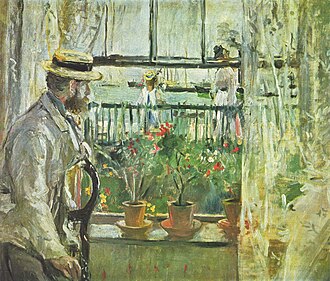 Eugène Manet on Isle of Wight - Berthe Morisot (1875)
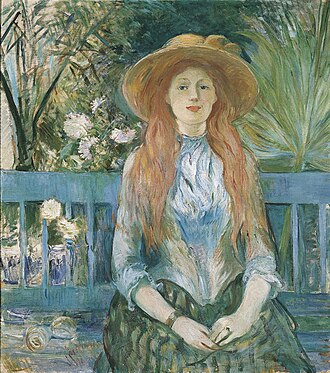 Young girl in a park - Berthe Morisot (1893)
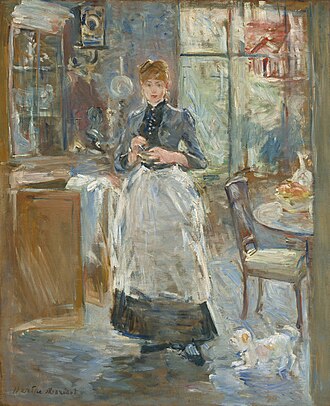 In the Dining Room - Berthe Morisot (1886)
関連する画家の作品
 印象・日の出 - Claude Monet (1872)
 睡蓮 - Claude Monet (1906)
 草上の昼食 - Édouard Manet (1863)
 オランピア - Édouard Manet (1863)
 ムーラン・ド・ラ・ギャレットの舞踏会 - Pierre-Auguste Renoir (1876)
 舟遊びの昼食 - Pierre-Auguste Renoir (1881)
 アブサントを飲む人 - Edgar Degas (1875)
 The Bellelli Family - Edgar Degas (1858)
 The Canal du Loing at Moret - Alfred Sisley (1892)
 The Watering Pond at Marly with Hoarfrost - Alfred Sisley (1876)
 パリの通り、雨 - Gustave Caillebotte (1877)
 床削り - Gustave Caillebotte (1875)