Old Italian Art
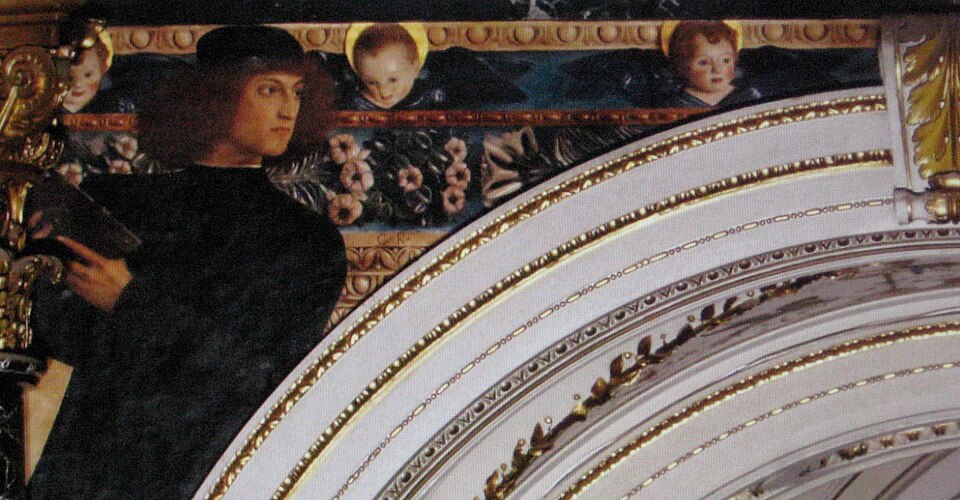
High on the staircase wall of a Vienna museum, a young man in black lowers his book to look at a woman in a gold patterned dress who beckons him with one finger. The young Klimt painted this pair in 1891, and in it scholars see Dante and Beatrice.
The story behind the painting
Old Italian Art is a painting by Gustav Klimt from 1891, set into a pair of spandrel and intercolumniation fields on the north wall, to the right, of the grand staircase of the Kunsthistorisches Museum in Vienna. Spandrels are the curved triangles beside an arch, and intercolumniations the spaces between columns. Klimt painted other fields in the same staircase: Roman and Venetian Quattrocento, Greek Antiquity and Egypt, and Florentine Cinquecento and Quattrocento. Wikidata gives no date for this work, while the German Wikipedia article dates it to 1891.
What to look for
In the left spandrel a young man dressed in black leans against the arch. Behind him, garlands of flowers worked as a frieze frame three angel heads. He holds an open book but is not reading: his head turns to the right spandrel, where a woman in a dress covered with gold ornament leans on the arcade and raises her right arm with a beckoning finger. In her left hand is a lily branch, and in the bend of her arm a cherub with red wings appears. Both wear punched haloes. Between the columns, a child angel in a light white robe, one sleeve slipping from the shoulder, stands before a dark bust of Dante.
Meaning and intent
The term old Italian is mostly used in linguistics, so its use for art is unusual. The barely noticeable Dante bust seems to be the key: the young man in black mirrors the dark bust, so he may be Dante himself, and the woman his dead beloved Beatrice, who in the Divine Comedy comes down to him in a cloud of flowers and leads him through Paradise. Her beckoning finger and her downward gaze, shared with the angel and cherub, place her in heaven. The red wings may stand for love and passion, the lily for Beatrice's purity. Another reading sees the shield of the angel and the colours gold, red and blue as an allusion to the Medici, patrons of art in Dante's Florence.
Legacy
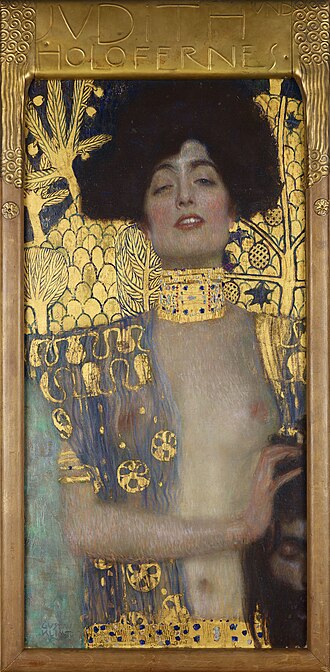
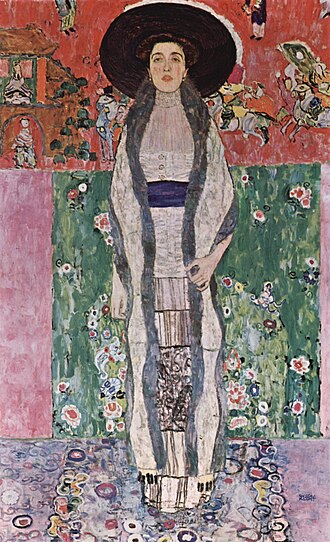
Two works in the gallery of the Academy of Fine Arts Vienna have been identified as models: Marco Palmezzano's Portrait of a Young Man, about 1490, and a Coronation of the Virgin of 1452 attributed to Antonio da Fabriano, which inspired the flower pattern of the dress. The garlands and angel heads recall Luca della Robbia. Above all, the woman is an early example of the separation of body parts from decorative elements such as robes and patterned backgrounds. This principle became a hallmark of Klimt's later works, such as Judith of 1901, Adele Bloch-Bauer I of 1907 and The Kiss of 1908 to 1909.
豆知識
- Painted by Klimt in 1891 for the staircase of the Kunsthistorisches Museum, Vienna.
- The young man and the woman may be Dante and Beatrice.
- The flower pattern of the dress was inspired by a 1452 Coronation of the Virgin.
- An early example of the flat ornament that marks The Kiss.
画家について
Gustav Klimt (1862-1918)
同じ画家の作品: Gustav Klimt
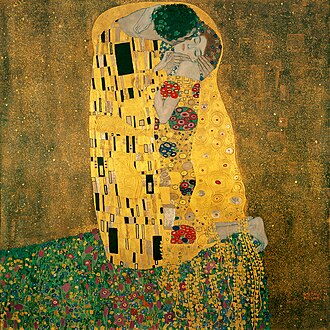 接吻 - Gustav Klimt (1907-1908)
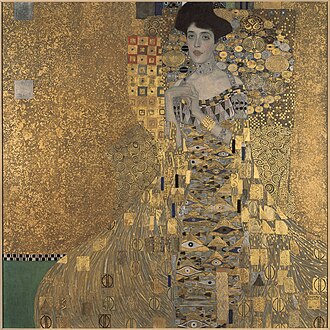 アデーレ・ブロッホ=バウアーの肖像 I - Gustav Klimt (1907)
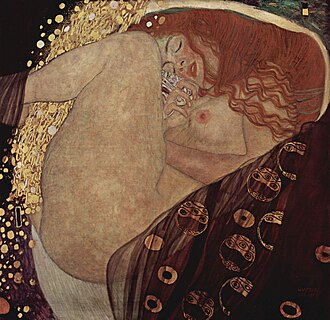 ダナエ - Gustav Klimt (1907)
 ユディト - Gustav Klimt (1901)
 The Three Ages of Woman - Gustav Klimt (1905)
 扇を持つ女 - Gustav Klimt (1917)
 Adele Bloch-Bauer II - Gustav Klimt (1912)
 婦人の肖像 - Gustav Klimt (1910s)