黒い牛の車
Vincent van Gogh · 1884
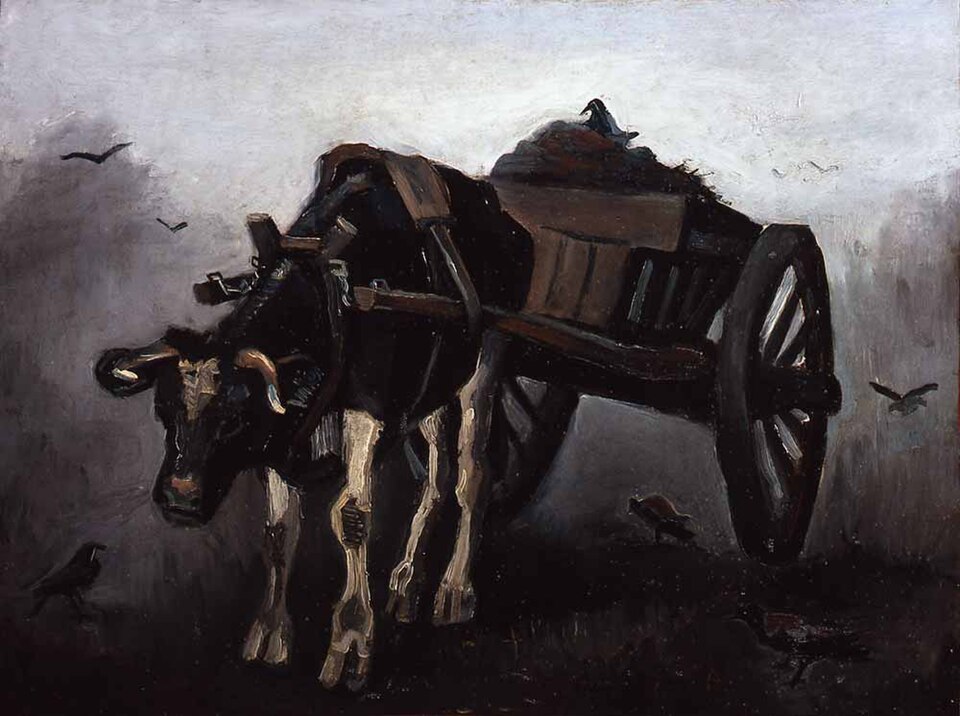
Before the sunflowers and starry skies, there was this: a worn-out cart, a dark ox, and a young painter in a Dutch village finding his own way of seeing.
The story behind the painting
Van Gogh painted Cart with Black Ox, also known as The Ox-Cart, in 1884 in the village of Nuenen in the Netherlands, years before he left for the south of France. This was his early, Dutch period, when he was teaching himself to paint by looking hard at rural life and the labour of ordinary people. The canvas, 60 by 80 centimetres, is one of a pair: in the same year he painted a related picture, Cart with Red and White Ox, now in the Kröller-Müller Museum in Otterlo. The sources say little about the exact circumstances of this painting's creation, but it has been cited as one of his important early works, a moment when the future Van Gogh first becomes visible.
What to look for
Begin with the darkness. The palette here is deep and earthy, far from the brilliant colour of his later years, and the mood has been described as disquieting. Both the ox and the cart are decrepit, worn by use and time. Now look closely at the wheel. The curator Bruce Guenther pointed to the way it seems lifted off the surface by the brush, the paint itself defining its form. That physical, emphatic handling of paint is something to watch for. There is also something you cannot see: a 2010 examination using digital X-ray and CT scanning revealed a flying bird that Van Gogh had painted out. Somewhere beneath the sky of this sombre scene, a bird once flew.
Meaning and intent
Van Gogh's early years in Nuenen were devoted to the peasant world, and this painting belongs to that devotion: an animal and a tool of farm work, shown without charm or prettiness. The decrepit cart and the dark tones speak of toil and weariness rather than rural idyll. For Bruce Guenther, the real significance lies in the brushwork. He argued that in the way the wheel is shaped by the brush, Van Gogh is establishing his vocabulary as a painter, adding: he becomes Van Gogh here. Read this way, the canvas is less about an ox than about an artist discovering that paint could build form with its own energy, a discovery that would later blaze in every stroke of his mature work.
Legacy
The painting was owned by a family who bought it in 1950, and in 2007 it was donated to the Portland Art Museum in Oregon, where it remains. It was described as the most generous gift the museum had received as of 2010. That same year, the canvas was studied with digital X-ray and CT scanning to learn about Van Gogh's working methods and to add to the research database at the Van Gogh Museum in Amsterdam, which is how the hidden bird came to light. Together with its companion in Otterlo, Cart with Black Ox gives visitors a vivid glimpse of the painter before the legend: earnest, dark-toned, and already unmistakably himself.
豆知識
- A painted-out flying bird was discovered by X-ray and CT scanning in 2010.
- It was painted in Nuenen in 1884, before Van Gogh moved to the south of France.
- A companion work, Cart with Red and White Ox, is in the Kröller-Müller Museum.
- It was donated to the Portland Art Museum in 2007.
画家について
Vincent van Gogh (1853-1890)
同じ画家の作品: Vincent van Gogh
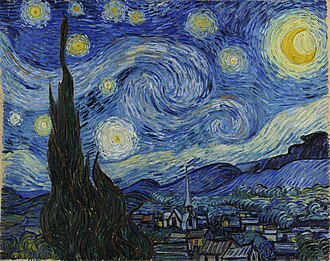 星月夜 - Vincent van Gogh (1889)
.jpg) 夜のカフェテラス - Vincent van Gogh (1888)
夜のカフェテラス - Vincent van Gogh (1888)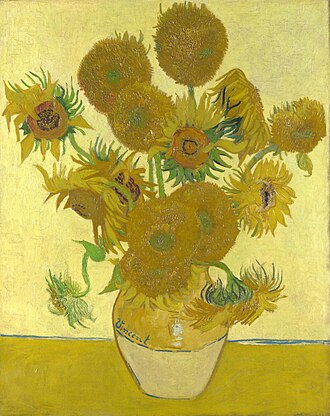 ひまわり - Vincent van Gogh (1888)
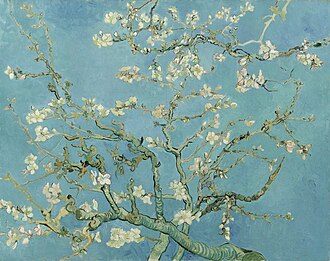 花咲くアーモンドの木の枝 - Vincent van Gogh (1890)
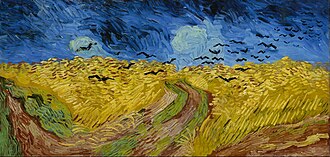 カラスのいる麦畑 - Vincent van Gogh (1890)
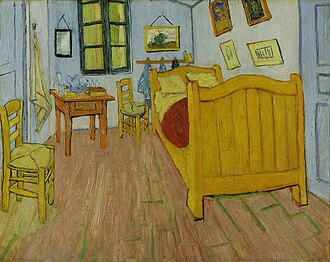 アルルの寝室 - Vincent van Gogh (1888)
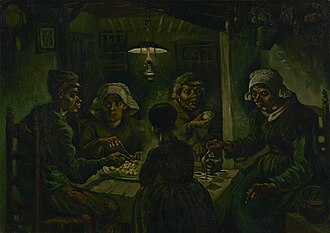 ジャガイモを食べる人々 - Vincent van Gogh (1885)
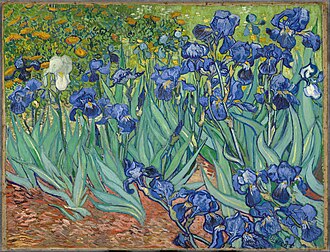 アイリス - Vincent van Gogh (1889)
関連する画家の作品
 我々はどこから来たのか 我々は何者か 我々はどこへ行くのか - Paul Gauguin (1897-1898)
%201889.jpg) 黄色いキリスト - Paul Gauguin (1889)
黄色いキリスト - Paul Gauguin (1889) 草上の昼食 - Édouard Manet (1863)
 オランピア - Édouard Manet (1863)