目隠し鬼
ジャン・オノレ・フラゴナール · 1760s
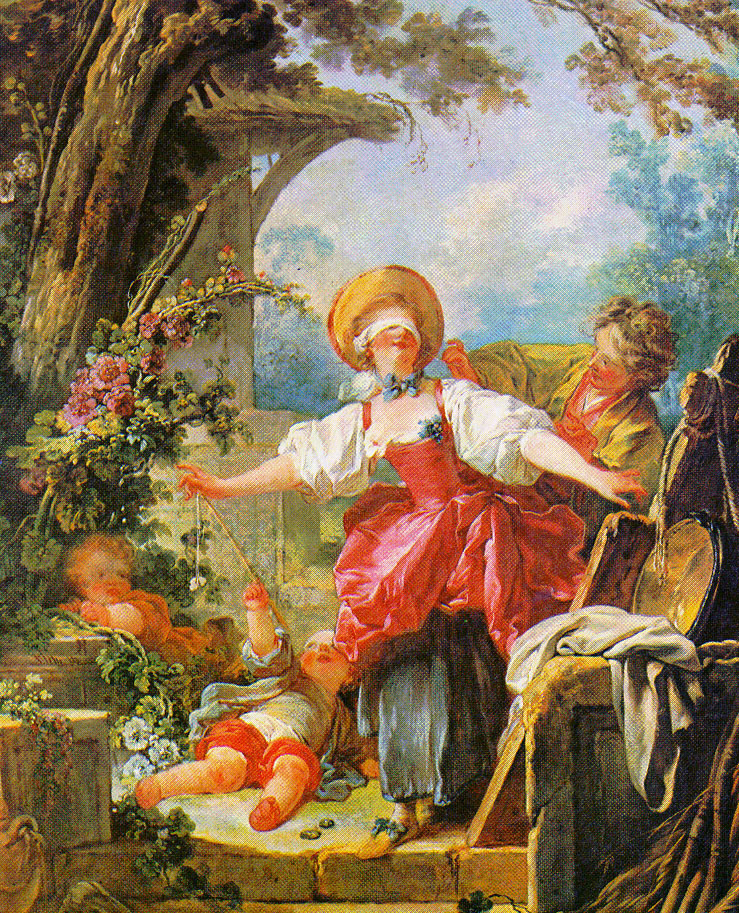
A girl in a blindfold reaches out in a leafy glade, but look closely: she is peeking. Fragonard's Blind Man's Bluff is a game of flirtation where nothing is quite what it seems.
The story behind the painting
Blind Man's Bluff, Le colin-maillard in French, is a painting by the Rococo painter Jean-Honoré Fragonard. Wikipedia dates it to around 1750, while Wikidata places it in the 1760s, so its exact date is uncertain. It was made as a companion to The See-Saw, now in the Thyssen-Bornemisza Museum in Madrid. Both draw heavily on the style of François Boucher, Fragonard's teacher. Fragonard later painted another work with the same title, some time between 1775 and 1780, which belongs to the Samuel H. Kress Collection.
What to look for
A young woman plays blind man's bluff with a young man in a wooded setting, but she is looking out from under her blindfold. The two wear pastoral costume, and the Toledo Museum of Art notes that their rustic clothes are improbably clean and fashionable: the woman's shoes even have elegant bows. Boucher's influence shows in the frame of luxuriant vegetation around them, but the careful composition of the scene is Fragonard's own. The background looks like a wood, yet it could be a stage set. Wikidata gives the canvas as 116.8 by 91.4 cm.
Meaning and intent
The painting is full of deceptions. The blindfold does not hide, the game seems a pretext leading to seduction, and the shepherd and shepherdess may really be nobles or bourgeois people playing at country life. The source sums it up as a picture that seems to abolish the boundary between truth and lies, reality and fiction. The museum calls it playfully erotic and sensuously painted, a scene of youthful flirtation that fulfilled the 18th-century aristocratic French taste for romantic pastoral themes. Blind man's bluff stands for courtship, while the see-saw of the companion piece is perhaps a metaphor for the sexual act.
Legacy
The Toledo Museum of Art in Ohio holds the painting. It was bought with funds from the Libbey Endowment, a gift of the glass manufacturer Edward Libbey, who founded the museum in 1901. Eighteenth-century engravings were made of both Fragonard versions of the subject, and they show that the paintings may originally have been as much as a foot taller at the top. So the leafy canopy we see today may once have risen higher still over the players, framing their little game.
豆知識
- A companion piece to Fragonard's The See-Saw.
- Dated around 1750 by Wikipedia, the 1760s by Wikidata.
- The blindfolded girl is peeking.
- Held by the Toledo Museum of Art, Ohio.
画家について
ジャン・オノレ・フラゴナール (1732-1806)
風俗美術 · カップル · プット · トレド美術館 · 総統美術館
同じ画家の作品: ジャン・オノレ・フラゴナール
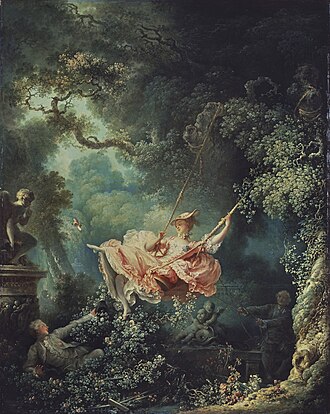 ぶらんこ - Jean-Honoré Fragonard (1760s)
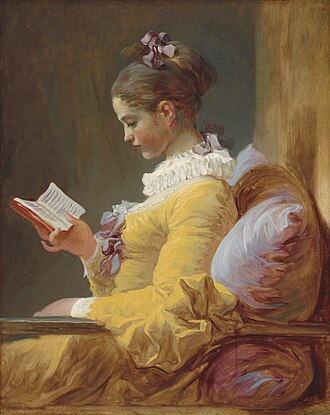 読書する娘 - Jean-Honoré Fragonard (1770)
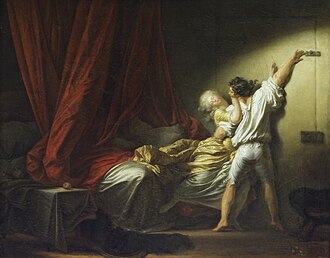 閂 - Jean-Honoré Fragonard (1770s)
 偶像に犠牲を捧げるヤロブアム - Jean-Honoré Fragonard (1752)
 La Gimblette - Jean-Honoré Fragonard (1770)
 カリロエを救うために自らを犠牲にするコレソス - Jean-Honoré Fragonard (1765)
 キューピッドからの贈り物を姉妹たちに見せるプシュケ - Jean-Honoré Fragonard (1753)
 嵐 - Jean-Honoré Fragonard
 シテール島の巡礼
 ピエロ
ピエロ 水浴のディアナ
 オダリスク
オダリスク 1808年5月3日
.jpg) 裸のマハ
裸のマハ