Arles: View from the Wheat Fields
Vincent van Gogh · 1888
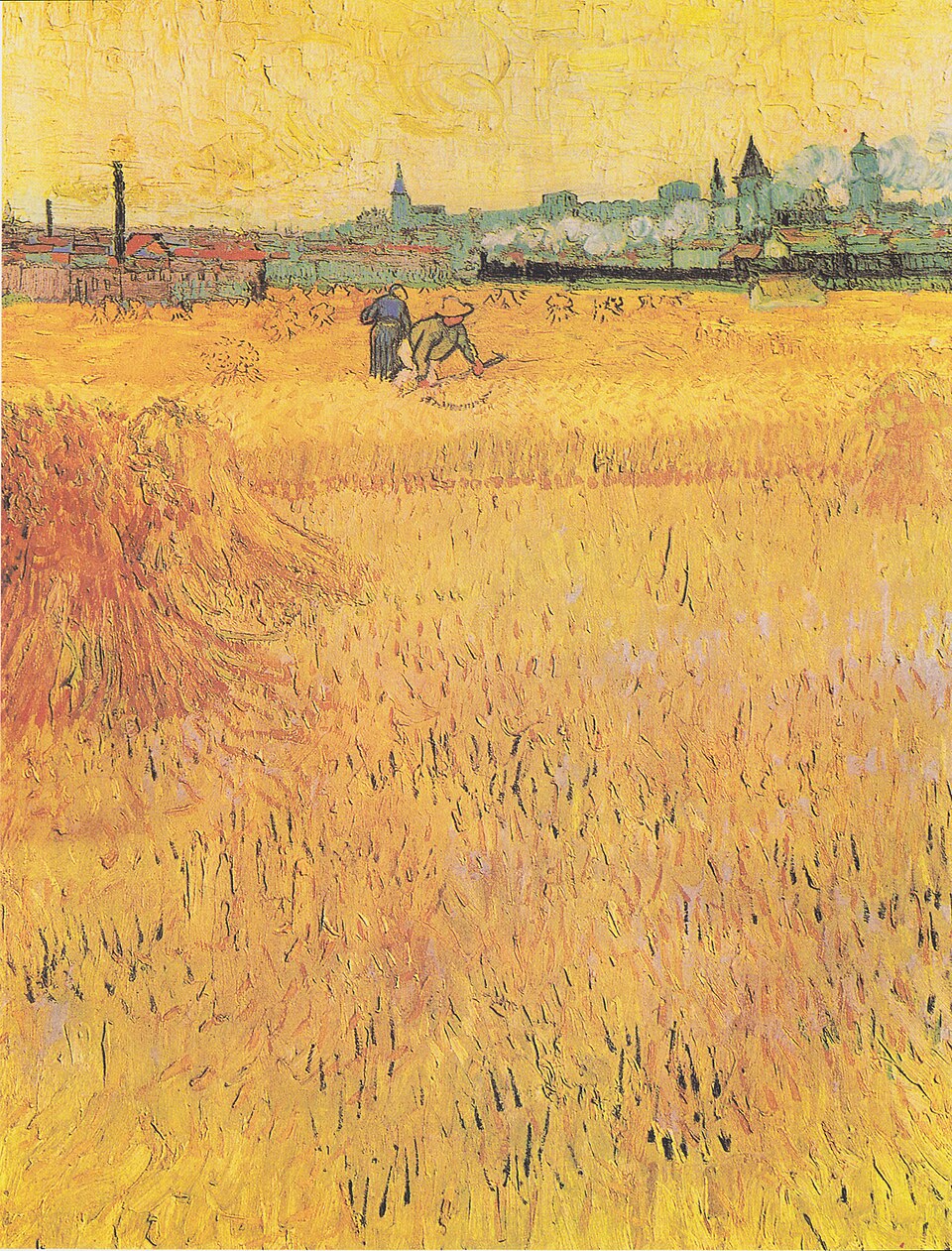
Sheaves lean together in the foreground, a couple works in a sea of yellow, and Arles lies along the horizon. Van Gogh painted it in June 1888, under a blazing sun, and stood this one wheat field upright.
The story behind the painting
Van Gogh was about 35 when he moved to Arles in southern France, and there he was at the height of his career. It was likely one of his happier periods: he was confident, clear-minded and seemingly content. In the last half of June 1888 he worked on a group of ten Harvest paintings, which let him experiment with colour and technique. On 21 June he wrote to his brother Theo that he had spent a week working hard in the wheat fields under the blazing sun. This canvas, also known as Wheat Field with Sheaves and Arles in the Background, is one of them.
What to look for
Start in the foreground, where sheaves of harvested wheat lean against one another. In the middle, a couple is at work in a sea of yellow and ochre, the harvest in progress. Along the horizon runs the town of Arles. Van Gogh described these wheat field pictures as landscapes in yellow, old gold, done quickly, quickly, in a hurry, just like the silent harvester under the blazing sun, intent only on the reaping. Notice the format too: all his other Wheat Fields paintings are horizontal, and this is the one exception, painted in portrait format.
Meaning and intent
Van Gogh was drawn to the close bond between peasants and the cycles of nature: sowing, harvest, sheaves in the fields. For him, the sower and the wheat sheaf stood for eternity, and the reaper with his scythe for irrevocable death. In 1889 he wrote that when we think of all we cannot understand, we can look at the fields of wheat, and asked whether we, who live by bread, are not ourselves very much like wheat, to be reaped when we are ripe. The harvest here is work, but also a quiet thought about life.
Legacy
His Arles work gathers what he had absorbed in Paris during the two previous years: Impressionism, Neo-Impressionism and Japanese art. From these his style grew into vivid colour and energetic, thickly loaded brushstrokes. The same months produced paintings of ordinary life such as Harvest at La Crau, and the sunflower pictures, now among his most recognisable works. Arles: View from the Wheat Fields belongs to that burst of activity, when he worked without pause to keep up with his ideas. Today it hangs in the Musée Rodin in Paris.
豆知識
- Painted in June 1888 in Arles.
- One of about ten Harvest paintings from late June 1888.
- The only portrait-format canvas among his Wheat Fields.
- Held at the Musée Rodin, Paris.
画家について
Vincent van Gogh (1853-1890)
同じ画家の作品: Vincent van Gogh
 星月夜 - Vincent van Gogh (1889)
 夜のカフェテラス - Vincent van Gogh (1888)
 ひまわり - Vincent van Gogh (1888)
 花咲くアーモンドの木の枝 - Vincent van Gogh (1890)
 カラスのいる麦畑 - Vincent van Gogh (1890)
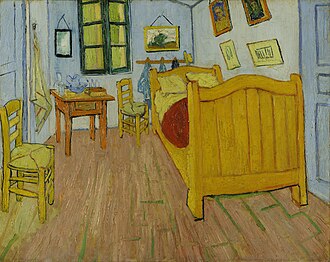 アルルの寝室 - Vincent van Gogh (1888)
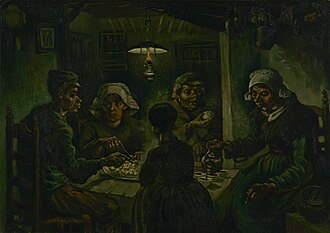 ジャガイモを食べる人々 - Vincent van Gogh (1885)
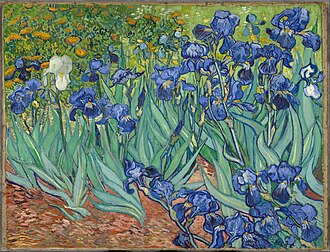 アイリス - Vincent van Gogh (1889)
関連する画家の作品
 大水浴図 - Paul Cézanne (1900s)
 赤いチョッキの少年 - Paul Cézanne
 我々はどこから来たのか 我々は何者か 我々はどこへ行くのか - Paul Gauguin (1897-1898)
 黄色いキリスト - Paul Gauguin (1889)
 キリスト昇架 - Peter Paul Rubens (1609)
 レウキッポスの娘たちの略奪 - Peter Paul Rubens (1618)
 Walk on the mountain - Joaquín Sorolla (1909)
 Sad Inheritance - Joaquín Sorolla (1898)
 ムーラン・ド・ラ・ギャレットの舞踏会 - Pierre-Auguste Renoir (1876)
 舟遊びの昼食 - Pierre-Auguste Renoir (1881)
 ムーラン・ルージュ - Henri de Toulouse-Lautrec (1892)
 La Toilette - Henri de Toulouse-Lautrec (1896)