アーレの闘技場
Vincent van Gogh · 1888
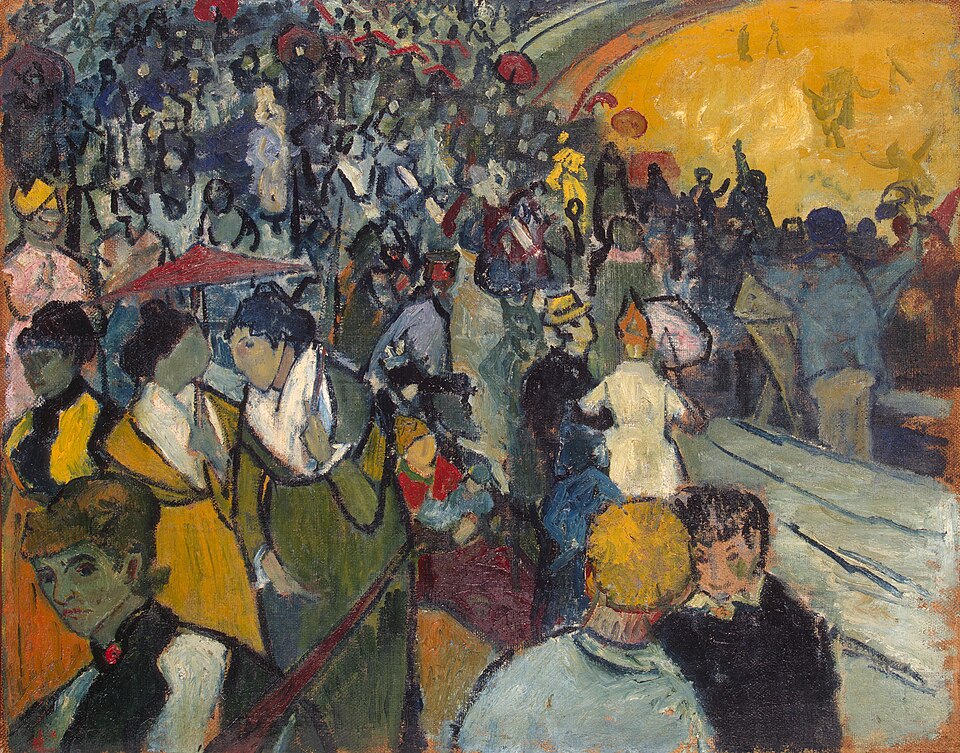
The bullfight season was long over when Van Gogh painted this crowd in the arena: he summoned it from memory, weeks before the night he cut his own ear.
The story behind the painting
Van Gogh painted Arena in Arles, also known as Les Arènes, in November or December 1888, while Paul Gauguin was living with him in the Yellow House. The bullfight season in Arles that year had run from Easter Sunday, 1 April, to 21 October, so this was not a study from life. Van Gogh painted it from memory, a way of working that Gauguin encouraged him to try in the studio. It was a tense and creative season: two strong-willed painters sharing a small house, arguing and experimenting side by side. The canvas, 73 by 92 centimetres, may never have been finished. The paint is very thinly applied, and in places patches of bare jute show through, as if the picture were caught halfway between memory and completion.
What to look for
This is a painting about the spectators as much as the spectacle. Look at the crowd that fills the arena, a gathering of people seen in the Arles light Van Gogh carried in his mind. The sources suggest that members of the Roulin family appear among them, the family of the postman whom Van Gogh painted many times, and that a woman in Arlésienne costume has the profile of Madame Ginoux, another of his Arles sitters. Pay attention to the surface too. The paint is thin, and here and there the rough jute canvas peeks through, a reminder of the speed and uncertainty of the work. Rather than a finished statement, you are looking at a painter rebuilding a scene from recollection, filling it with familiar faces.
Meaning and intent
Painting from memory changed what the image could be. Freed from the need to record exactly what he saw, Van Gogh populated the arena with people he knew, turning a public event into something more personal. The picture also sits in the shadow of what came next. A matter of weeks after painting it, Van Gogh cut off part of his own ear. One of many theories links this act to the bull games of Arles, where, according to custom, a victorious matador displayed the severed ear of a defeated bull to the crowd and presented it to a lady of his choice. The sources are careful here: there is some doubt as to whether bulls were treated this way in Arles in Van Gogh's time. It remains a theory, not a fact.
Legacy
Today the painting belongs to the Hermitage Museum in Saint Petersburg. It is one of the more unusual works from Van Gogh's Arles period: a crowd scene rather than a landscape or a portrait, painted under Gauguin's influence and from memory rather than nature. That makes it a valuable witness to the brief, intense collaboration between the two painters in the Yellow House, an episode that ended in crisis. Its unfinished surface, with bare jute showing through, lets us glimpse the painter's process. And because it was made only weeks before the ear incident, it has drawn the attention of those who search Van Gogh's art for clues to his state of mind, even though such links remain speculative.
豆知識
- The 1888 bullfight season in Arles ended on 21 October, so this was painted from memory.
- Patches of bare jute show through the thin paint, suggesting it may be unfinished.
- A woman in Arlésienne costume appears to have the profile of Madame Ginoux.
- The painting is in the Hermitage Museum.
画家について
Vincent van Gogh (1853-1890)
同じ画家の作品: Vincent van Gogh
 星月夜 - Vincent van Gogh (1889)
.jpg) 夜のカフェテラス - Vincent van Gogh (1888)
夜のカフェテラス - Vincent van Gogh (1888) ひまわり - Vincent van Gogh (1888)
 花咲くアーモンドの木の枝 - Vincent van Gogh (1890)
 カラスのいる麦畑 - Vincent van Gogh (1890)
 アルルの寝室 - Vincent van Gogh (1888)
 ジャガイモを食べる人々 - Vincent van Gogh (1885)
 アイリス - Vincent van Gogh (1889)
関連する画家の作品
 我々はどこから来たのか 我々は何者か 我々はどこへ行くのか - Paul Gauguin (1897-1898)
%201889.jpg) 黄色いキリスト - Paul Gauguin (1889)
黄色いキリスト - Paul Gauguin (1889) 草上の昼食 - Édouard Manet (1863)
 オランピア - Édouard Manet (1863)