海の呪文
ダンテ・ゲイブリエル・ロセッティ · 1877
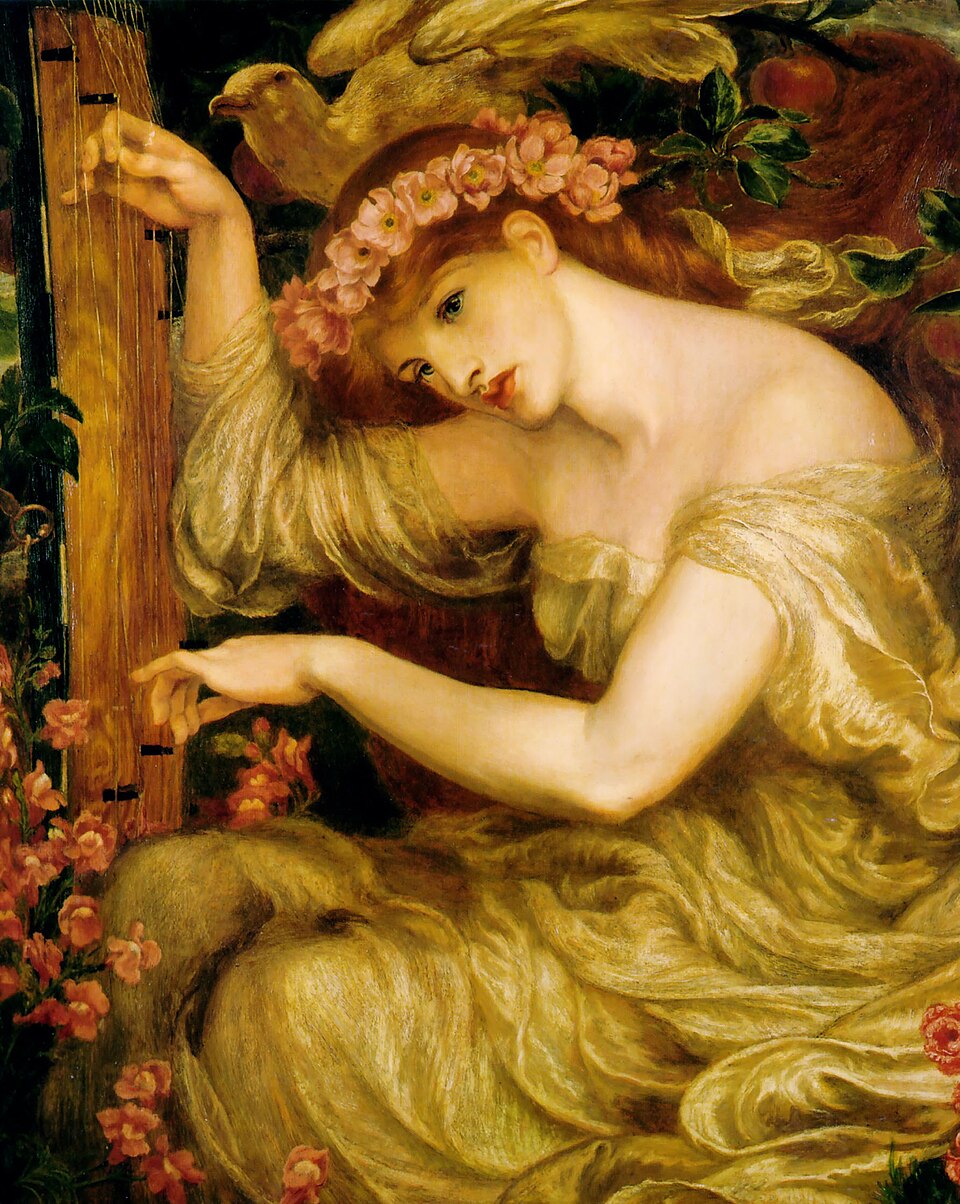
A siren bends over her strings among apple blossoms, and a seagull swoops down to listen. Her song, Rossetti's brother wrote, will prove fatal to some fascinated mariner.
The story behind the painting
Dante Gabriel Rossetti wrote a sonnet called A Sea-Spell in 1869 and completed the painting in 1877, as a double of the poem, as he did for several works in those years. In 1873 he drew a sea-maiden with an instrument, Ligeia Siren, as a study. He had begun the painting by 18 August 1875. His brother William Michael Rossetti wrote that Gabriel painted it, with The Roman Widow, after his patron Frederick Richards Leyland suggested he wanted several such half-length figures; Leyland later denied any commitment. A naturalist helped find and position the stuffed seagull, which caused some delay.
What to look for
The siren appears in human form, playing in a thoughtful reverie, surrounded by apples, apple blossoms and a seagull. Her instrument has been described as a harp and as related to the psaltery, but an analysis in the journal Music in Art identifies it as an unusually short Japanese koto, a thirteen-stringed zither. The model was Alexa Wilding, one of Rossetti's muses, who also posed for its companion, Veronica Veronese. The canvas is about 111.5 by 93 cm. William Michael described her as a Siren, or Sea-Fairy, whose lute summons a sea-bird to listen.
Meaning and intent
Critics disagree. Jerome McGann called it a failure caused by too much intellectualising, while earlier critics blamed slipshod execution. Helene E. Roberts placed it among Rossetti's images of the ideal woman, meant to stir reverie in the viewer through music, and argued that he steers us toward a spiritual response by stressing the face and giving the bare arms a masculine or matronly quality. Lucien Agosta read it as Art triumphing over Nature: here the singer draws the bird to her, reversing Veronica Veronese, where the musician is inspired by a bird.
Legacy
The painting was owned by Leyland and sold through Christie's in 1892. It passed to T. F. Wigley, David Croal Thomson and Viscount Leverhulme, then through New York dealers to the collector Grenville L. Winthrop in 1935. Winthrop gave it in 1939 to the Fogg Art Museum at Harvard, his alma mater. It was shown in the 1883 posthumous Rossetti exhibition in London, in South Australia in 1899, in Kansas in 1958 and in Tokyo in 2002. Today it hangs on the second floor of the Harvard Art Museums in Cambridge, Massachusetts.
豆知識
- Painting of 1877, paired with a sonnet of 1869.
- Modelled by Alexa Wilding; companion to Veronica Veronese.
- The instrument may be a short Japanese koto.
- At the Harvard Art Museums since Winthrop's 1939 gift.
画家について
ダンテ・ゲイブリエル・ロセッティ (1828-1882)
ラファエル前派 · 花 · ハーバード美術館群 · フォッグ美術館 · 鳥類
同じ画家の作品: ダンテ・ゲイブリエル・ロセッティ
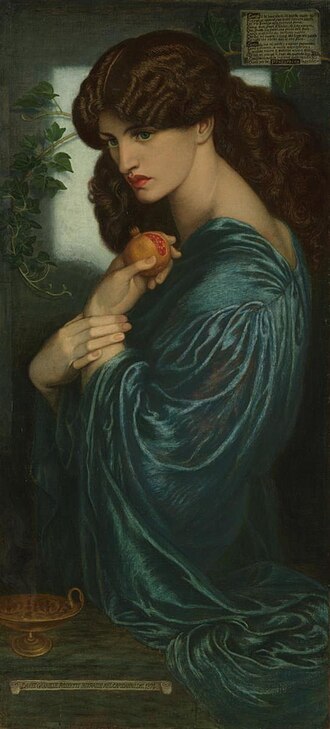 プロセルピナ - Dante Gabriel Rossetti (1874)
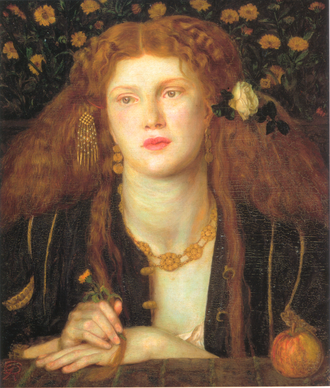 キスされた唇 - Dante Gabriel Rossetti (1859)
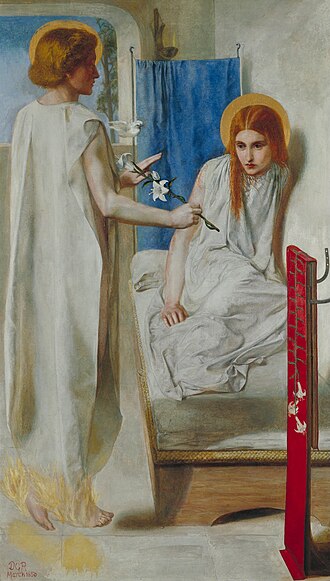 幼児のマリア - Dante Gabriel Rossetti (1850)
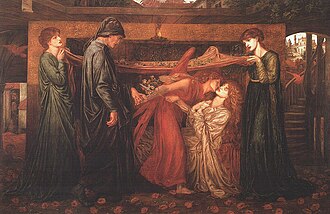 ベアトリーチェの死とダンテの夢 - Dante Gabriel Rossetti (1871)
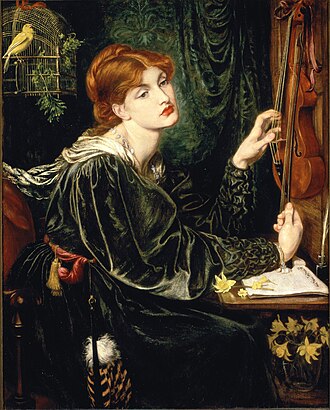 ヴェロニカ・ヴェロネーゼ - Dante Gabriel Rossetti (1872)
 モナ・ローザ - Dante Gabriel Rossetti (1867)
 The Girlhood of Mary Virgin - Dante Gabriel Rossetti (1840s)
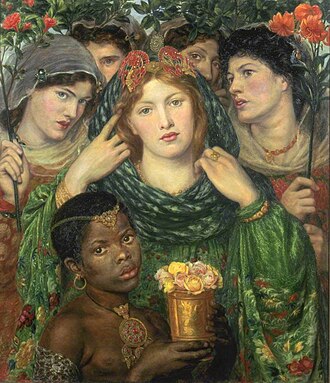 The Beloved - Dante Gabriel Rossetti (1865)
関連する画家の作品
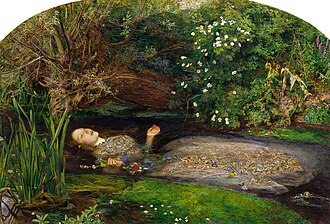 オフィーリア - John Everett Millais (1851)
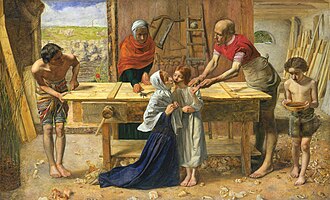 両親の家のキリスト - John Everett Millais (1849)
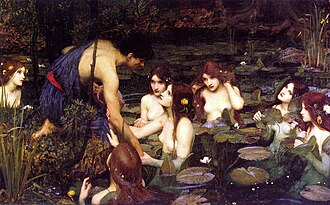 ヒュラスとニンフたち - John William Waterhouse (1896)
 シャロットの女 - John William Waterhouse (1888)