Women Ironing
Edgar Degas · 1884
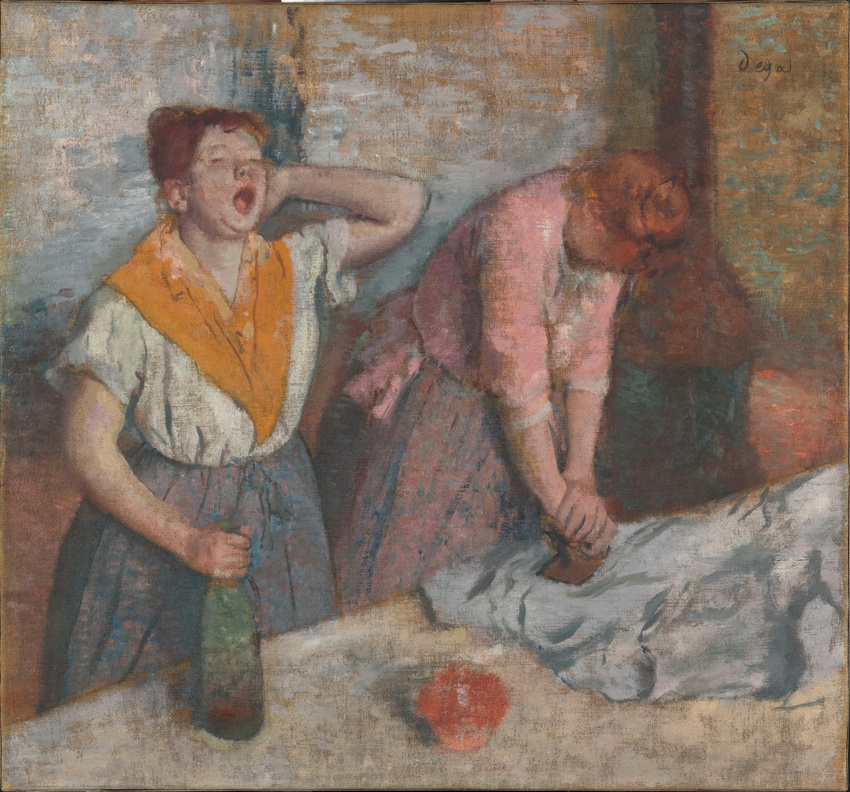
One woman yawns and rubs her neck, a wine bottle in her hand. The other leans her whole weight into a shirt. Degas painted two laundresses at work, and the yawn scandalised his critics.
The story behind the painting
Like bathers and dancers, laundresses return again and again in Degas's work, in several versions over twelve years. The first, of 1874, was commissioned by Jean-Baptiste Faure, the famous baritone and art collector, who lent it to the Impressionist exhibition of 1876. Degas was not satisfied with that first version and made this second one, painted around 1884 to 1886. Wanting an even more realistic view of women at work, he painted straight onto unprimed canvas, which gives the picture its rough texture.
What to look for
The light comes from the right, falling on the woman in the pink shirt, while the one who yawns stays more in shadow. The colours are mainly blues, with touches of white, green, brown and pink. The handling is quick, laid over excellent drawing that shows in the arms and faces. Degas may have been trying to capture the damp, steamy air of an ironing room. The yawning woman clutches a bottle of wine while the other bends over her work. The canvas is about 76 by 81 cm.
Meaning and intent
Following Courbet and Daumier, Degas shows the women in their hard work with no idealisation, far from good manners or refinement. The yawn was rejected almost unanimously: for some it stood for laziness, for others vulgarity and an offence to decency. George Moore wrote that it was one thing to paint laundresses and another to show them yawning. Paul Jamot of the Gazette des Beaux-Arts described the yawning woman with cruel mockery. Yet Alexandre Pathey praised a movement as true and strong as a Daumier. The weariness of the worker is perfectly caught.
Legacy
Women Ironing shows Degas's stubborn return to the same subject, refining it until it said exactly what he saw. The scandal it caused shows how new it was to paint working women tired, unposed and ordinary. The painting belongs today to the Musée d'Orsay in Paris. It sits alongside his dancers and bathers as part of his long study of women's bodies at work and at rest, a realism of gesture that critics could argue about but not ignore.
Lo sapevi?
- A second version of a subject Degas first painted in 1874.
- Painted around 1884-1886 on unprimed canvas.
- The yawning laundress caused a scandal.
- Now in the Musée d'Orsay, Paris.
L'artista
Edgar Degas (1834-1917)
woman · genre art · Musée d'Orsay · bottle
Altre opere di Edgar Degas
 L'Absinthe - Edgar Degas (1875)
 The Bellelli Family - Edgar Degas (1858)
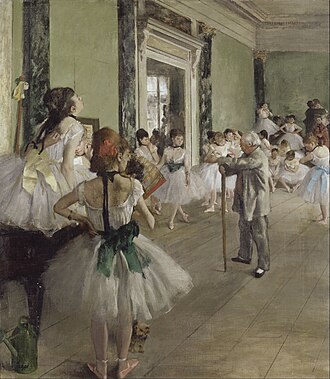 The Ballet Class - Edgar Degas (1871)
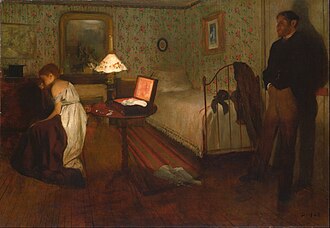 Interior - Edgar Degas (1868)
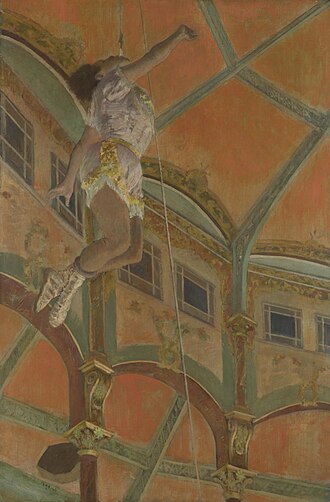 Miss La La at the Cirque Fernando - Edgar Degas (1879)
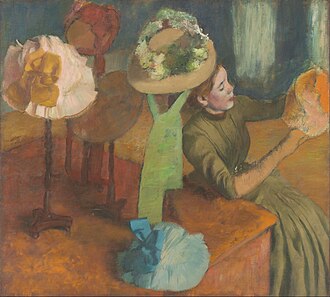 The Millinery Shop by Edgar Degas - Edgar Degas
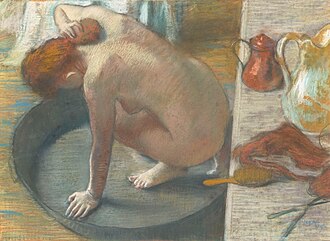 The Tub - Edgar Degas (1886)
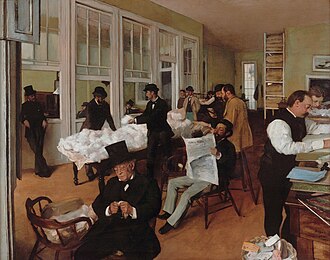 A Cotton Office in New Orleans - Edgar Degas (1873)
Dipinti di artisti collegati
 Impression, Sunrise - Claude Monet (1872)
 Water Lilies - Claude Monet (1906)
 Luncheon on the Grass - Édouard Manet (1863)
 Olympia - Édouard Manet (1863)
 Dance at Le Moulin de la Galette - Pierre-Auguste Renoir (1876)
 Luncheon of the Boating Party - Pierre-Auguste Renoir (1881)
 The Cradle - Berthe Morisot (1872)
 Summer's Day - Berthe Morisot (1879)
 The Canal du Loing at Moret - Alfred Sisley (1892)
 The Watering Pond at Marly with Hoarfrost - Alfred Sisley (1876)
 Paris Street; Rainy Day - Gustave Caillebotte (1877)
 Les raboteurs de parquet - Gustave Caillebotte (1875)