Vierge à l'Enfant
Hieronymus Bosch · 1505
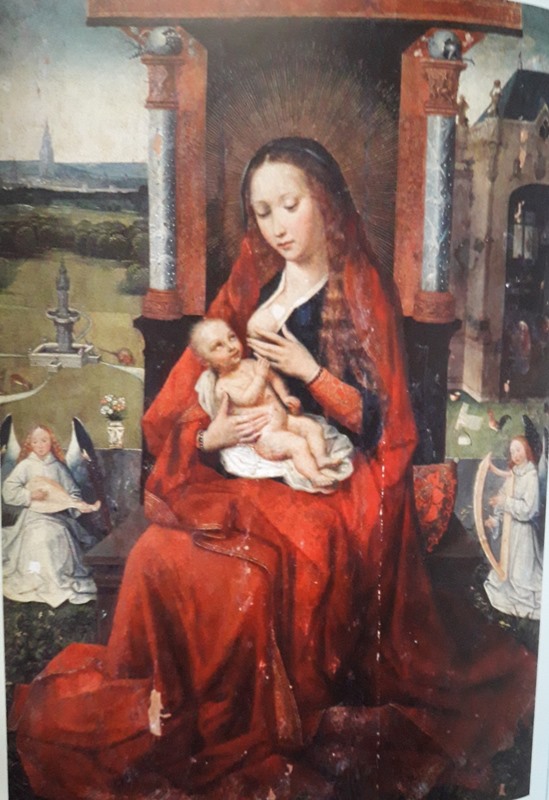
A mother nurses her child under a canopy, with paradise on one side and a dark kitchen on the other. The panel carries the signature of Hieronymus Bosch, yet nobody can say for sure that his hand painted it.
The story behind the painting
Nobody in art history knew this panel until 1989. Until then it belonged to a family in Normandy, according to the French Wikipedia article, which flags that claim as needing a reference. In March 1989 the Louvre laboratory examined it and judged the attribution to Bosch doubtful, and that verdict is what allowed the French government to grant an export licence. The painting was first offered for sale in Chateaudun and then sold at auction in Switzerland. A private collector in Ghent bought it, and in 2002 the panel was cleaned and partly restored. Wikidata dates it to 1505.
What to look for
The oak panel, 100.5 by 71 cm, is made of three boards joined with wooden pegs and signed Jheronimus bosch at lower left. Mary, dressed in red, nurses the Child on a throne beneath a canopy held by two small marble columns. Behind her, two angels play the lute and the harp. At the foot of the right column a relief shows the worship of the golden calf. On the capital, a man rides a deer, and over the door of the building at right two men struggle under a giant bunch of grapes. Look left for a fountain of life, the edge of a wood and a walled town far off.
Meaning and intent
The panel is built on contrasts. The idyllic landscape to the left, with its fountain evoking Paradise, faces a stranger scene to the right: through the door of an odd building topped with threatening statues, an old woman sits in a dark kitchen, a gloom that may stand for Hell. The golden calf is an Old Testament scene set against the true worship of the Child, in the medieval habit of pairing scriptures. With Mary placed between Paradise and Hell as an intercessor, the source suggests the panel never had wings and was a single picture for private prayer.
Legacy
Who painted it is still open. In 2001 tree-ring analysis by Peter Klein showed it could have been painted from 1494, and more likely from 1500. Paul Vandenbroeck then gave it to Bosch's circle, perhaps Gielis Panhedel. In 2004 Frederic Elsig dated it about 1505 to 1510 and saw a collaborator, possibly Bosch's nephew Anthonis van Aken. The Bosch Research and Conservation Project, unable to examine it before its 2016 catalogue, called it possibly a work very close to Bosch and asked for new scientific study. Losses, lifting paint and heavy repainting, above all on the faces and the throne, still make it hard to read.
Lo sapevi?
- Unknown to art historians until 1989.
- Signed Jheronimus bosch, but its attribution is still debated.
- Tree rings show the panel was likely painted after 1500.
- Held by a private collector in Ghent, restored in 2002.
L'artista
Hieronymus Bosch (1450-1516)
religious art · Mary · Christ Child · Nursing Madonna
Altre opere di Hieronymus Bosch
 The Garden of Earthly Delights - Hieronymus Bosch
 Ship of Fools - Hieronymus Bosch (1500s)
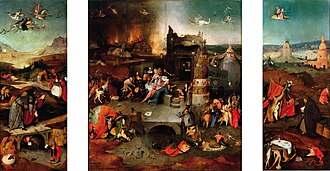 Temptation of Saint Anthony - Hieronymus Bosch (1501)
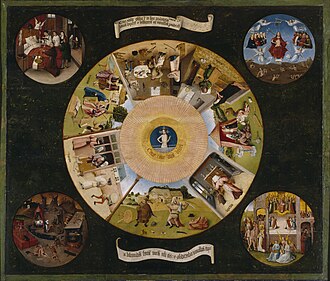 The Seven Deadly Sins and the Four Last Things - Hieronymus Bosch (1500)
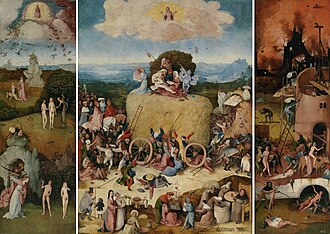 The Haywain Triptych - Hieronymus Bosch (1510s)
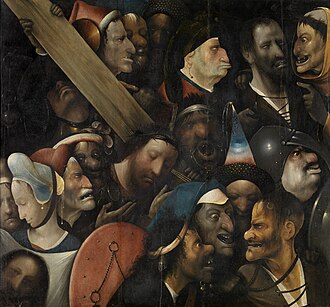 Christ Carrying the Cross - Hieronymus Bosch (1510s)
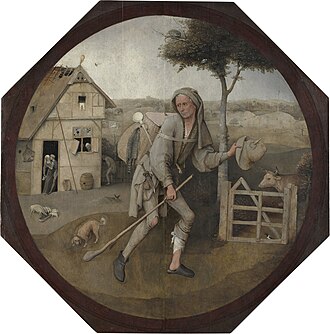 The Wayfarer - Hieronymus Bosch (1500)
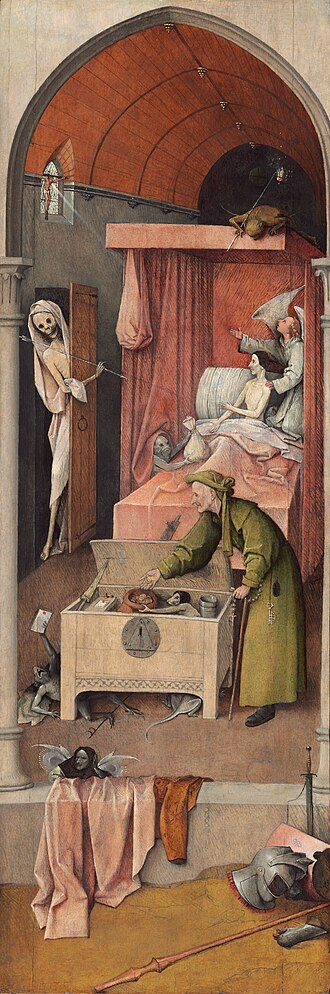 Death and the Miser - Hieronymus Bosch (1500s)
Dipinti di artisti collegati
 The Descent from the Cross - Rogier van der Weyden (1440s)
 Portrait of a Lady - Rogier van der Weyden (1460)
 Arnolfini Portrait - Jan van Eyck (1434)
 Ghent Altarpiece - Jan van Eyck (1432)
 Annunciation - Hans Memling (1480s)
 Scenes from the Passion of Christ - Hans Memling (1470)
 The Hunters in the Snow - Pieter Bruegel the Elder (1565)
 Netherlandish Proverbs - Pieter Bruegel the Elder (1551)