The Natchez
Eugène Delacroix · 1835
.jpg)
By the banks of the Mississippi, a father holds a newborn while the exhausted mother looks on. Delacroix carried this quiet, uneasy scene with him for twelve years before he let it go.
The story behind the painting
Eugène Delacroix, regarded as the leader of the French Romantic school, began The Natchez in 1823 and finished it only in 1835. From early on he drew on literature: by 1825 he was making lithographs after Shakespeare and soon after Goethe's Faust. This canvas came from French literature. It was inspired by Atala, a novel by François-René de Chateaubriand published in 1801, which features the Natchez people in the 1730s. When it was finally done, Delacroix exhibited it at the Salon in Paris in 1835. The long gap between start and finish says something about how the subject stayed with him.
What to look for
The oil on canvas, about 90 by 117 cm, shows a Native North American family on the banks of the Mississippi. The father holds in his arms a newborn child to whom his companion has just given birth. She rests nearby, worn out by the labour. Delacroix famously wrote that colour always occupied him, and his art favoured colour and movement over clarity of outline. Look at how the small group sits within the wide landscape of the river, a family alone at the edge of the world.
Meaning and intent
Asher Miller, a curator at the Metropolitan Museum of Art, suggests the group can recall a Holy Family, which links it to the Christian themes of Atala. The mother's gaze, heavy with exhaustion, can also be read as a dark premonition of the child's death, which happens in Chateaubriand's novel. So the picture holds two feelings at once: the tenderness of a birth and the shadow of loss. It is a scene of new life painted by an artist who knew how the story ends.
Legacy
After its showing at the Salon of 1835, the painting eventually crossed the Atlantic. It has been in the collection of the Metropolitan Museum of Art in New York since 1989, and is listed among Delacroix's selected works under the date 1835. Kept there, it continues to show how a Romantic painter in Paris turned a novel into an image of family, fragility and grief, through a slow work that took him twelve years to complete.
Lo sapevi?
- Begun 1823, finished 1835.
- Inspired by Chateaubriand's novel Atala (1801).
- Shown at the Paris Salon of 1835.
- In the Metropolitan Museum of Art since 1989.
Wikipedia · Wikipedia · Wikidata
L'artista
Eugène Delacroix (1798-1863)
Metropolitan Museum of Art · mother · family
Altre opere di Eugène Delacroix
 Liberty Leading the People - Eugène Delacroix (1830)
 Death of Sardanapalus - Eugène Delacroix (1827)
 The Massacre at Chios - Eugène Delacroix (1824)
 The Barque of Dante - Eugène Delacroix (1822)
 The Women of Algiers - Eugène Delacroix (1834)
 Greece on the Ruins of Missolonghi - Eugène Delacroix (1826)
 A Young Tiger Playing with its Mother - Eugène Delacroix (1830)
.jpg) Last Words of the Emperor Marcus Aurelius - Eugène Delacroix (1844)
Last Words of the Emperor Marcus Aurelius - Eugène Delacroix (1844)
Dipinti di artisti collegati
 The Third of May 1808 - Francisco Goya (1814)
.jpg) La maja nuda - Francisco Goya (1800)
La maja nuda - Francisco Goya (1800)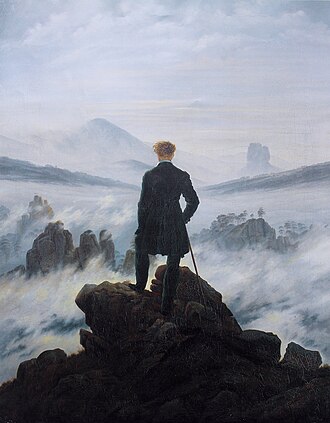 Wanderer above the Sea of Fog - Caspar David Friedrich (c. 1818)
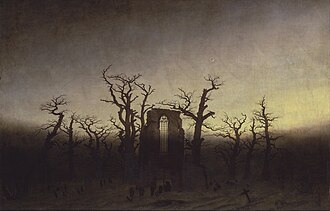 The Abbey in the Oakwood - Caspar David Friedrich (1800s)
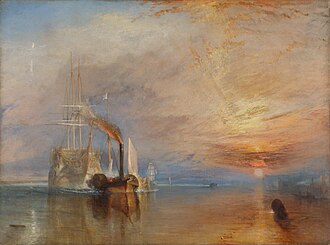 The Fighting Temeraire - J. M. W. Turner (1839)
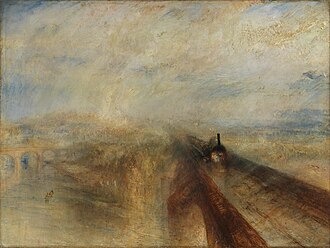 Rain, Steam and Speed - The Great Western Railway - J. M. W. Turner (1844)