The holy Jacob and the magician Hermogenes
Hieronymus Bosch · 1550
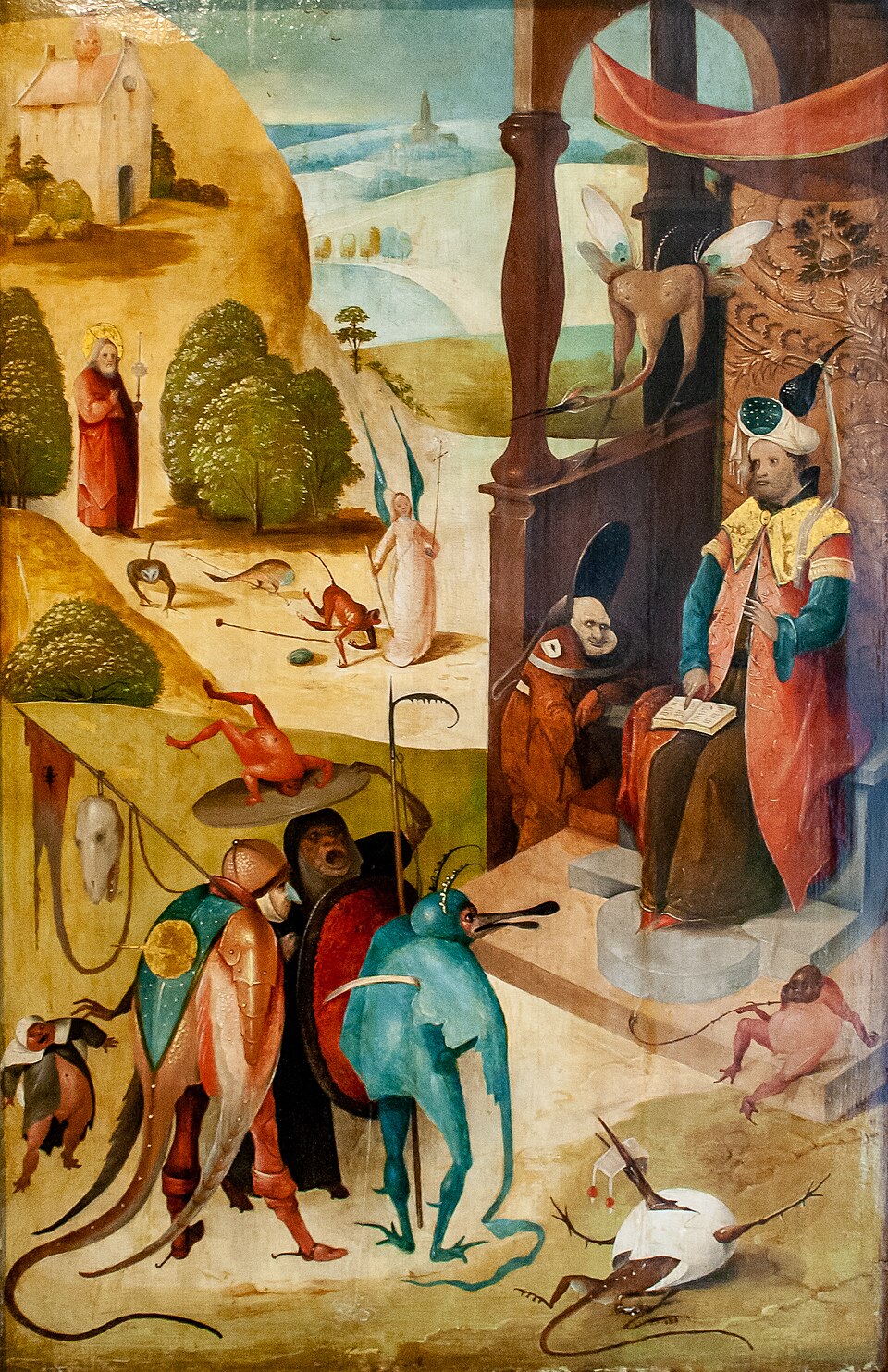
A magician on a throne calls up his demons to seize a saint, while an angel quietly overpowers them. This two-sided panel in Valenciennes carries Bosch's name, yet scholars have argued for over a century about whose hand really painted it.
The story behind the painting
The panel tells a passage from the Golden Legend: the clash between Saint James the Greater and the magician Hermogenes. Tree-ring analysis carried out in 2000 and 2001 showed that the wood was prepared after 1515. Because both faces are painted, it is thought to be a single wing of a larger altarpiece, probably made for a house of the Order of Saint Anthony and taken apart between the sixteenth and eighteenth centuries. Before the French Revolution it belonged to the Duke of Croy, who hung it in his Hermitage castle at Conde-sur-l'Escaut. The duke emigrated in 1792, and in 1796 his castle and its art were seized and sent to the new museum at Valenciennes.
What to look for
The panel is oil on wood, 62 cm high and 41.5 cm wide. On the front, two moments share one space. In the foreground Hermogenes sits enthroned under a canopy, summoning demons and ordering them to capture James. Behind, in the middle ground, James stands behind an angel who has just subdued the magician's demonic servants. Look at the small demon sitting at the magician's feet: a detail already noticed in the nineteenth century may show it smoking a pipe. Turn the panel around and the mood changes completely. The back shows an Antonine priory, recognisable by the tau on the coat of arms above its gate, with a monk reading and four beggars. Two crippled men fight outside the enclosure while a monk passes alms through a window to another.
Meaning and intent
The front is a story of faith defeating sorcery: the magician's power is broken not by force from James himself but by the angel in front of him. The reverse turns from legend to daily life, showing the charity of an Antonine house toward the poor and the disabled, which fits the idea that the altarpiece was made for that order. In the nineteenth century Arthur Dinaux proposed that the priory was the Antonine house of Havre, near Mons. The caricatured faces, with bulging eyes, link the panel to the world of grotesque imagery that Bosch made famous and that his followers kept alive for decades.
Legacy
For a long time nobody agreed on the painter. Until the mid nineteenth century it was catalogued as Pieter Bruegel the Elder, and the James side was often mistaken for a Temptation of Saint Anthony until Francois Nicolle identified it correctly before 1882. In 1852 Louis Clement de Ris first proposed Bosch. Others disagreed: Dollmayr saw a follower, Lafond saw Pieter Huys, Friedlander supported Bosch and Baldass rejected him. Today the French Wikipedia article calls it the work of a follower of Bosch, while Wikidata still lists Bosch and the year 1550. Frederic Elsig names him the Master of the Valenciennes double-sided panel, active in Antwerp in the 1560s, and links him to an Ecce Homo in Philadelphia.
Lo sapevi?
- Painted on both sides in oil, 62 by 41.5 cm.
- Tree-ring dating shows the panel was made after 1515.
- Seized from the Duke of Croy in 1796 and sent to Valenciennes.
- Attributed over time to Bruegel, Bosch, Pieter Huys and a Bosch follower.
L'artista
Hieronymus Bosch (1450-1516)
religious art · man · Early Netherlandish painting · angel · book · garden · reading · St. James the Elder · Christian cross
Altre opere di Hieronymus Bosch
 The Garden of Earthly Delights - Hieronymus Bosch
 Ship of Fools - Hieronymus Bosch (1500s)
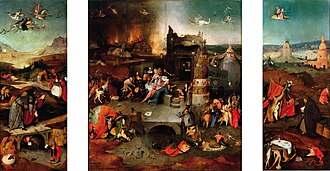 Temptation of Saint Anthony - Hieronymus Bosch (1501)
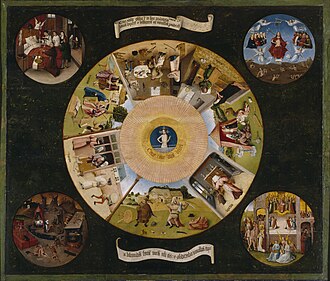 The Seven Deadly Sins and the Four Last Things - Hieronymus Bosch (1500)
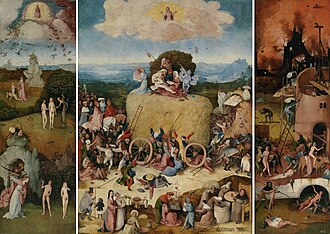 The Haywain Triptych - Hieronymus Bosch (1510s)
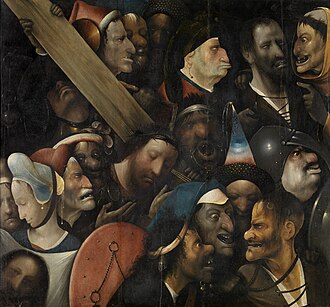 Christ Carrying the Cross - Hieronymus Bosch (1510s)
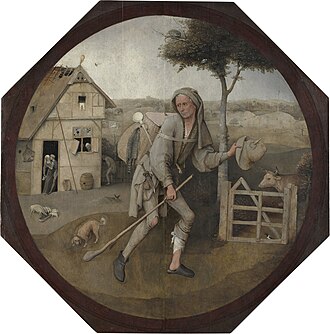 The Wayfarer - Hieronymus Bosch (1500)
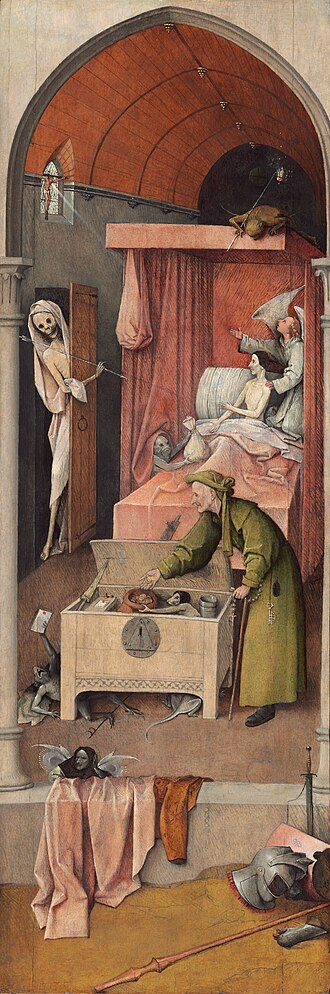 Death and the Miser - Hieronymus Bosch (1500s)
Dipinti di artisti collegati
 The Descent from the Cross - Rogier van der Weyden (1440s)
 Portrait of a Lady - Rogier van der Weyden (1460)
 Arnolfini Portrait - Jan van Eyck (1434)
 Ghent Altarpiece - Jan van Eyck (1432)
 Annunciation - Hans Memling (1480s)
 Scenes from the Passion of Christ - Hans Memling (1470)
 The Hunters in the Snow - Pieter Bruegel the Elder (1565)
 Netherlandish Proverbs - Pieter Bruegel the Elder (1551)