Susanna and the Elders
Jacopo Tintoretto · 1550s
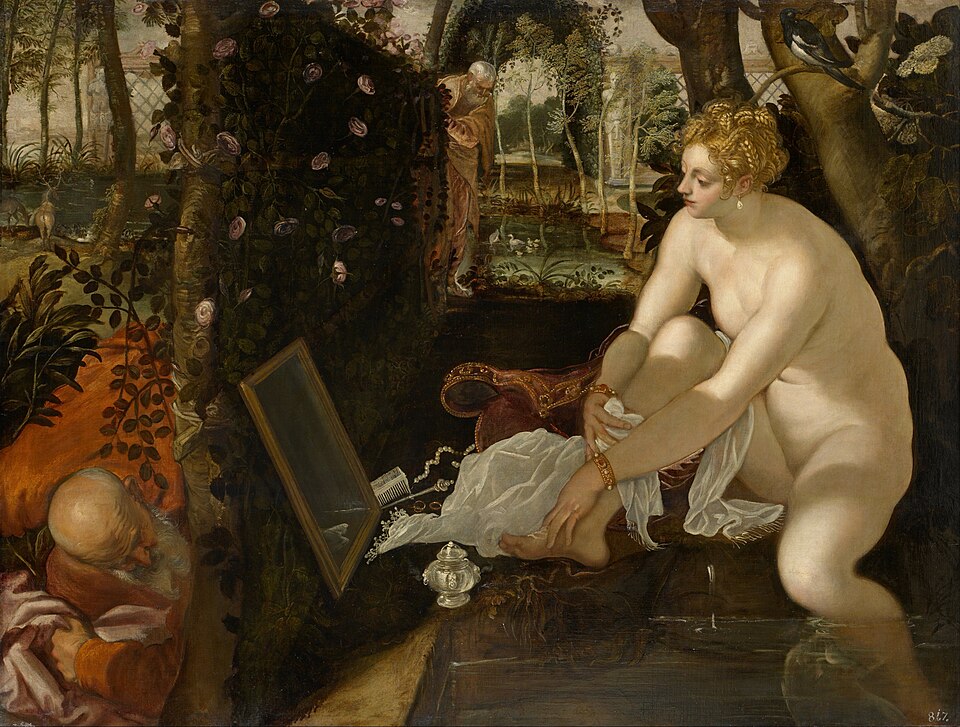
A woman sits by a garden pool, lost in her own reflection, unaware that two old men are peering at her around a wall of roses. Tintoretto paints the calm moment just before a terrible injustice.
The story behind the painting
The painting tells a story from the Book of Daniel. Susanna, a young married Jewish woman, bathed each day in a pool in her garden. Two elderly men, judges and guests of her wealthy husband Joakim, lusted after her and waited until she was alone. When she sent her maids away for oils and perfumes, they rushed forward and threatened to denounce her if she refused them. Susanna refused. The elders then falsely accused her of adultery with a young man, and she was condemned to death. On the way to execution, the young Daniel, urged by an angel, questioned the two men separately; they named different trees, their lie was exposed, and Susanna was freed.
What to look for
Tintoretto shows the moment before the drama. Susanna sits naked beside the pool, leaning against a tree and facing a dense rose trellis, against which a mirror leans. She gazes into it, absorbed. Around her on the ground lie bright objects: a white silk shawl, pearls, jewellery, a comb and silverware, together forming a kind of still life. Now look at the ends of the trellis. At either side an elderly man peers around to watch her. The composition makes their intrusion clear to us while Susanna remains unaware, and that gap between what she knows and what we see gives the quiet scene its tension. The canvas, about 146 by 194 cm, is in Vienna.
Meaning and intent
Tintoretto, born Jacopo Robusti, was called Il Furioso for the energy and fury with which he painted, and he worked on both sacred and profane subjects in what is sometimes called Venice's golden century. Here the two meet. The story is biblical, a tale of innocence falsely accused and justice restored, yet the painting lingers on beauty, light and luxurious things. We are placed in an uneasy position, sharing the view of the hidden watchers. The mirror, the jewels and the shawl speak of a private, untroubled world, about to be broken by men who were supposed to be respected judges of the community. The truth will come later, through Daniel.
Legacy
Susanna and the Elders was a popular subject in late Renaissance art, and Tintoretto returned to it more than once. The Vienna painting, dated about 1555-1556, is one of several works on the subject from his studio, with other versions shown at the Louvre, the Museo del Prado and the National Gallery of Art in Washington. Wikidata dates this canvas to the 1550s, consistent with that date. It now hangs in the Kunsthistorisches Museum, where it represents both the Mannerist currents and the Venetian school to which Tintoretto belonged. For many visitors it remains the version in which the story's suspense is held most delicately.
Lo sapevi?
- Painted about 1555-1556, it is in the Kunsthistorisches Museum, Vienna.
- Tintoretto was nicknamed Il Furioso for the energy with which he painted.
- Susanna gazes into a mirror propped against a rose trellis while two elders peer around its ends.
- Other versions of the subject from Tintoretto's studio are at the Louvre, the Prado and the National Gallery of Art, Washington.
L'artista
Jacopo Tintoretto (1518-1594)
religious art · woman · nude · sitting · Venetian school · nudity · Mannerism · Kunsthistorisches Museum · mirror · navel · bracelet · washing
Altre opere di Jacopo Tintoretto
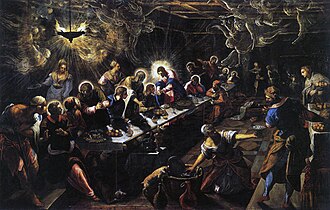 Last Supper - Jacopo Tintoretto (1563)
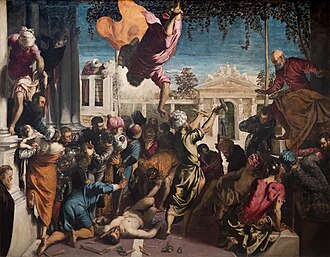 Miracle of the Slave - Jacopo Tintoretto (1540s)
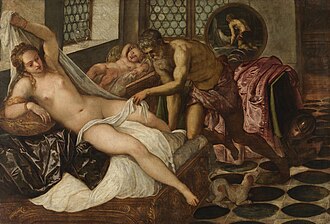 Venus and Mars Surprised by Vulcan - Jacopo Tintoretto (1555)
 The Origin of the Milky Way - Jacopo Tintoretto (1575)
 St Mark's Body Brought to Venice - Jacopo Tintoretto (1560s)
 Finding of the body of St Mark - Jacopo Tintoretto (1562)
%20Jacopo%20Tintoretto%20-%20Gloria%20del%20Paradiso%20-%20Sala%20del%20Maggior%20Consiglio.jpg) Paradise - Jacopo Tintoretto
Paradise - Jacopo Tintoretto Temptation of Adam - Jacopo Tintoretto (1550s)
Dipinti di artisti collegati
.jpg) Venus of Urbino - Titian (1538)
Venus of Urbino - Titian (1538) Assumption of the Virgin - Titian (1510s)