Still Life with Teapot
Paul Cézanne · 1900s
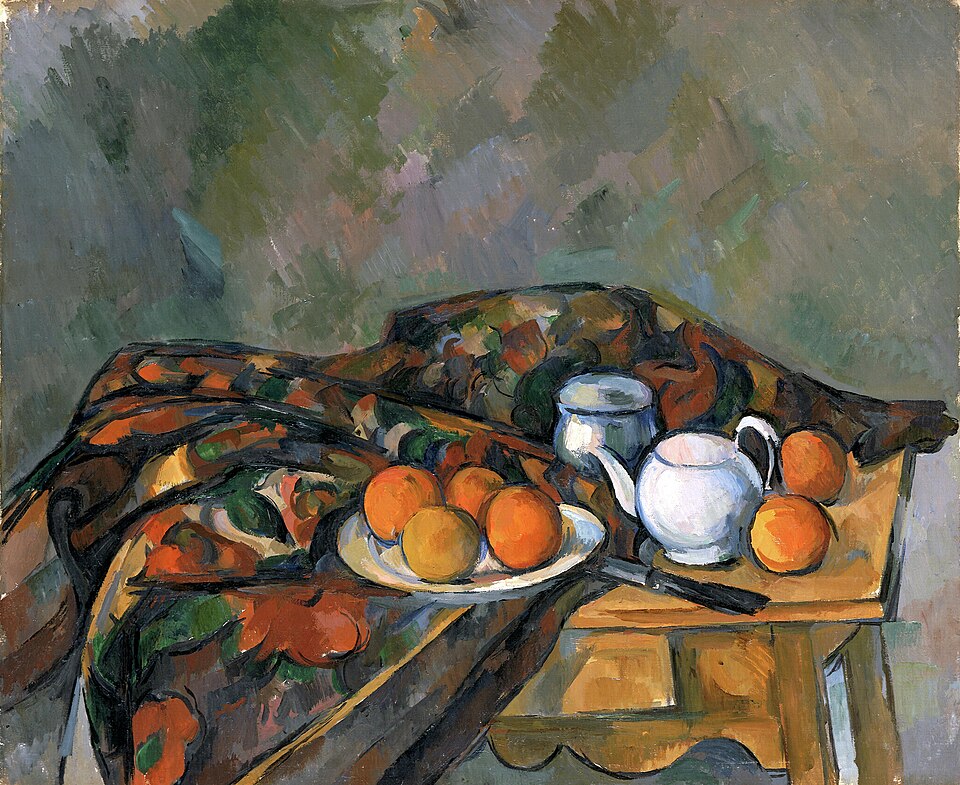
A cloth, a sugar bowl, a plate of fruit, a knife and a teapot on a table in Aix-en-Provence. Cézanne painted them near the end of his life, and the table itself still stands in his studio.
The story behind the painting
Cézanne began to concentrate on still life from 1870 onwards, perhaps inspired by the still lifes of Jean-Baptiste-Siméon Chardin that the Louvre acquired in 1869, and also influenced by Spanish and Dutch painters of the genre. Fruit became the central motif of much of this work. In early pictures he often set each fruit apart, as in Vessels, Fruit and Cloth of 1879, but in the 1880s he changed his approach, building more elaborate counterpoints of shape, colour and texture. Still Life with Teapot belongs to the very end of his life: it is thought to date between 1902 and 1906, and it was painted in his studio at Aix-en-Provence.
What to look for
A patterned cloth is draped over the table in carefully arranged folds. On it sit a sugar bowl and a plate holding four fruit. On the bare part of the table, to the right, rest a teapot, a knife and two more fruit. The strong colours of the vessels, fruit and cloth stand against a washed-out green-grey background. Look closely at the plate, which seems to bend, and at the table legs, which do not match the angle of the tabletop. Cézanne moved his position while painting his late still lifes to study each object on its own, so the perspective shifts slightly from thing to thing.
Meaning and intent
Even the identity of the fruit is open. In her 2005 book Colour and Light, Ann Sumner calls them peaches. In 1962 the critic David Sylvester said that we do not really know which are apples, oranges or apricots, and that we do not care: what we know, physically, is the feeling of a sphere, a perfectly compact shape. In that reading the subject matters less than the weight and roundness of things, built up from many slightly different points of view rather than one fixed eye.
Legacy
By 1920 the picture belonged to the Paris art firm Bernheim-Jeune. That year it was bought by the Welsh philanthropist Gwendoline Davies, and National Museum Wales describes it as one of her finest acquisitions. When she died in 1952 she bequeathed her collection to the museum. In 1961 the painting was lent to an exhibition in France and stolen there; the insurers paid out for the loss, but the police recovered the work, it returned to Cardiff and the museum gave the money back. As of 2019 it hung in gallery 16 of National Museum Cardiff. Wikipedia dates it 1902 to 1906, while Wikidata records it only as from the 1900s.
Lo sapevi?
- Painted in Cézanne's studio in Aix-en-Provence, about 1902-1906.
- Bought by Gwendoline Davies in 1920 and bequeathed to National Museum Wales in 1952.
- Stolen in France in 1961 and later recovered.
- Measures 61.6 x 74.3 cm.
L'artista
Paul Cézanne (1839-1906)
still life · Amgueddfa Cymru - Museum Wales · fruit
Altre opere di Paul Cézanne
 Les Grandes Baigneuses - Paul Cézanne (1900s)
 The Boy in the Red Vest - Paul Cézanne
 The Basket of Apples - Paul Cézanne (1893)
 Rideau, Cruchon et Compotier - Paul Cézanne (1890s)
 Maison devant la Sainte-Victoire près de Gardanne - Paul Cézanne (1880s)
 A Modern Olympia - Paul Cézanne (1873)
 La Femme à la cafetière - Paul Cézanne (1895)
 Pyramid of Skulls - Paul Cézanne (1899)
Dipinti di artisti collegati
 The Starry Night - Vincent van Gogh (1889)
 Café Terrace at Night - Vincent van Gogh (1888)
 Where Do We Come From? What Are We? Where Are We Going? - Paul Gauguin (1897-1898)
 Cristo giallo - Paul Gauguin (1889)
 Walk on the mountain - Joaquín Sorolla (1909)
 Sad Inheritance - Joaquín Sorolla (1898)
 Dance at Le Moulin de la Galette - Pierre-Auguste Renoir (1876)
 Luncheon of the Boating Party - Pierre-Auguste Renoir (1881)
 At the Moulin Rouge - Henri de Toulouse-Lautrec (1892)
 La Toilette - Henri de Toulouse-Lautrec (1896)