Portrait of a Man
Diego Velázquez · 1623
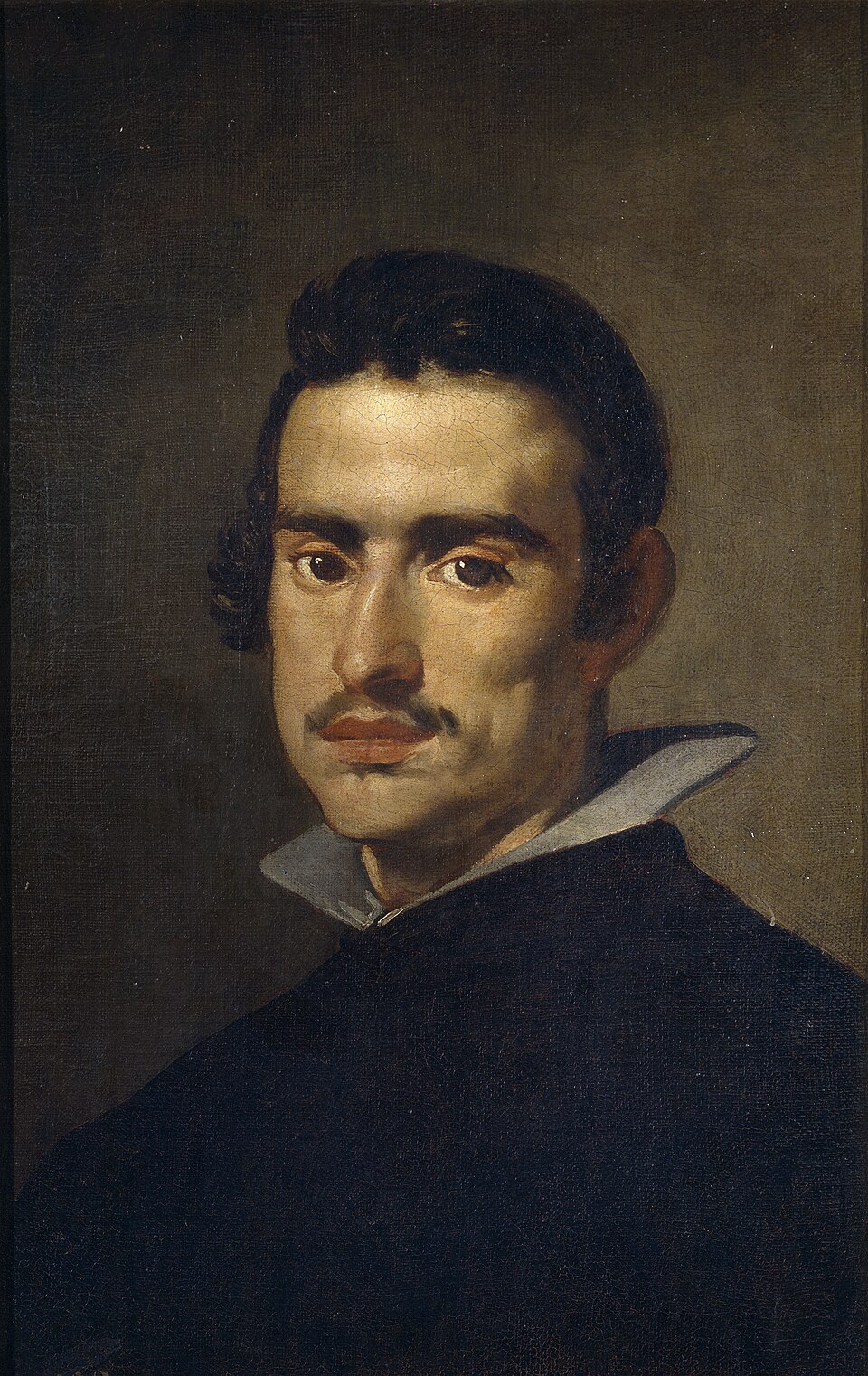
A young man in black with a plain white collar looks straight at us. That collar dates the painting, and his face has been read as Velázquez himself, his brother, or simply an experiment.
The story behind the painting
Diego Velázquez painted this oil on canvas in Madrid around 1623, early in his career, the year he settled there for good. Nothing is known of the painting before it entered the Prado, where it has been since the museum opened in 1819, as part of the legacy of Ferdinand VII's collection. It was not part of the royal collection, perhaps because the sitter had no distinctive features. The key to its date is the collar: this starched, silvery white collar replaced the ruff in Madrid in January 1623, after laws against luxury in clothing, as José López-Rey recalls.
What to look for
The canvas follows portrait conventions: the bust of a young man turned three-quarters, looking out from a neutral background. He is dressed in black with a white collar edged with a border. The colour range is limited to the black of the clothing, dark brown, the pinks and browns of the skin and the greyish white of the collar. Note the touches of light on the nose and eyes and the tiny brushstrokes that shape the lashes, brows and moustache, all typical of Velázquez. X-rays show wider gaps between brushstrokes than are visible on the surface.
Meaning and intent
The face is modelled by patches of light, painted with notable simplicity over the intense red ground typical of Velázquez's Madrid works. Jacinto Octavio Picón and others, including Allende Salazar, August L. Mayer and José Camón Aznar, saw it as a self-portrait, though some of them thought it a copy. López-Rey and Jonathan Brown accept it as by Velázquez but suggest it shows his brother Juan, also a painter in Madrid, because of a likeness to the figure of Saint John at Patmos. The question remains open.
Legacy
Fernando Marías proposed that this and other minor works of the time may have let the painter try out new techniques before applying them to royal portraits. That fits the date: the picture seems to announce the first portraits of Philip IV, to which it is close in style. Carl Justi is reported to have found it rough and hard, though the source marks that remark as doubtful. Small at about 55.5 by 38 cm, it shows a young painter on the threshold of court success.
Lo sapevi?
- Painted in Madrid around 1623.
- Dated by its starched white collar, introduced in Madrid in January 1623.
- Read as a self-portrait or as Velázquez's brother Juan.
- In the Prado since 1819.
L'artista
Diego Velázquez (1599-1660)
portrait · man · Museo del Prado
Altre opere di Diego Velázquez
 Las Meninas - Diego Velázquez (1656)
 The Surrender of Brea - Diego Velázquez (1635)
 Rokeby Venus - Diego Velázquez (1644)
 Las Hilanderas - Diego Velázquez
 Portrait of Innocent X - Diego Velázquez
 Old Woman Cooking Eggs - Diego Velázquez (1618)
 Il pranzo - Diego Velázquez (1617)
 Il trionfo di Bacco - Diego Velázquez (1628)
Dipinti di artisti collegati
 Supper at Emmaus - Caravaggio (1601)
 La vocazione di San Matteo - Caravaggio (1609)
 Saint Francis in Meditation - Francisco de Zurbarán (1639)
 The Immaculate Conception - Francisco de Zurbarán (1661)
 Charles I in Three Positions - Anthony van Dyck (1635)
 Charles I (1600-1649) with M. de St Antoine - Anthony van Dyck (1636)
 The Elevation of the Cross - Peter Paul Rubens (1609)
 The Rape of the Daughters of Leucippus - Peter Paul Rubens (1618)
 The Night Watch - Rembrandt van Rijn (1642)
 Self-Portrait - Rembrandt van Rijn (1659)
 A Militiaman Holding a Berkemeyer, Known as the ‘Merry Drinker’ - Frans Hals (1620s)
 Laughing Cavalier - Frans Hals (1624)