Oloron-Sainte-Marie
Édouard Manet · 1871
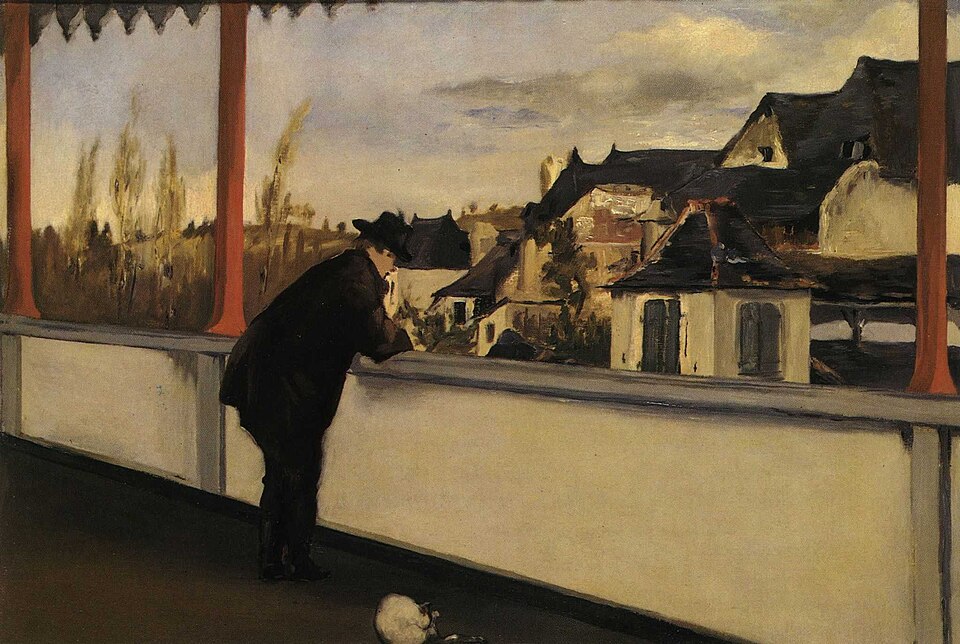
A man in a soft felt hat leans on a white balcony above the river, his back to us, while a cat washes itself beside him. Manet painted this view in his single week in Oloron-Sainte-Marie, at the end of the Franco-Prussian War.
The story behind the painting
The Franco-Prussian War of 1870 to 1871 bled France and forced a change of regime. On 8 September 1870, during the siege of Paris, Manet, then a reserve lieutenant in the artillery, sent his family to safety in Oloron-Sainte-Marie, in the Béarn. His wife Suzanne Leenhoff and her son Léon Koelin-Leenhoff were taken in by a friend, Albert de Lailhacar, at a house he owned, the maison Souviron. On 12 February 1871 Manet joined them. He stayed only a week, long enough to set up a studio and paint this single picture.
What to look for
The painting shows the jumbled slate roofs of Oloron-Sainte-Marie, capital of the Haut-Béarn, seen from what seems to be the top balcony of the maison Souviron, which overhangs the Gave d'Ossau river. A man seen from behind, wearing a soft felt hat, leans on the balustrade, probably watching the water below. Beside him a cat is grooming itself. In the background lies the countryside around the town, with a few poplars pointing up into a cloudy sky. The canvas measures about 42.5 by 62.5 cm.
Meaning and intent
The contrast between the town and its nature and the coolness of the dark-clad figure on his white balcony is quite clear. Who that figure is remains uncertain. According to people close to the painter, it is Léon Koelin-Leenhoff, then nineteen. The Oloron historian Pierre-Louis Giannerini disagreed, writing that the man looks mature, and leaned towards Manet's host, Monsieur Lailhacar. Building on the work of the journalist Adolphe Tabarant, Giannerini also proposed that Manet made other sketches in the town, but their authorship is still debated, and this painting is the only one whose authorship and context are established.
Legacy
The houses Manet painted, reached from today's rue Palassou and rue de la Justice, still look as he saw them, though large trees now block the view of the countryside. The maison Souviron, a clothing business handed down through generations, is said to be one of the oldest shops still active in France. After returning to Paris, Manet is said to have sold the painting to a restaurant owner to whom he owed money. Today it belongs to the Foundation E.G. Bührle Collection and is listed with the Kunsthaus Zürich.
Lo sapevi?
- Painted in February 1871, in Manet's one-week stay in Oloron.
- A view from the balcony of the maison Souviron over the Gave d'Ossau.
- The figure may be Léon Koelin-Leenhoff or the host Albert de Lailhacar.
- Now in the E.G. Bührle Collection, Kunsthaus Zürich.
L'artista
Édouard Manet (1832-1883)
Kunsthaus Zürich · Foundation E.G. Bührle Collection
Altre opere di Édouard Manet
 Luncheon on the Grass - Édouard Manet (1863)
 Olympia - Édouard Manet (1863)
 Un bar ai Folies-Bergère - Édouard Manet (1882)
 Il balcone - Édouard Manet (1868)
 Music in the Tuileries - Édouard Manet (1862)
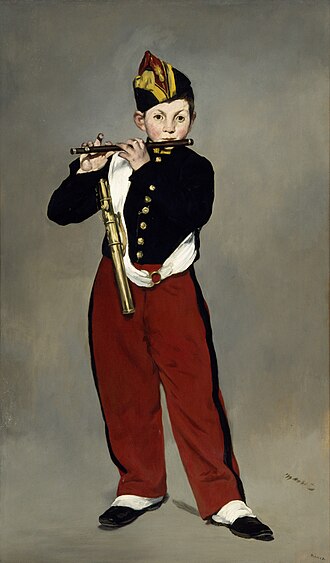 The Fif - Édouard Manet (1866)
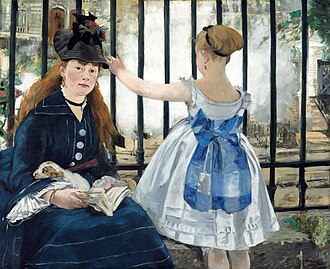 The Railway - Édouard Manet (1873)
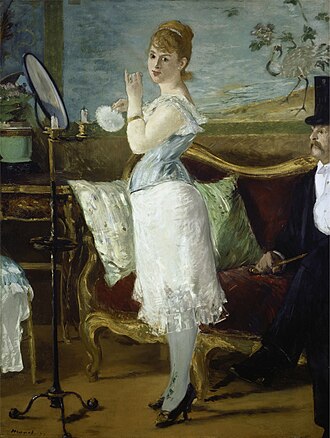 Nana - Édouard Manet (1877)
Dipinti di artisti collegati
 Impression, Sunrise - Claude Monet (1872)
 Water Lilies - Claude Monet (1906)
 Dance at Le Moulin de la Galette - Pierre-Auguste Renoir (1876)
 Luncheon of the Boating Party - Pierre-Auguste Renoir (1881)
 The Cradle - Berthe Morisot (1872)
 Summer's Day - Berthe Morisot (1879)
 L'Absinthe - Edgar Degas (1875)
 The Bellelli Family - Edgar Degas (1858)
 The Canal du Loing at Moret - Alfred Sisley (1892)
 The Watering Pond at Marly with Hoarfrost - Alfred Sisley (1876)
 Paris Street; Rainy Day - Gustave Caillebotte (1877)
 Les raboteurs de parquet - Gustave Caillebotte (1875)