Un bar ai Folies-Bergère
Édouard Manet · 1882
%20(33539037428).jpg)
A young barmaid looks straight out at you, surrounded by bottles, oranges and the glittering crowd of Paris. But look at the mirror behind her: the reflection does not seem to obey the rules, and that puzzle is exactly the point.
The story behind the painting
A Bar at the Folies-Bergère is considered Édouard Manet's last major work. He painted it in 1882 and showed it at the Paris Salon that same year. The Folies-Bergère was one of the most famous nightspots of Paris, a place of music, acrobats and crowds in evening dress. Rather than paint the scene on the spot, Manet brought a real employee of the venue into his studio: a young woman known as Suzon, who worked at the Folies-Bergère in the early 1880s, posed behind a counter he arranged there. A preliminary study shows that he first placed her off to the right, then moved her to the very centre of the canvas. The finished picture first belonged to the composer Emmanuel Chabrier, a close friend of Manet, who hung it above his piano.
What to look for
Start with the woman. She stands square and calm at the marble counter, her gaze turned toward the viewer, yet her expression seems withdrawn and far away. Behind her runs the gold frame of an enormous mirror that stretches across the whole width of the picture, and in it the hall dissolves into a shimmer of lights, faces and balconies. Now find the details a hurried visitor misses. In the upper left corner, a pair of green feet dangles into view: a trapeze artist performing above the crowd. On the counter stand bottles marked with a red triangle, the label of Bass Pale Ale, beside a glass dish of oranges. Finally, look to the right edge, where her reflection appears to lean toward a man in a top hat, a meeting that seems impossible from where we stand.
Meaning and intent
For more than a century critics argued that Manet had simply got the perspective wrong. In 2000 the art historian Malcolm Park staged a reconstruction showing the scene is physically possible if the viewer stands to the right and close to the bar; in that reading, the man is outside our field of vision and is not even facing her. The mirror becomes the heart of the painting, and many interpreters have compared it to Las Meninas by Velázquez, a painter Manet admired. In the reflection the barmaid seems engaged with a customer; face on, she is guarded and remote. Some historians, such as T. J. Clark and Larry L. Ligo, read details like the oranges as signs that she is presented as both seller and commodity. Even the British beer has been read as a quiet echo of anti-German feeling in France after the Franco-Prussian War.
Legacy
The painting is now one of the treasures of the Courtauld Gallery in London. Its puzzles have kept it alive in scholarship ever since, with the philosopher Michel Foucault among those drawn to its play of mirrors and gazes. It has also travelled far beyond the museum. In 1934 Ninette de Valois choreographed a ballet, Bar aux Folies-Bergère, set to Chabrier's music and built around the painting. The Australian artist John Brack answered it with The Bar of 1954, a bleak Melbourne scene, and the Canadian photographer Jeff Wall referred to it in Picture for Women of 1979. Even the 1988 film Coming to America included a playful spoof of it. It endures because it asks a modern question: what does it feel like to be looked at all night, in the middle of the crowd?
Lo sapevi?
- The woman at the bar was a real employee of the Folies-Bergère, known as Suzon, who posed for Manet in his studio.
- The green feet in the upper left corner belong to a trapeze artist performing above the audience.
- The beer bottles can be identified as Bass Pale Ale by the red triangle on their labels.
- The painting first hung above the piano of the composer Emmanuel Chabrier, Manet's friend.
L'artista
Édouard Manet (1832-1883)
woman · portrait · Impressionism · Courtauld Gallery · Courtauld Institute of Art · gaze towards the viewer
Altre opere di Édouard Manet
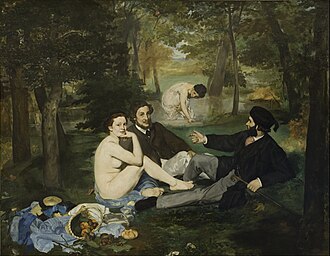 Luncheon on the Grass - Édouard Manet (1863)
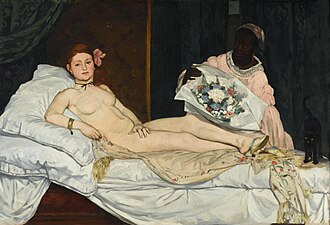 Olympia - Édouard Manet (1863)
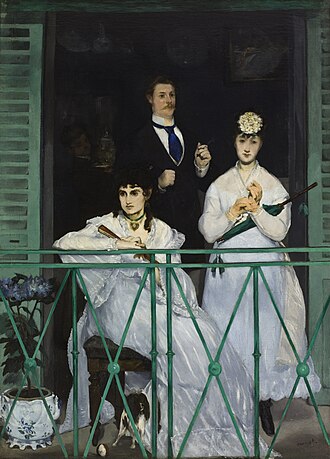 Il balcone - Édouard Manet (1868)
.jpg) Music in the Tuileries - Édouard Manet (1862)
Music in the Tuileries - Édouard Manet (1862).jpg) The Fif - Édouard Manet (1866)
The Fif - Édouard Manet (1866)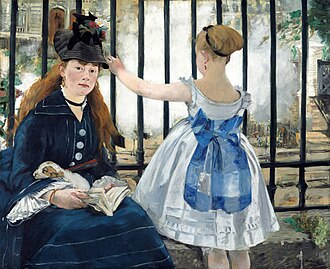 The Railway - Édouard Manet (1873)
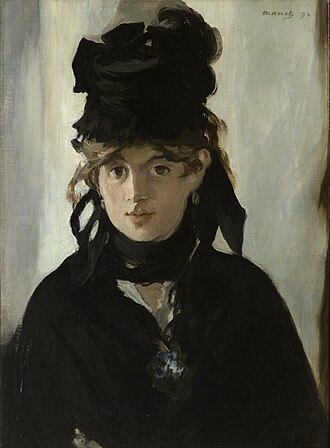 Berthe Morisot with a Bouquet of Violets - Édouard Manet (1872)
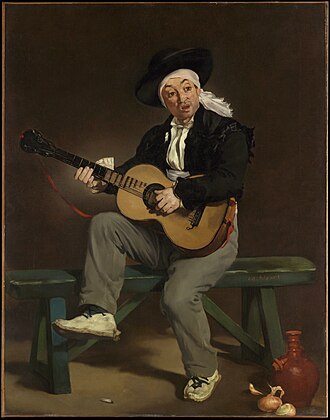 The Spanish Singer - Édouard Manet (1860)
Dipinti di artisti collegati
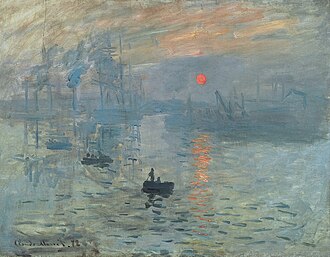 Impression, Sunrise - Claude Monet (1872)
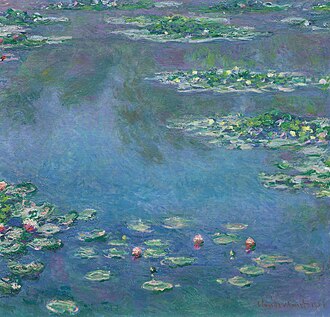 Water Lilies - Claude Monet (1906)
 Dance at Le Moulin de la Galette - Pierre-Auguste Renoir (1876)
 Luncheon of the Boating Party - Pierre-Auguste Renoir (1881)
 The Starry Night - Vincent van Gogh (1889)
.jpg) Café Terrace at Night - Vincent van Gogh (1888)
Café Terrace at Night - Vincent van Gogh (1888)