Madame Georges Charpentier and her Children
Pierre-Auguste Renoir · 1878
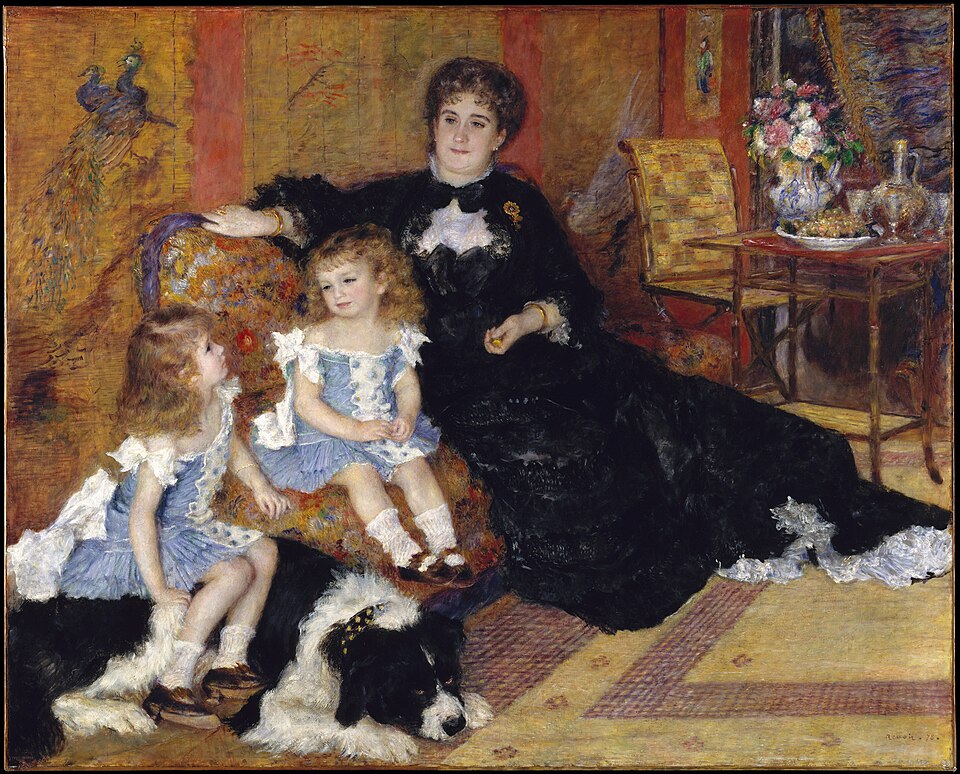
A mother in black silk smiles at two small children in matching blue, while a big Newfoundland dog lies patiently under one of them. Renoir's portrait of his patrons' family went to the Salon of 1879 and later crossed the ocean to New York.
The story behind the painting
The publisher Georges Charpentier, patron of naturalist writers such as Émile Zola, was an early collector of Impressionist painting. He married Marguerite Lemonnier in 1871. After buying works by Renoir in 1875, he was introduced to him by Zola. By 1876 the couple held famous Friday salons at their home on the rue de Grenelle, while Renoir, Monet and Sisley wrote to them asking for financial help. From 1876 to 1879 the Charpentiers were Renoir's main patrons. Earlier portraits of Madame Charpentier and of Georgette, shown in 1877, were well received and led to this larger commission. Renoir painted it from September to October 1878.
What to look for
Madame Charpentier sits with her children in a private sitting room next to her bedroom, decorated with colourful Japanese art and bamboo. She wears a black dress with lace, made by the House of Worth, fit for receiving guests even in this intimate space. She smiles at her children, who wear matching blue dresses and hairstyles, as was the custom in France until about four or five. Her arm is around her son Paul, on the sofa, while Georgette sits on Porthos, the family's Newfoundland dog, whose black and white fur repeats the contrast of her mother's dress. The signature Renoir 78 is in the lower right corner.
Meaning and intent
The painting places the family in its world. Kathleen Adler of the National Gallery writes that Renoir's portraits of women often include references to a setting that positions them in terms of wealth and status, and here the Japanese decor and the fashionable gown do that work. At the same time the picture is warm and domestic: a mother watching her children, a dog lying still. It also shows a friendship between a painter in need and the family who supported him. According to Charpentier's youngest daughter, Madame Dubar, it was Renoir who persuaded him to take on this second commission.
Legacy
The painting was shown at the Salon of 1879 and later in Brussels in 1886 and 1904, at the Georges Petit gallery in Paris in 1886, and by Renoir in 1892 and 1900. Léonce Bénédite called it one of Renoir's best works and regretted that it ever left France. After Marguerite died in 1904 and Georges in 1905, their daughters sold the collection. The dealer Paul Durand-Ruel persuaded Roger Fry, then curator of paintings at the Metropolitan Museum of Art, to buy it for the museum, and it entered the Met in April 1907.
Lo sapevi?
- Painted by Pierre-Auguste Renoir in September-October 1878.
- Shows Marguerite Charpentier with her children Georgette and Paul.
- Shown at the Paris Salon of 1879.
- In the Metropolitan Museum of Art since 1907.
L'artista
Pierre-Auguste Renoir (1841-1919)
genre art · boy · Metropolitan Museum of Art · sitting · mother · girl · family portrait · family
Altre opere di Pierre-Auguste Renoir
 Dance at Le Moulin de la Galette - Pierre-Auguste Renoir (1876)
 Luncheon of the Boating Party - Pierre-Auguste Renoir (1881)
 La Balançoire - Pierre-Auguste Renoir (1876)
 The Great Bathers - Pierre-Auguste Renoir (1884)
 Girls at the Piano - Pierre-Auguste Renoir (1892)
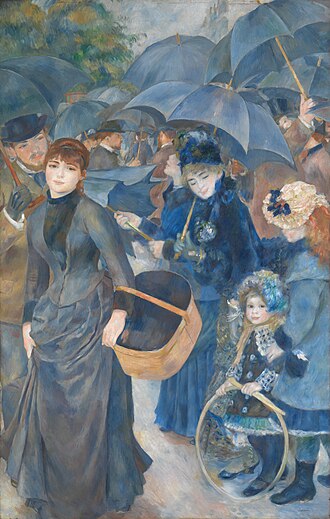 The Umbrellas - Pierre-Auguste Renoir (1880s)
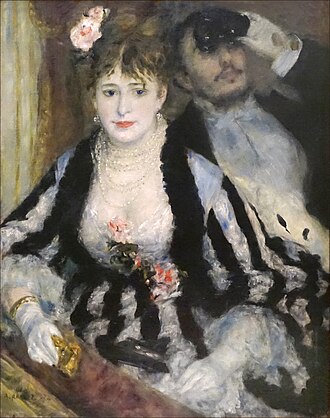 La loge - Pierre-Auguste Renoir (1874)
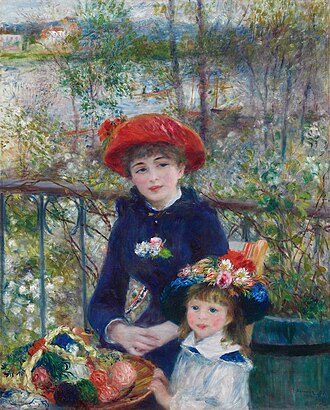 Two Sisters - Pierre-Auguste Renoir (1881)
Dipinti di artisti collegati
 Impression, Sunrise - Claude Monet (1872)
 Water Lilies - Claude Monet (1906)
 Luncheon on the Grass - Édouard Manet (1863)
 Olympia - Édouard Manet (1863)
 The Cradle - Berthe Morisot (1872)
 Summer's Day - Berthe Morisot (1879)
 L'Absinthe - Edgar Degas (1875)
 The Bellelli Family - Edgar Degas (1858)
 The Canal du Loing at Moret - Alfred Sisley (1892)
 The Watering Pond at Marly with Hoarfrost - Alfred Sisley (1876)
 Paris Street; Rainy Day - Gustave Caillebotte (1877)
 Les raboteurs de parquet - Gustave Caillebotte (1875)