Luncheon in the Studio
Édouard Manet · 1868
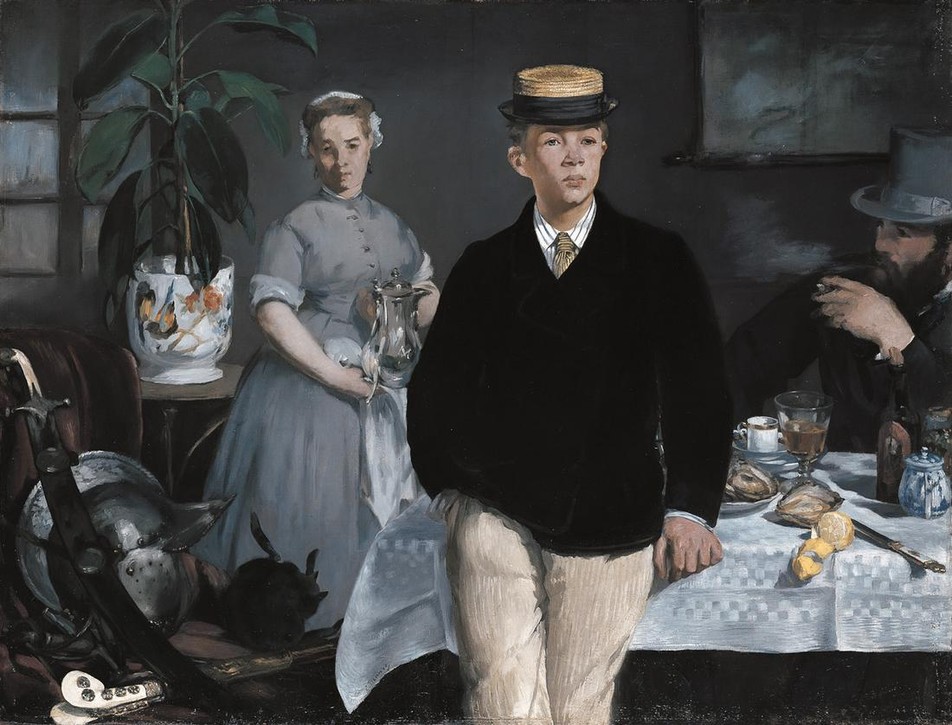
A sixteen-year-old in a straw hat leans against a table, his back to the meal, gazing past us. Behind him lie oysters, a peeled lemon, a black cat and, oddly, a suit of armour.
The story behind the painting
In the summer of 1868 Édouard Manet spent his holiday in Boulogne-sur-Mer, and there he painted Luncheon in the Studio, posed in the dining room of his rented house. Its central figure is the sixteen-year-old Léon Leenhoff, son of Suzanne Leenhoff before her 1863 marriage to Manet, and possibly the son of Manet or of Manet's father Auguste. The painting, about 118.3 by 154 cm, belongs to the Bavarian State Painting Collections in Munich. Critic Nan Stalnaker calls it brilliantly painted and a major Manet work, despite questions about its meaning.
What to look for
Léon stands in front, his back to the table. Behind him a man smokes a cigar with coffee and a digestif, and a servant woman gazes toward the viewer. In a muted scheme, the yellow of Léon's tie, trousers and straw hat echoes the lemon on the table. The table holds a peeled lemon, oysters, a Delft sugar bowl and a knife jutting over the edge. A black cat sits on a chair. In the bottom left corner lie a helmet and swords, an armour that seems out of place in a dining room.
Meaning and intent
The figures were once identified as Léon's mother and Manet himself; today the man is considered anonymous, though he resembles Manet, and the woman a servant. Jeffrey Meyers suggests they may still stand symbolically for Suzanne and Édouard. Michael Fried sees echoes of Vermeer and of Chardin's still life The Ray, and the black cat is very likely a reference to Baudelaire, who had died the year before. Ross King describes the armour as symbols of masculine bravery turned into cast-off props.
Legacy
The painting was shown at the Salon of 1869 together with The Balcony, and both were found wanting. Jules-Antoine Castagnary complained that the oysters and lemon did not belong together and that the young man's position made no sense; Marius Chaumelin said the figures seemed only to say "Look at me!" What those critics saw as arbitrary is now part of the work's fascination. Its unsolved questions are exactly why viewers keep returning to it.
Lo sapevi?
- Painted in summer 1868 at Boulogne-sur-Mer.
- Exhibited at the 1869 Paris Salon with The Balcony.
- Bavarian State Painting Collections, Munich.
- Size: 118.3 x 154 cm (Wikidata).
L'artista
Édouard Manet (1832-1883)
genre art · Impressionism · table · Bavarian State Painting Collections · body armor · tablecloth · top hat
Altre opere di Édouard Manet
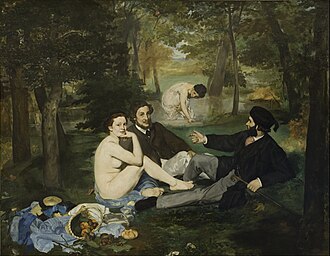 Luncheon on the Grass - Édouard Manet (1863)
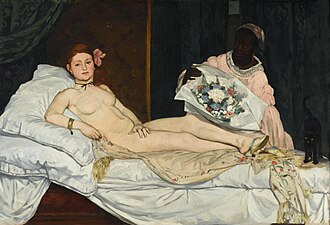 Olympia - Édouard Manet (1863)
%20(33539037428).jpg) Un bar ai Folies-Bergère - Édouard Manet (1882)
Un bar ai Folies-Bergère - Édouard Manet (1882)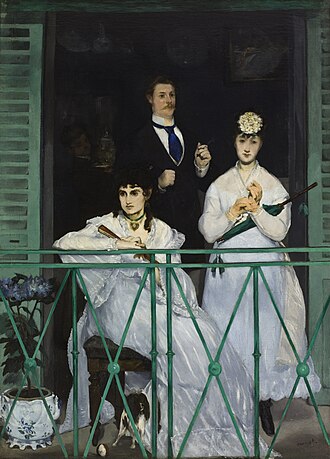 Il balcone - Édouard Manet (1868)
.jpg) Music in the Tuileries - Édouard Manet (1862)
Music in the Tuileries - Édouard Manet (1862).jpg) The Fif - Édouard Manet (1866)
The Fif - Édouard Manet (1866)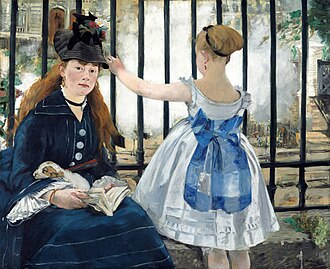 The Railway - Édouard Manet (1873)
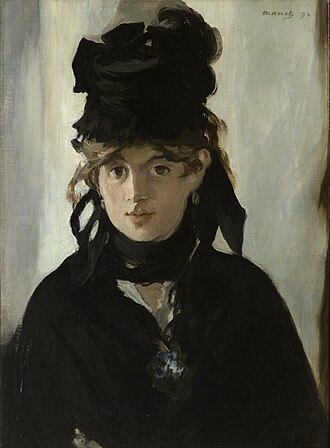 Berthe Morisot with a Bouquet of Violets - Édouard Manet (1872)
Dipinti di artisti collegati
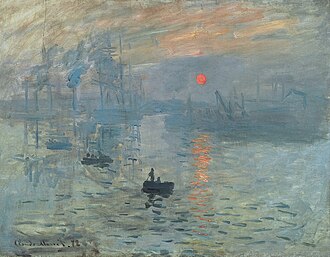 Impression, Sunrise - Claude Monet (1872)
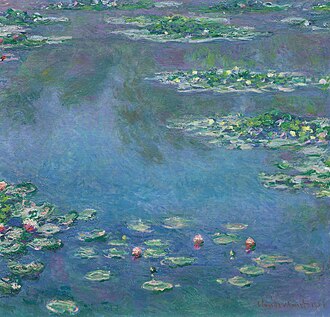 Water Lilies - Claude Monet (1906)
 Dance at Le Moulin de la Galette - Pierre-Auguste Renoir (1876)
 Luncheon of the Boating Party - Pierre-Auguste Renoir (1881)
 The Starry Night - Vincent van Gogh (1889)
.jpg) Café Terrace at Night - Vincent van Gogh (1888)
Café Terrace at Night - Vincent van Gogh (1888) The Fighting Temeraire - J. M. W. Turner (1839)
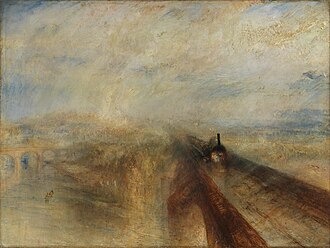 Rain, Steam and Speed - The Great Western Railway - J. M. W. Turner (1844)
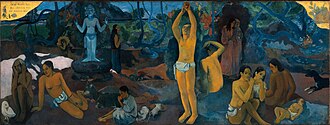 Where Do We Come From? What Are We? Where Are We Going? - Paul Gauguin (1897-1898)
%201889.jpg) Cristo giallo - Paul Gauguin (1889)
Cristo giallo - Paul Gauguin (1889)