La actriz María Guerrero como «La dama boba»
Joaquín Sorolla · 1906
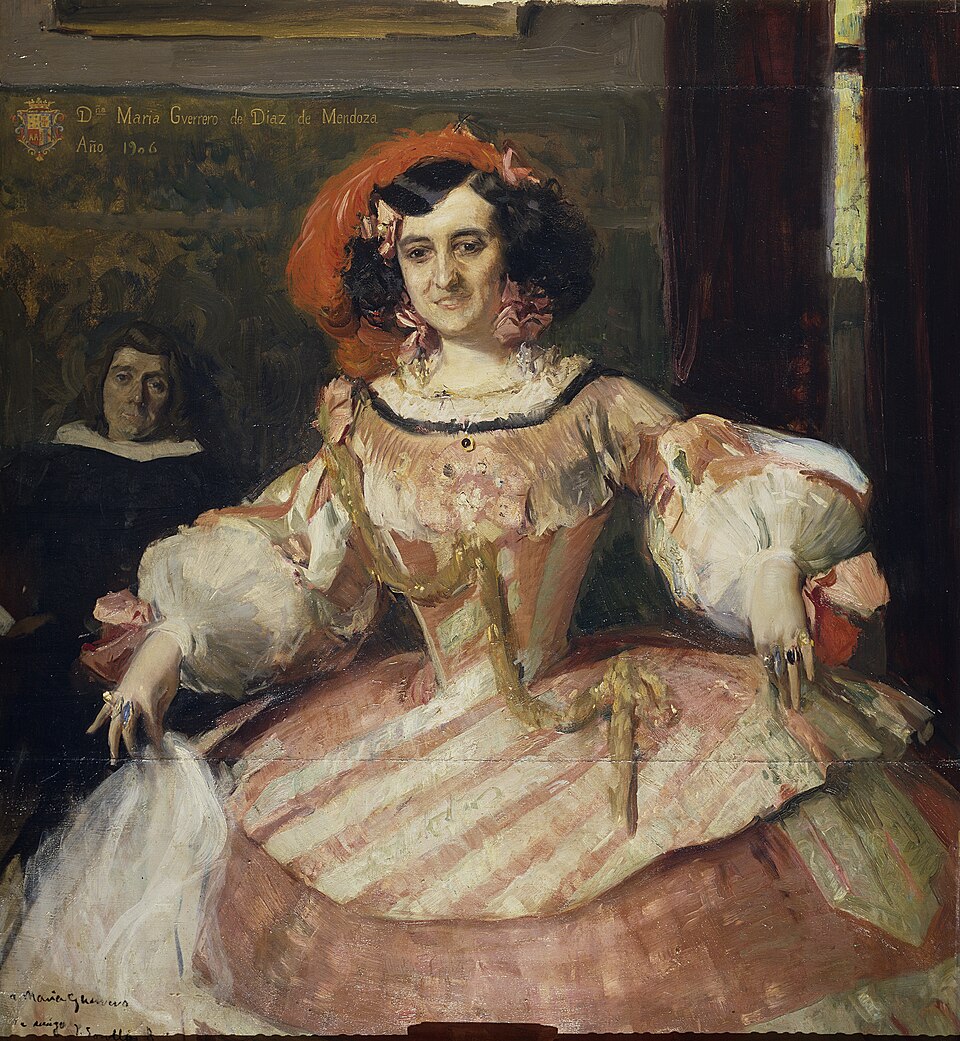
A great Spanish actress, dressed for a comedy by Lope de Vega, smiles out of a canvas painted by her friend. Sorolla began it in 1897 and came back years later to make it larger and to change her serious face into a happier one.
The story behind the painting
Although the canvas is dated 1906, Sorolla actually composed it in 1897 in a smaller format. Years later he enlarged it by adding two horizontal bands of canvas, and he changed the actress's serious expression into a more cheerful one. In the upper left corner he added the new date with the inscription Doña María de Guerrero de Mendoza, 1906. In the lower left corner he dedicated the picture to her as her friend. So the portrait carries two moments of one friendship, almost ten years apart.
What to look for
María Guerrero appears at 39, at the best moment of her career, as Finea, the heroine of Lope de Vega's comedy La dama boba. Look at her costume, typical of that earlier age, and especially the wide hooped skirt, the guardainfante. Behind her, in the depth of the interior, you can see her husband, also dressed for the play. The surface is alive with carmines, whites and pinks, laid on with a free, loose and thick brushstroke. The canvas measures about 131 by 120.5 cm.
Meaning and intent
The old costume gave Sorolla a way to pay tribute to Velázquez, a homage that the source finds most visible in the hooped skirt and in the atmosphere of the room. Yet the result is not a pastiche. The variety of colour and the quick, loaded brushwork give the painting a surprising modernity, and that is why it is counted among Sorolla's finest works. It is a portrait of an actress inside her role, with her real husband on the same stage behind her.
Legacy
The painting stayed with the actress's descendants until 27 February 1933, when her son, Carlos Díaz de Mendoza, sold it to the Museo de Arte Moderno in Madrid. It remained there until that museum ceased to exist in 1971, and then it passed into the collections of the Museo del Prado, where it is kept today. The dedication to his friend still sits in the corner, a small reminder that this was first a gift between people who knew each other well.
Lo sapevi?
- Composed in 1897, enlarged and dated 1906.
- Shows María Guerrero as Finea in Lope de Vega's La dama boba.
- Her husband appears in the background, dressed for the play.
- In the Museo del Prado since 1971.
L'artista
Joaquín Sorolla (1863-1923)
portrait · Museo del Prado · Post-impressionism
Altre opere di Joaquín Sorolla
 Walk on the mountain - Joaquín Sorolla (1909)
 Sad Inheritance - Joaquín Sorolla (1898)
 Chicos en la playa - Joaquín Sorolla (1910)
 White slave trade - Joaquín Sorolla (1894)
 And They Still Say Fish is Expensive! - Joaquín Sorolla (1894)
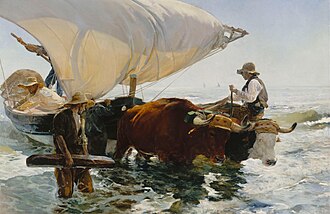 The Return from Fishing - Joaquín Sorolla (1894)
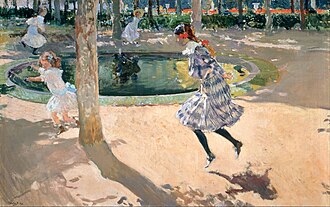 The Skipping Rope - Joaquín Sorolla (1911)
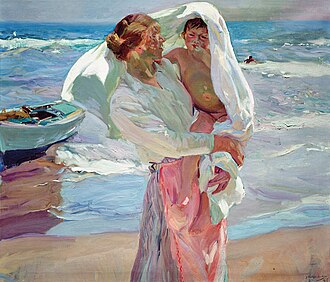 After Bathing - Joaquín Sorolla (1915)
Dipinti di artisti collegati
 The Starry Night - Vincent van Gogh (1889)
 Café Terrace at Night - Vincent van Gogh (1888)
 Where Do We Come From? What Are We? Where Are We Going? - Paul Gauguin (1897-1898)
 Cristo giallo - Paul Gauguin (1889)
 Les Grandes Baigneuses - Paul Cézanne (1900s)
 The Boy in the Red Vest - Paul Cézanne
 Dance at Le Moulin de la Galette - Pierre-Auguste Renoir (1876)
 Luncheon of the Boating Party - Pierre-Auguste Renoir (1881)
 At the Moulin Rouge - Henri de Toulouse-Lautrec (1892)
 La Toilette - Henri de Toulouse-Lautrec (1896)