Jael and Sisera
Artemisia Gentileschi · 1620
%20-%20Artemisia%20Gentileschi%20(Museum%20of%20Fine%20Arts%2C%20Budapest).jpg)
A woman in gold kneels over a sleeping general, hammer raised, a tent peg against his temple. Artemisia Gentileschi carved her name and the year 1620 into the stone beside them, proud of what she had made.
The story behind the painting
The scene comes from the Book of Judges. Sisera, a defeated Canaanite general, flees after his defeat by the Israelites and is taken in by the Kenite woman Jael, who promises to feed and hide him. As soon as he falls asleep she drives a tent peg through his temple, an act the biblical text praises as courage. Artemisia painted it around 1620. The date places her in Rome, yet she signed as Artemisia Lomi, the surname she used in Florence to stress her link to her uncle Aurelio, which suggests a Florentine patron. Beyond that clue, who ordered the painting is unknown.
What to look for
Look first at the colours: Jael's golden gown stands out against Sisera's red and blue clothes, and the gold is thought to signal her virtue and coming victory. Historians think Artemisia knew a version by the Florentine Ludovico Cigoli, but where his figures are pressed together she keeps the two bodies clearly apart. Then find the pillar. A three-line signature is carved into it, ARETEMITA LOMI, FACIBAT, MDCXX, and Jael's slightly awkward right hand seems placed to lead the eye there. It is the first time Artemisia used the Latin form facibat, perhaps echoing the way Michelangelo signed his Pieta.
Meaning and intent
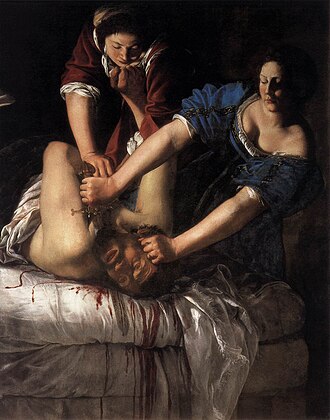
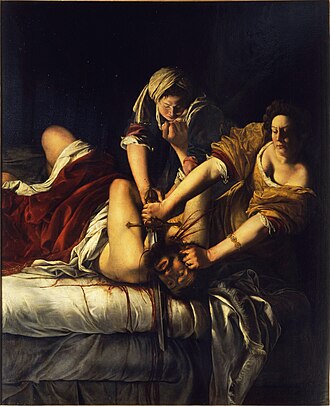
In the Middle Ages Jael was shown alongside Judith, the virtue Humility and the Virgin Mary, and her story appears in fourteenth-century manuscripts of the Speculum Humanae Salvationis. Artemisia and painters of her generation made many images of strong women, including Judith beheading Holofernes. Her teacher Agostino Tassi was also convicted of raping her, and he is said to have modelled for Holofernes; the source notes that Sisera bears a striking resemblance to both. The prominent signature suggests that this was a work she was proud of.
Legacy
The painting was first recorded in the imperial collection in Vienna in 1781, when it was moved to Bratislava Castle, and three years later it went to the Royal Palace in Buda, from where it may have been dispersed in 1856. It reappeared at auction in Budapest in 1974 and now hangs in the Museum of Fine Arts, Budapest. In 1978 Veronika Ember restored it, repairing heavy paint loss in the upper left and lower right corners. Some restored shadows look more mechanical than Artemisia's own hand, but the signature survived intact.
Lo sapevi?
- Signed and dated 1620 on the pillar.
- Signed Artemisia Lomi, the name she used in Florence.
- Restored in 1978 after paint loss in two corners.
- Now in the Museum of Fine Arts, Budapest.
L'artista
Artemisia Gentileschi (1593-1653)
religious art · woman · man · Museum of Fine Arts, Budapest
Altre opere di Artemisia Gentileschi
 Judith Slaying Holofernes - Artemisia Gentileschi (1613)
 Judith and Her Maidservant - Artemisia Gentileschi (1618)
%2C%20Artemisia%20GentileschiFXD.jpg) Susanna and the Elders - Artemisia Gentileschi (1610)
Susanna and the Elders - Artemisia Gentileschi (1610)%20-%20Artemisia%20Gentileschi.jpg) Self-Portrait as the Allegory of Painting - Artemisia Gentileschi (1638)
Self-Portrait as the Allegory of Painting - Artemisia Gentileschi (1638) Allegory of Inclination - Artemisia Gentileschi (1615)
 Danaë - Artemisia Gentileschi (1612)
 Judith Beheading Holofernes - Artemisia Gentileschi (1620)
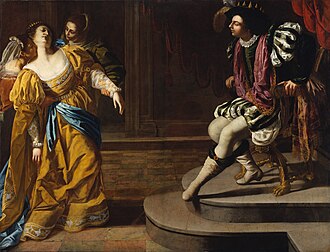 Esther before Ahasuerus - Artemisia Gentileschi (1620s)