Fort Vimieux
J. M. W. Turner · 1831
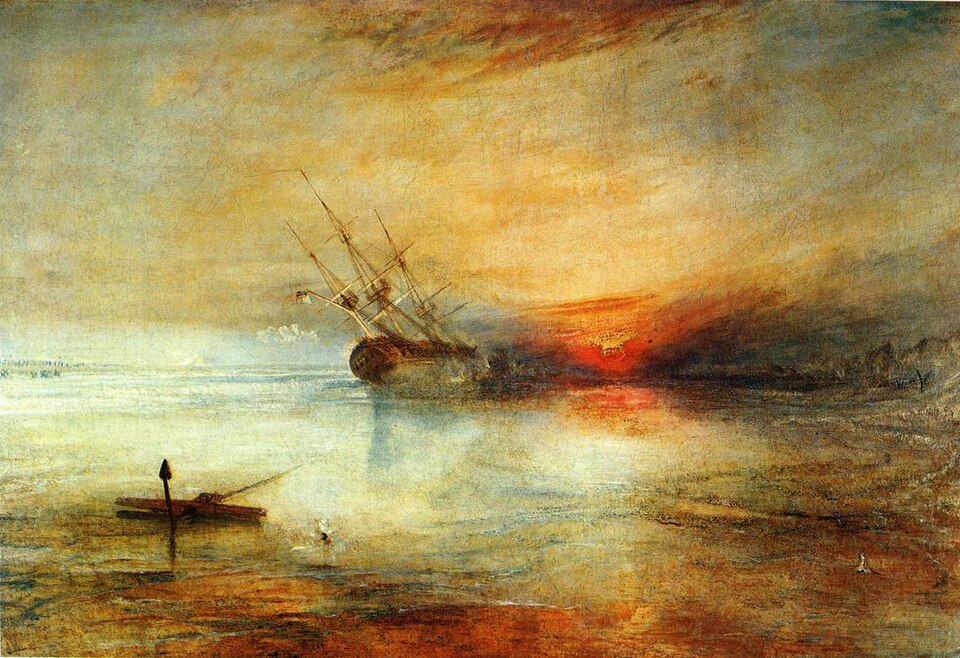
An English warship lies stranded on its side under French guns, waiting for the tide, while the setting sun burns red behind it. Turner turned a small episode of the Napoleonic wars into a study of light.
The story behind the painting
J. M. W. Turner painted this canvas in 1831 after a stay in France, where he had gone for a project on the great rivers. He had already sketched the coast and the fort in his sketchbook in 1829. The episode he chose dates from 1805, when Napoleon gathered a large flotilla on the French coast to invade England. An English reconnaissance squadron approached the fort of Vimereux, in fact at Wimereux, to tempt the French ships out of their shelter. One English ship was hit by the French batteries and ran aground.
What to look for
The picture shows the English ship lying on its side, lit by the setting sun, stranded and waiting for the tide to float it off again. Contemporary admirers singled out the light, the overall effect and the bright red of the sunset. Wikidata records the canvas at about 71 by 107 cm. The fort itself, which Turner had drawn on the spot two years earlier, sits on the shore from which the guns fired. Rather than the heat of battle, the scene captures the pause after the damage, as the warm evening light falls across the stricken hull.
Meaning and intent
According to the French Wikipedia article, Turner shows in this canvas his love of the sea, which he had always known, his taste for marine painting and his full mastery of light. A military incident from a war more than twenty years in the past becomes an occasion for colour and atmosphere: the danger of the ship and the beauty of the sunset are held in the same frame. The stranded vessel, helpless until the water returns, gives the calm evening a quiet tension that runs beneath the glow.
Legacy
The painting was judged admirable and received an enthusiastic welcome at its first showing at the Royal Academy in London in 1831, as number 406. Turner kept it until around 1845, when it passed to Charles Meigh of Grove House in Shelton, Staffordshire, who passed it in 1850 to Colonel James Lenox. It became the property of the New York Public Library, which parted with it in 1956. It appeared at Sotheby's in 2004 and is again in a private collection. It has been exhibited in Boston, Toronto, Ottawa, Indianapolis, London, Canberra and Melbourne.
Lo sapevi?
- Painted in 1831 from sketches made in France in 1829.
- Shows an English ship stranded under French guns in 1805.
- First shown at the Royal Academy in 1831 to warm praise.
- Once owned by the New York Public Library; now in a private collection.
L'artista
J. M. W. Turner (1775-1851)
Altre opere di J. M. W. Turner
 The Fighting Temeraire - J. M. W. Turner (1839)
 Rain, Steam and Speed - The Great Western Railway - J. M. W. Turner (1844)
 The Slave Ship - J. M. W. Turner (1840)
 Dido building Carthage - J. M. W. Turner (1815)
 The Battle of Trafalgar - J. M. W. Turner (1820s)
 Fishermen at Sea - J. M. W. Turner (1796)
 Snow Storm: Hannibal and his Army Crossing the Alps - J. M. W. Turner (1812)
 Dolbadarn Castle - J. M. W. Turner (1800)
Dipinti di artisti collegati
 The Ladies Waldegrave - Joshua Reynolds (1780)
 Captain George K. H. Coussmaker - Joshua Reynolds (1782)
 Impression, Sunrise - Claude Monet (1872)
 Water Lilies - Claude Monet (1906)
 The Third of May 1808 - Francisco Goya (1814)
 La maja nuda - Francisco Goya (1800)
 Wanderer above the Sea of Fog - Caspar David Friedrich (c. 1818)
 The Abbey in the Oakwood - Caspar David Friedrich (1800s)
 Liberty Leading the People - Eugène Delacroix (1830)
 Death of Sardanapalus - Eugène Delacroix (1827)
 The Blue Boy - Thomas Gainsborough (1770)
 Mr and Mrs Andrews - Thomas Gainsborough (1748)