Boniface VIII declaring the Jubilee Year of 1300
Giotto · 1300
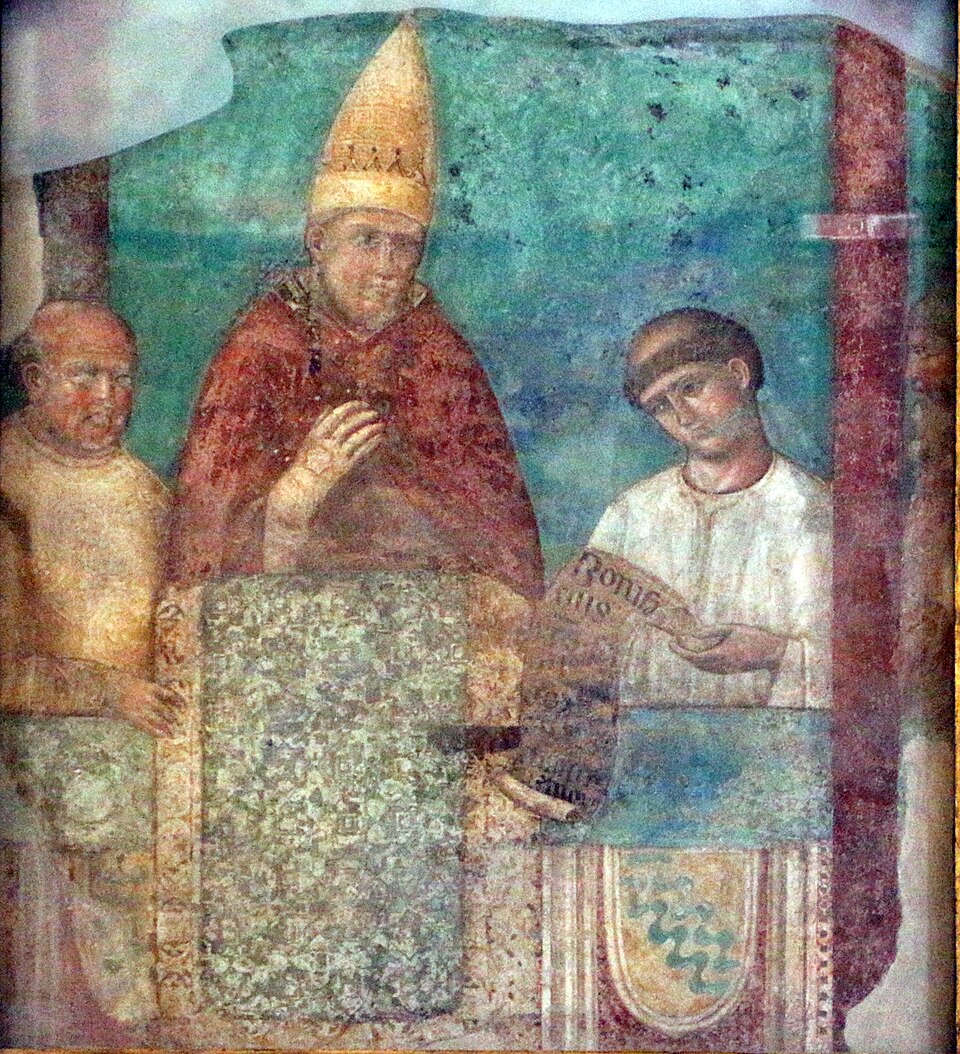
A pope blesses the crowd from a loggia in the jubilee year 1300. Only a damaged fragment of this fresco survives in the Lateran, and for centuries people argued whether Cimabue, Giotto or an assistant painted it.
The story behind the painting
The fragment is attributed to Giotto and dates from around 1300, the year of the first Jubilee. It originally decorated the loggia known as the thalamus or pulpit of Boniface, which Pope Boniface VIII built in front of the palace attached to the Lateran. In 1570 Giacomo Pavinio recalled that the scene belonged to a cycle that also showed the Baptism of Constantine and the building of the Lateran Basilica. The commission for the paintings broke up at the pope's death, a point almost all scholars accept, with the exception of Meiss in 1960.
What to look for
What survives is a fragment of a much larger fresco. A copy by Jacopo Grimaldi, in a manuscript at the Biblioteca Ambrosiana, lets us reconstruct the whole. It showed Boniface VIII during the celebrations of the Jubilee of 1300, blessing the crowd from the loggia of the Lateran Basilica, flanked by a cleric and a cardinal, perhaps Francesco Caetani. Outside the papal canopy stood many other prelates in two symmetrical groups to the right and left. Look at the fragment knowing it was once the centre of that wide, ordered scene.
Meaning and intent
The composition was probably inspired by the chariot race prize-giving carved on the Obelisk of Theodosius in Constantinople, which Giotto could have known from a copy then in Rome. The pope appears as a ruler presenting himself to his people from a high balcony, at the moment of a great public celebration. The authorship has long been debated: writers of the 16th and 17th centuries named Cimabue (Pavinio, Sanctorius) or Giotto (Chacón), or both (Rasponi), and Vasari in 1550 spoke of a portrait of Boniface at the Lateran by Giottino.
Legacy
When the loggia was demolished in 1586, the central part of the fresco was cut out and moved to the cloister. Two centuries later it was brought inside the basilica, where, on behalf of the Caetani family, it was placed in a chapel against a pillar. Later scholarship reaffirmed the direct link with Giotto. In 1952 the fragment was restored and freed of many repaintings, but its poor condition still prevents a full judgement, which wavers between the master and one of his assistants. It remains in the Archbasilica of St. John Lateran in Rome.
Lo sapevi?
- Fragment of a fresco from around 1300.
- Originally in the loggia of Boniface VIII at the Lateran.
- Cut out when the loggia was demolished in 1586.
- Restored in 1952; attribution still split between Giotto and an assistant.
L'artista
Giotto (1267-1337)
Altre opere di Giotto
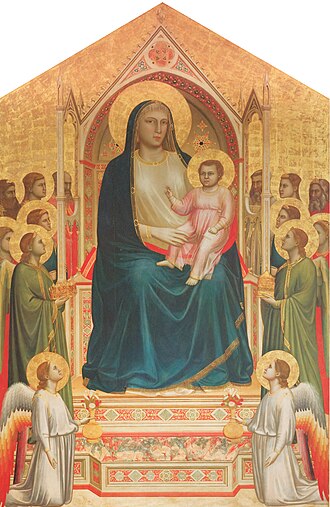 Madonna Enthroned - Giotto (1300s)
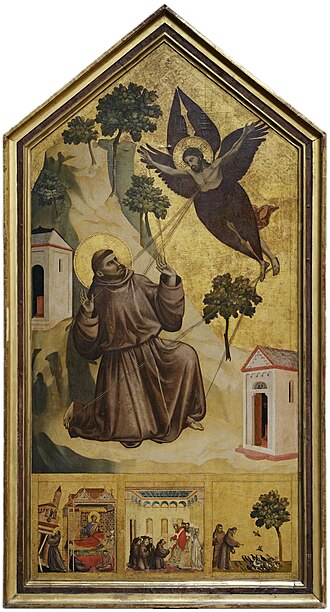 St. Francis of Assisi Receiving the Stigmata - Giotto (1290s)
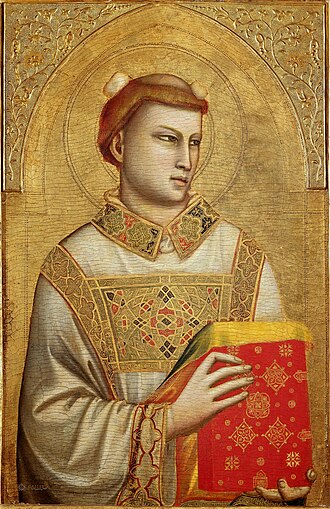 Saint Stephen - Giotto (1320)
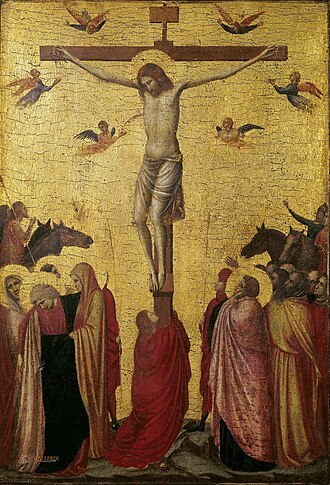 Crucifixion of Strasbourg - Giotto (1315)
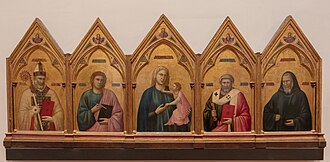 Badia Polyptych - Giotto (1300s)
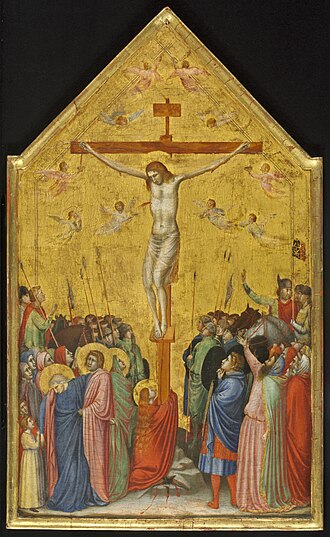 The Crucifixion of Christ - Giotto (1310s)
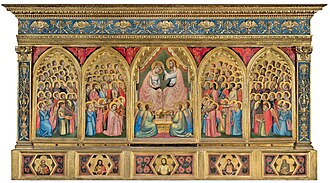 Coronation of Mary with Angels and Saints - Giotto (1328)
 Scenes from the New Testament: Lamentation - Giotto (1291)