Bologna Polyptych
Giotto · 1330s
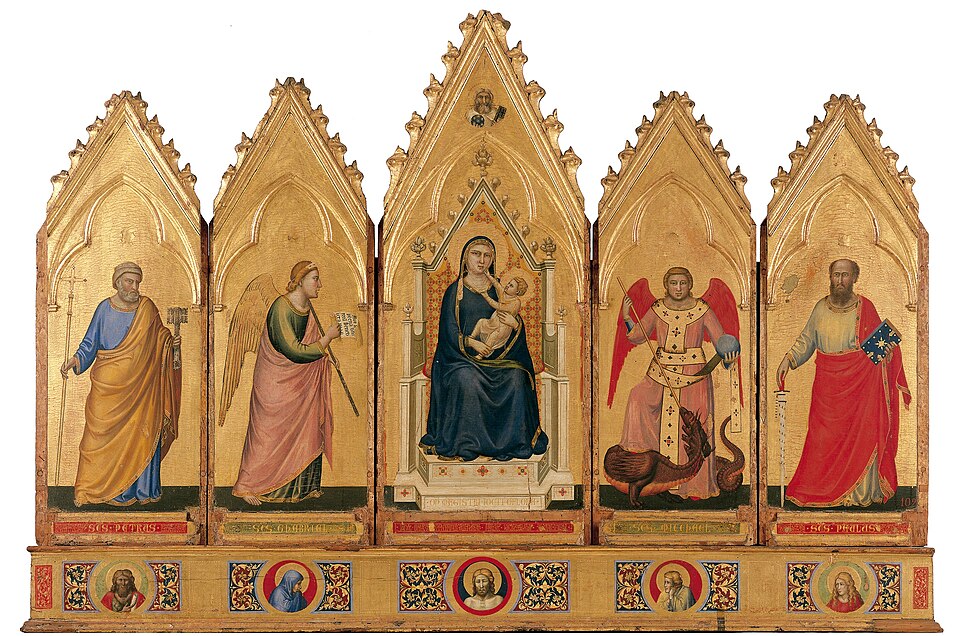
On the step of the Virgin's throne a small inscription names the work of master Giotto of Florence. Yet the Bologna Polyptych is also a story of a busy workshop, a papal commission, and panels taken apart and put back together.
The story behind the painting
The Bologna Polyptych is an altarpiece in tempera on panel with gold backgrounds, attributed to Giotto with workshop participation and generally dated to the early 1330s. The Fondazione Federico Zeri catalogue dates it to 1333-1334, matching Wikidata's 1330s. Modern accounts describe it as probably commissioned by the papal legate Bertrand du Pouget for the papal complex at Porta Galliera in Bologna, a city then part of the Papal States. Its later history was unsettled. In 1782 it was moved from the church of Santa Maria degli Angeli to a chapel of the Collegio Montalto in Bologna. During the Napoleonic period, in 1808, it was taken apart, and only in 1894 was it reassembled in a new frame.
What to look for
The polyptych is wide and low, 91 by 340 centimetres, with gold grounds shining behind every figure. The central panel shows the Virgin enthroned with the Child. On either side, arranged symmetrically, stand four figures identified as Saint Peter, the Archangel Gabriel, the Archangel Michael and Saint Paul. Look for the balance this creates: the two apostles on the outer edges, the two archangels nearest the throne. Then look down to the step of the Virgin's throne, where the inscription is painted, usually transcribed as opus magistri jocti de florentia, the work of master Giotto of Florence. A predella associated with the altarpiece shows figures connected with the Passion of Christ and its witnesses.
Meaning and intent
The choice of saints suits a papal commission. Peter and Paul, the founding apostles of the Church of Rome, frame the whole work, while the archangels Gabriel and Michael flank the enthroned Virgin like a heavenly guard. The gold grounds lift the figures out of any earthly setting. The inscription, though, raises an interesting question. It proudly names Giotto, yet modern summaries consider the polyptych largely a workshop product. The Zeri catalogue records both an attribution to Giotto and one to Giotto and helpers. In this, the painting reflects how a famous master's name could stand for the output of his workshop.
Legacy
The reassembly of 1894 caused damage to some of the original panels, a reminder that the work we see today has been shaped by its history as well as by its makers. Even so, it remains a substantial late work associated with Giotto, carrying his name in its own paint and tied to an ambitious papal project in Bologna. Today it is preserved in the Pinacoteca Nazionale di Bologna, where visitors can look for the inscription on the throne step and weigh for themselves how much of the master's hand they see.
Lo sapevi?
- Dated 1333-1334 by the Zeri catalogue; Wikidata gives the 1330s.
- Tempera on panel with gold grounds, 91 x 340 cm.
- Attributed to Giotto with workshop participation.
- Pinacoteca Nazionale di Bologna.
L'artista
Giotto (1267-1337)
religious art · woman · Mary · Christ Child · boy
Altre opere di Giotto
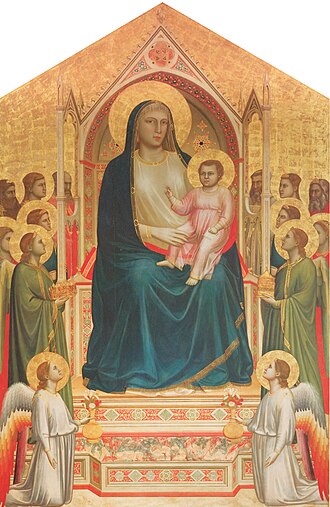 Madonna Enthroned - Giotto (1300s)
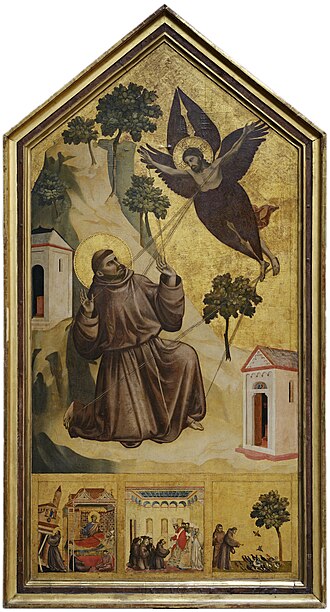 St. Francis of Assisi Receiving the Stigmata - Giotto (1290s)
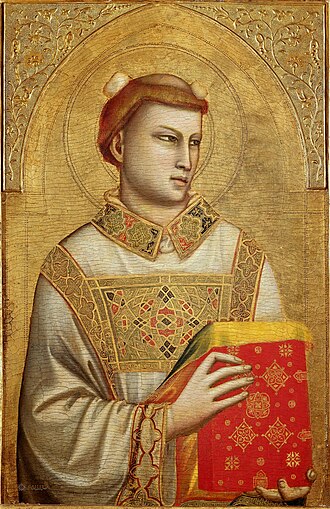 Saint Stephen - Giotto (1320)
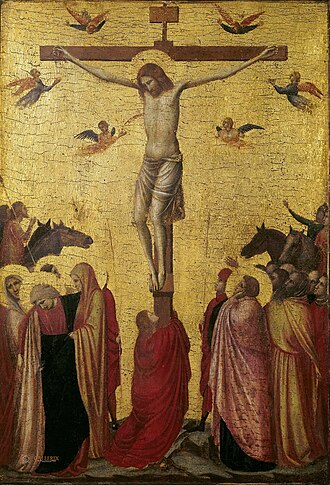 Crucifixion of Strasbourg - Giotto (1315)
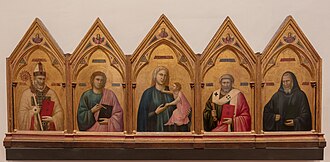 Badia Polyptych - Giotto (1300s)
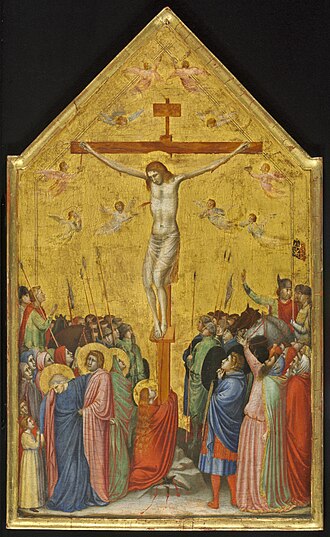 The Crucifixion of Christ - Giotto (1310s)
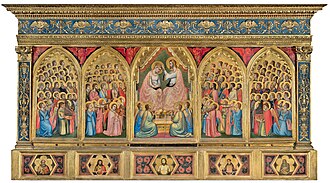 Coronation of Mary with Angels and Saints - Giotto (1328)
 Scenes from the New Testament: Lamentation - Giotto (1291)