Jean-Honoré Fragonard
1732-1806
Jean-Honoré Fragonard painted love, play and fleeting glances with a speed and lightness few could match. A glover's son from Grasse, he left more than 550 paintings, dated only five of them, and gave the late Rococo its most famous swing.
Origins
Jean-Honoré Fragonard was born on 5 April 1732 in Grasse, the only child of François Fragonard, a glover, and Françoise Petit. In 1738 the family moved to Paris. The boy's gift for art was noticed by François Boucher, who recommended him to the studio of Chardin. Fragonard studied there only briefly and returned to Boucher around 1749, taking on his style so completely that the master trusted him to paint replicas of his own pictures. Though not yet a student of the Academy, he won the Prix de Rome in 1752 with Jeroboam Sacrificing to Idols, then studied three more years under Charles-André van Loo before leaving for Rome.
Life and turning points
In December 1756 Fragonard arrived at the French Academy in Rome. There he became friends with the painter Hubert Robert, and in 1760 the two toured Italy together, sketching the countryside and its romantic gardens. He returned to Paris in 1761, and in 1765 his Coresus Sacrificing Himself to Save Callirhoe won him admission to the Academy and was bought by the king. He did not aspire to be a history painter and struggled to finish official commissions, so he painted mostly for private patrons. In 1769 he married Marie-Anne Gérard, a miniature painter; their daughter Rosalie became a favourite model, and a son, Alexandre-Évariste, became a painter and sculptor. The Revolution took away his patrons, and in 1790 he took refuge with a cousin in Grasse. He died on 22 August 1806.
Style and technique
Fragonard's late Rococo manner is known for remarkable facility, exuberance and pleasure. Among his best-loved works are genre scenes full of intimacy and veiled flirtation, such as Blind Man's Bluff, The Love Vow and The Bolt, which are carried by the tender beauty of his colour and his quick, fluent brush. In Italy he admired the Dutch and Flemish masters, Rubens, Hals, Rembrandt and Ruisdael, and imitated their loose, vigorous brushstrokes; he was also deeply struck by the rich splendour of Tiepolo, whose works he studied in Venice. After a lukewarm response to his ambitious love series, he set the Rococo aside and experimented with Neoclassicism.
Stories and anecdotes
The Swing, in the Wallace Collection in London, is his best-known work and one of the masterpieces of the Rococo. A young man hidden in the bushes watches a lady on a swing being pushed by her husband, who stands unaware in the shadows behind, and as she swings forward the young man glimpses beneath her dress. According to the memoirs of Charles Collé, a young nobleman wanted a picture of his mistress on a swing and first asked Gabriel François Doyen, who felt uneasy with such a frivolous subject and passed the commission to Fragonard. Back home in Grasse during the Revolution, Fragonard decorated his cousin's house with The Progress of Love, panels first painted for Madame du Barry.
Legacy
For half a century or more after his death Fragonard was so thoroughly ignored that Wilhelm Lübke's art history of 1873 does not even name him. Later reassessment placed him among the great masters of French painting. His handling of colour and his confident, expressive brushstroke clearly influenced the Impressionists, especially Renoir and his own great-niece Berthe Morisot. Writers have kept returning to The Swing: it seems to be echoed in The Great Gatsby, and W. B. Yeats alluded to it in a poem. Together with the paintings of Boucher, his pictures seem to sum up an entire era, light, playful and full of feeling.
Lo sapevi?
- His wife's younger sister, Marguerite Gérard, became his student and assistant in 1778 at the age of fourteen.
- His early Christ Washing the Feet of the Apostles is in Grasse Cathedral.
- In 1773 and 1774 he made a second Italian journey and returned through Vienna, Prague, Dresden and Strasbourg.
- T. S. Eliot's The Waste Land describes a carved dolphin like the one in his Progress of Love: The Pursuit.
Artisti collegati
Jean-Antoine Watteau · François Boucher · Francisco Goya
Dipinti di Jean-Honoré Fragonard
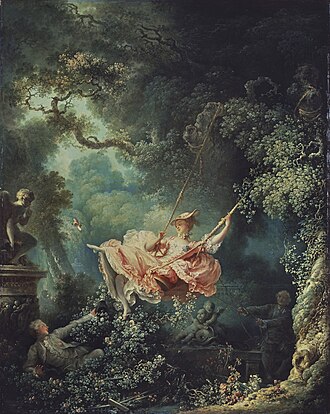 The Swing - Jean-Honoré Fragonard (1760s)
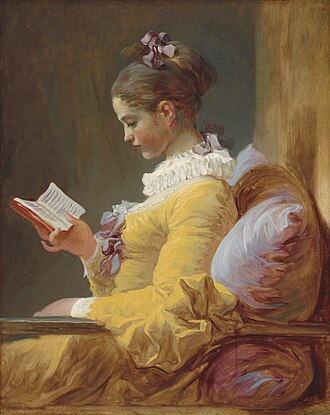 A Young Girl Reading - Jean-Honoré Fragonard (1770)
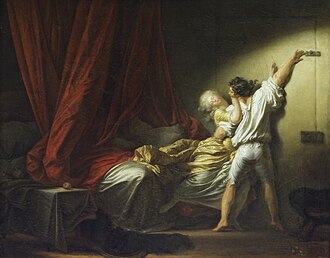 The Lock - Jean-Honoré Fragonard (1770s)
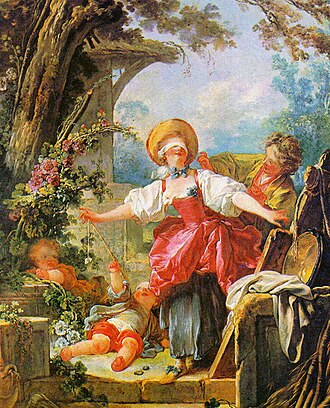 Blind Man's Bluff - Jean-Honoré Fragonard (1760s)
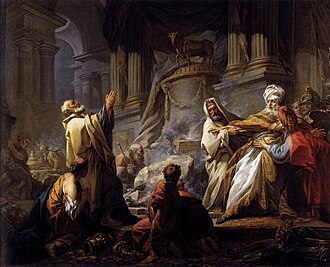 Jeroboam Sacrificing to Idols - Jean-Honoré Fragonard (1752)
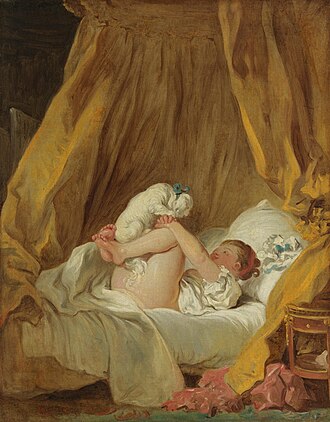 La Gimblette - Jean-Honoré Fragonard (1770)
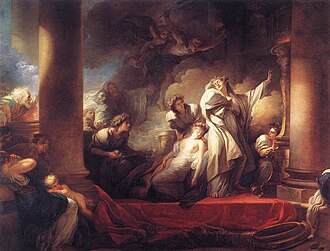 Coresus Sacrificing Himself to Save Callirhoe - Jean-Honoré Fragonard (1765)
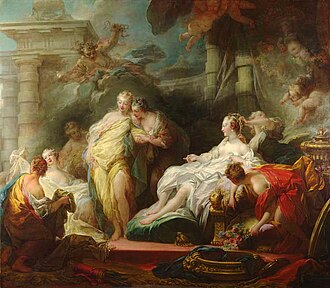 Psyche showing her Sisters her Gifts from Cupid - Jean-Honoré Fragonard (1753)
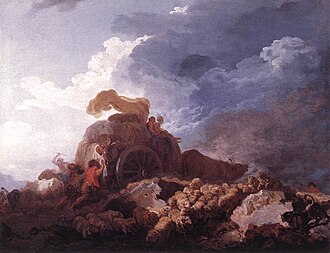 The Storm - Jean-Honoré Fragonard
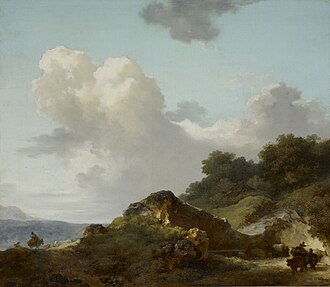 Le Rocher - Jean-Honoré Fragonard (1780)