François Boucher
1703-1770
François Boucher painted a world of shepherdesses, goddesses and soft pink skies, and for a while all of France seemed to want to live in it. The Goncourt brothers said he was one of those rare men who embody the taste of an entire century.
Origins
François Boucher was born in Paris on 29 September 1703. His father, Nicolas Boucher, was a lesser known painter and gave him his first artistic training. At seventeen, one of the young man's paintings was admired by the painter François Lemoyne, who took him on as an apprentice, but after only three months Boucher went to work for the engraver Jean-François Cars. That early time among engravers mattered: he would remain a prolific printmaker and draughtsman all his life. In 1720 he won the prestigious Grand Prix de Rome for painting, but because of financial problems at the Royal Academy he could not take up the chance to study in Italy until about five years later.
Life and turning points
After his studies in Italy, Boucher was admitted to the Académie royale de peinture et de sculpture on 24 November 1731, with Rinaldo and Armida as his reception piece. In 1733 he married Marie-Jeanne Buzeau, and the couple had three children. From 1734 his career accelerated: he became a faculty member, then Professor and Rector of the academy, inspector at the Royal Gobelins Manufactory and finally, in 1765, First Painter of the King. His great admirer was the Marquise de Pompadour, the mistress of Louis XV, and his portraits were central to how she presented herself. Late in his career his reputation came under attack, notably from the critic Denis Diderot. Boucher died in his native Paris on 30 May 1770.
Style and technique
Boucher took inspiration from Peter Paul Rubens and Antoine Watteau. His art is known for idyllic and voluptuous scenes on classical themes, decorative allegories and pastorals, in which mythology becomes intimate and amorous rather than epic. He was also a master of the genre scene: in The Breakfast of 1739 he used his own wife and children as models. He designed theatre costumes and sets, court festivities and tapestries; for the Beauvais workshops he produced six series of hangings over two decades, beginning with the Italian Festivals of 1736. He etched some 180 original copperplates, and his drawings were so sought after that 266 of them were reproduced in red ink to look like red chalk drawings that could be framed.
Stories and anecdotes
Boucher is famous for saying that nature is too green and badly lit, a phrase that fits his painted world of perfect light. His pastoral pair The Enjoyable Lesson and An Autumn Pastoral was based on characters from a 1745 play by his close friend Charles-Simon Favart, and those figures later became porcelain figurines made at Sèvres. A surviving oil sketch at Waddesdon Manor shows Madame de Pompadour picking up a pearl bracelet bearing the king's portrait, a quiet sign of the bond on which her position depended. The Adoration of the Shepherds in the Metropolitan Museum was long thought to be a study for her private altarpiece, but recent scholarship suggests it was made at least ten years later as an independent work.
Legacy
By the time of his death, Boucher's name, together with that of Madame de Pompadour, had become synonymous with French Rococo. The Goncourt brothers wrote that he was one of those men who express, personify and embody the taste of a century. He may have been the most celebrated painter and decorative artist of the 18th century, and his designs spread through engravings and onto porcelain from Vincennes and Sèvres. He also taught others: the gem engraver Jacques Guay, the painter Martin Ferdinand Quadal and, in 1767, the young Jacques-Louis David, who would become the great neoclassical painter. His paintings still invite us into a softer, lighter world, made with real skill and delight.
Lo sapevi?
- He helped spread the fashion for chinoiserie after etching twelve Chinese figures by Watteau.
- In his last decade he came to favour brown chalk for drawing.
- He made many etchings after the work of Watteau.
- His collaboration with the Gobelins lasted until 1765, when he stepped down as inspector.
Artisti collegati
Jean-Antoine Watteau · Jean-Honoré Fragonard · Francisco Goya
Dipinti di François Boucher
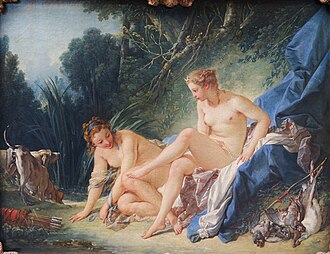 Diana leaving her Bath - François Boucher (1742)
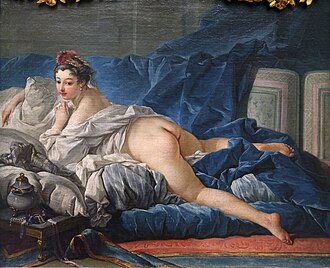 Brown Odalisque - François Boucher (1740s)
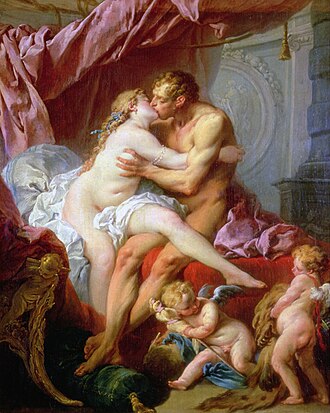 Hercules and Omphale - François Boucher (1730s)
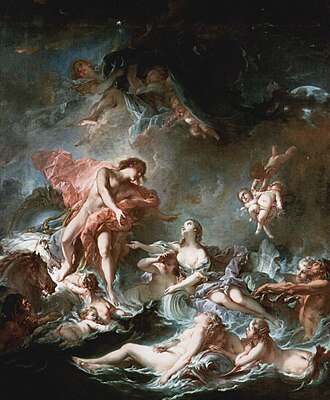 The setting of the sun - François Boucher (1752)
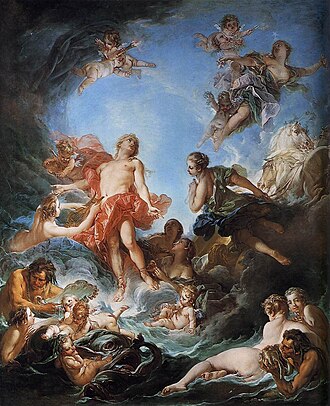 The Rising of the Sun - François Boucher (1753)
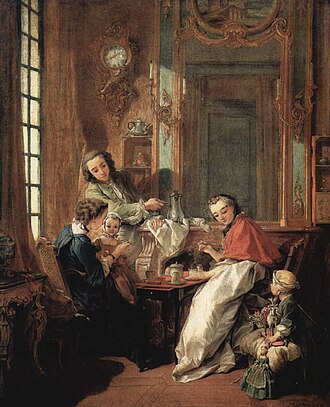 Morning Coffee - François Boucher (1739)
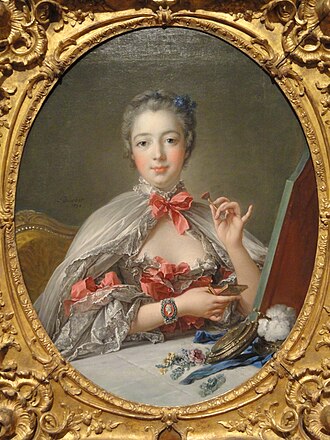 Jeanne-Antoinette Poisson, Marquise de Pompadour - François Boucher (1750)
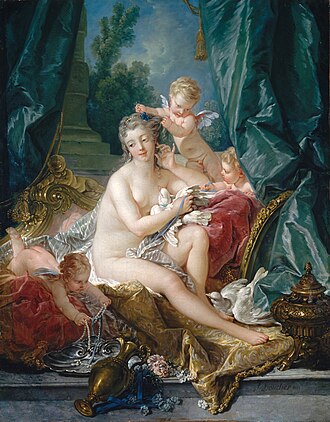 The Toilette of Venus - François Boucher (1751)
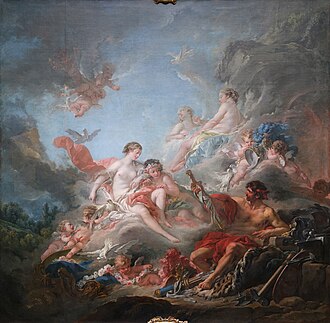 Vulcan Presenting Venus with Arms for Aeneas - François Boucher (1757)
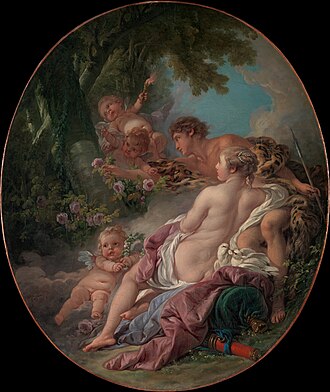 Angelica and Medoro - François Boucher (1763)