Jeune femme assise
Pierre-Auguste Renoir · 1876
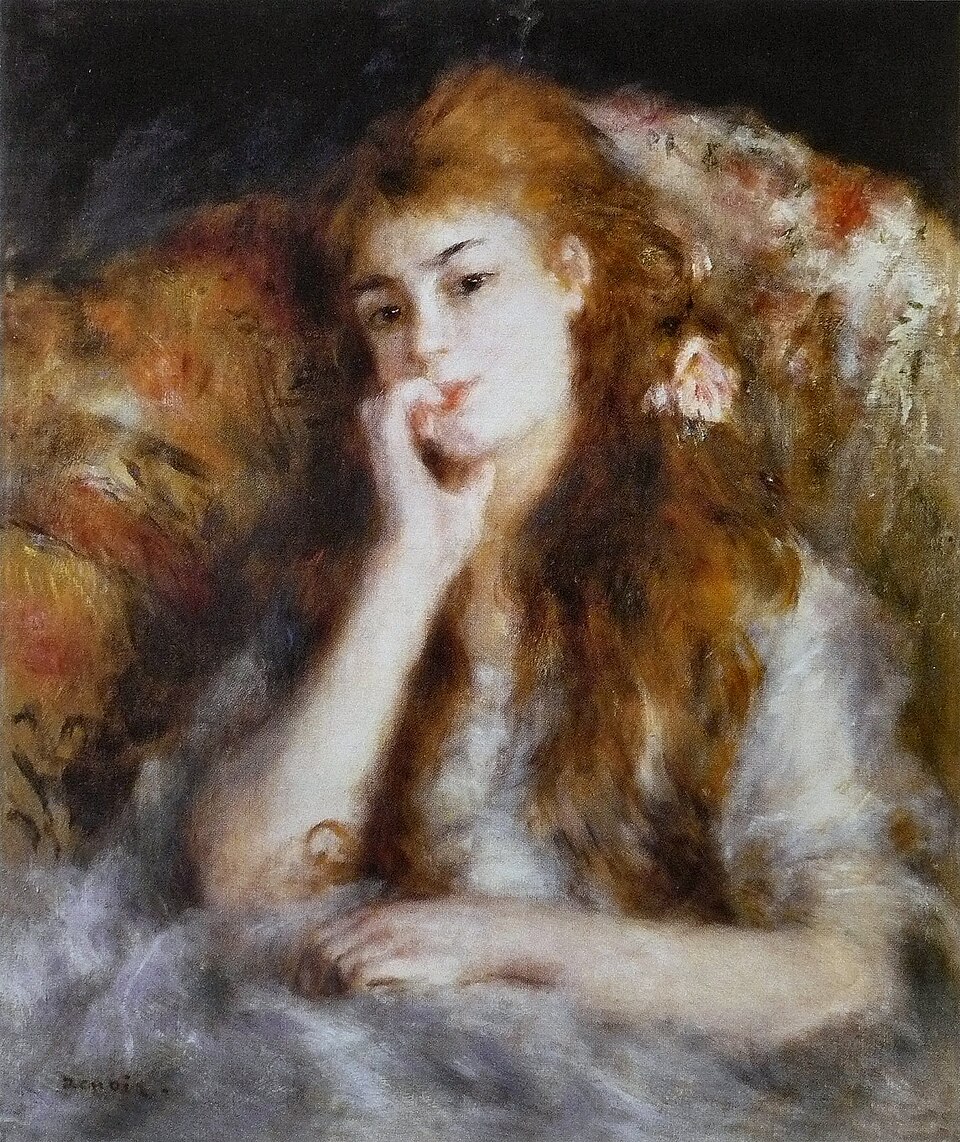
A young woman in white muslin sinks into a patterned armchair, a finger at her lips, her gaze drifting somewhere far away. The art trade called the picture La Pensée, the thought. Renoir hated the title.
The story behind the painting
Renoir painted this oil on canvas around 1876 to 1877, according to German Wikipedia, while Wikidata gives 1876. His model was Nini Lopez, a professional model who appears again and again in his pictures of the late 1870s. The painting is signed Renoir at lower left but not dated. Talking with his dealer Ambroise Vollard, Renoir simply called it the woman biting her finger. The canvas is small and intimate, 66 by 55.5 cm, and the half-length seated young woman is a frequent motif in his work.
What to look for
She sits comfortably leaning back in a high armchair of rich colours against a dark background, in a short-sleeved white muslin dress, her long reddish-blond hair falling loose over her chest. Her right thumb rests under her chin while the bent fingers reach her lips. Look at how Renoir treats each material: the airy dress, the full hair, the pale, almost porcelain skin. With almost no outlines, the areas seem to flow into each other, in soft oranges and reds with green and blue accents, yet with less play of light than his other works of the time.
Meaning and intent
She seems at once flirtatious and bored, chewing on her little finger. In 1883 the critic Philippe Burty compared her to a panther sharpening its claws. Richard Verdi saw a genre scene more than a portrait, full of femininity and sensuality, Colin B. Bailey an intimate mood and an almost meditative absorption, and Nina Zimmer a gaze moved by longing or melancholy. The title La Pensée came from the art trade, first used at an 1899 auction, and Renoir is said to have been annoyed, telling the painter Albert André that his models had no thoughts.
Legacy
The first known owner after Renoir was the collector Armand Doria. The banker Jakob Goldschmidt, persecuted as a Jew in Germany, emigrated in 1933 and managed to take only a few major works with him to New York, this painting among them. His son sold it at Sotheby's in London in 1958 to the Birmingham property developer Jack Cotton. In 1984 his heirs gave it to the state in lieu of inheritance tax, and it went to the Barber Institute of Fine Arts in Birmingham, where it still hangs.
Le saviez-vous ?
- Model: Nini Lopez.
- Dated about 1876-1877 by Wikipedia, 1876 by Wikidata.
- Renoir rejected the title La Pensée.
- At the Barber Institute of Fine Arts, Birmingham, since 1984.
À propos de l'artiste
Pierre-Auguste Renoir (1841-1919)
Autres œuvres de Pierre-Auguste Renoir
 Bal du moulin de la Galette - Pierre-Auguste Renoir (1876)
 Le Déjeuner des canotiers - Pierre-Auguste Renoir (1881)
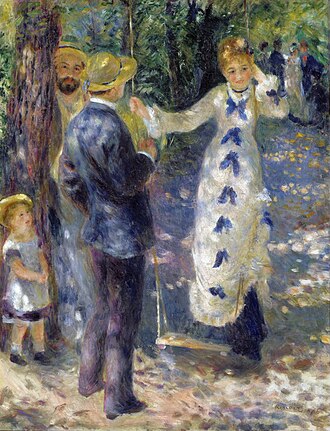 La Balançoire - Pierre-Auguste Renoir (1876)
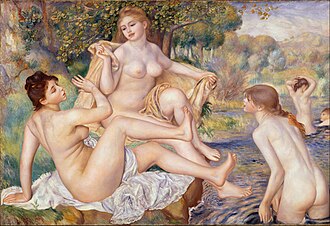 Les Grandes Baigneuses - Pierre-Auguste Renoir (1884)
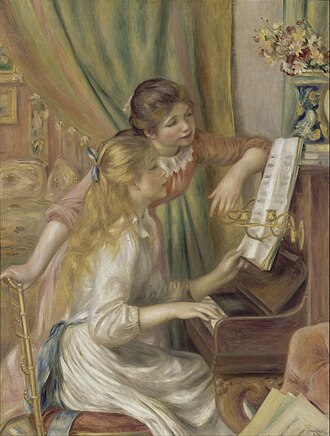 Jeunes Filles au piano - Pierre-Auguste Renoir (1892)
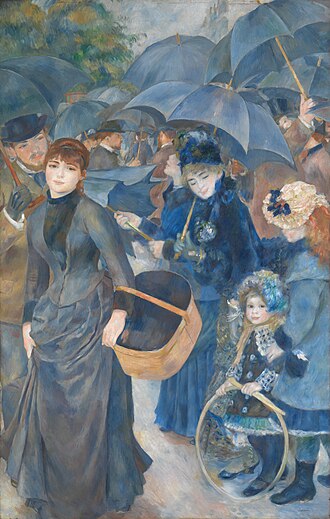 Les Parapluies - Pierre-Auguste Renoir (1880s)
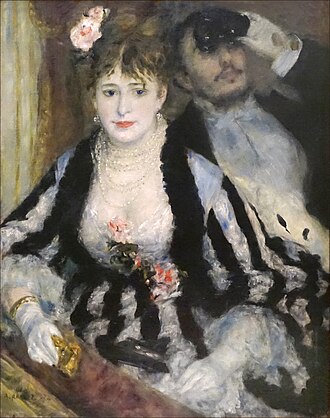 La Loge - Pierre-Auguste Renoir (1874)
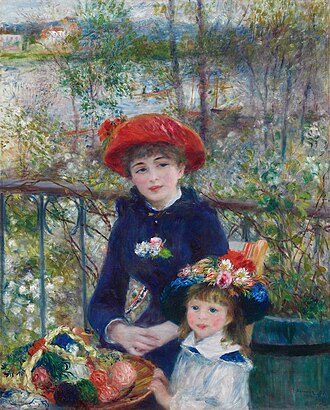 Les Deux Sœurs - Pierre-Auguste Renoir (1881)
Œuvres d'artistes liés
 Impression, soleil levant - Claude Monet (1872)
 Nymphéas - Claude Monet (1906)
 Le Déjeuner sur l'herbe - Édouard Manet (1863)
 Olympia - Édouard Manet (1863)
 Le Berceau - Berthe Morisot (1872)
 Jour d'été - Berthe Morisot (1879)
 L'Absinthe - Edgar Degas (1875)
 La Famille Bellelli - Edgar Degas (1858)
 Le Canal du Loing - Alfred Sisley (1892)
 L'Abreuvoir à Marly-Le-Roi, gelée blanche - Alfred Sisley (1876)
 Rue de Paris, temps de pluie - Gustave Caillebotte (1877)
 Les Raboteurs de parquet - Gustave Caillebotte (1875)