Demoiselles des bords de la Seine
Gustave Courbet · 1857
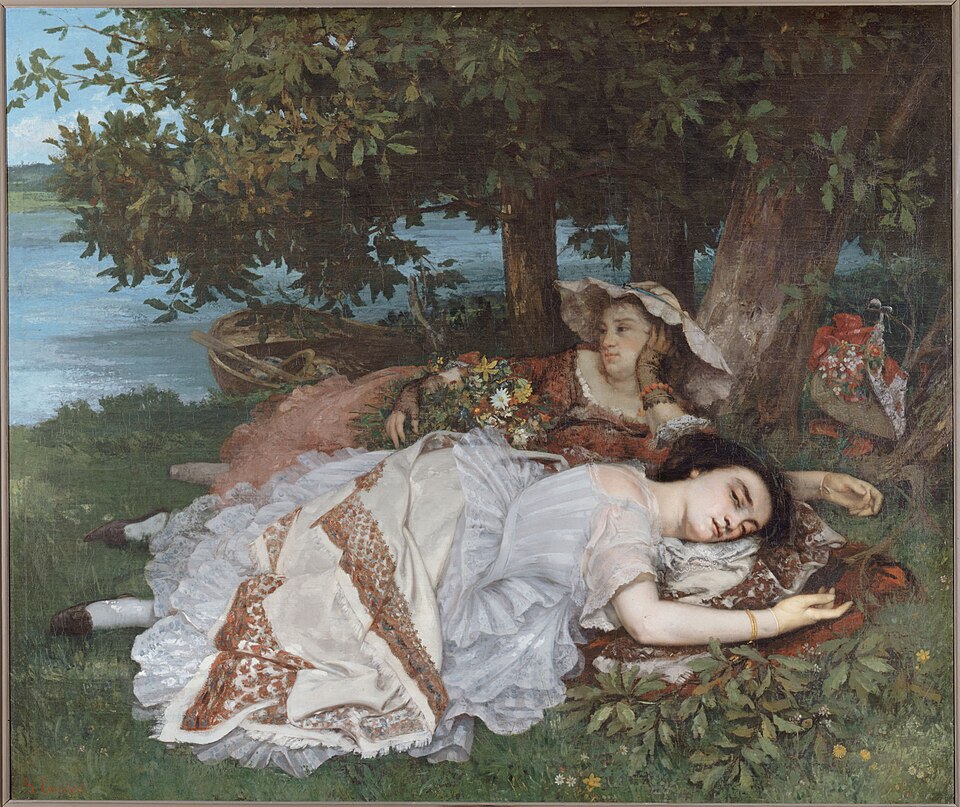
Two young Parisian women lie in the grass by the Seine on a summer day, one drowsing face down, the other gazing at the water. Courbet gave them a huge canvas, and the Salon of 1857 was scandalised.
The story behind the painting
Courbet painted Young Ladies Beside the Seine (Summer) between late 1856 and early 1857; Wikidata gives 1857. It is a large oil on canvas, about 174 by 206 cm. He submitted it to the jury of the Paris Salon, which accepted it, and it was shown from 15 June 1857 together with five other works by him, two portraits and three landscapes. The full French title, Les Demoiselles des bords de la Seine, tells us it is summer and that the two women are young and unmarried. They are city dwellers who have come out to cool off at the water's edge on a summer day.
What to look for
Two women lie under trees at the river's edge. In front, one in a patterned white dress lies on her stomach, her bare head resting on a cloth, her eyes half closed. Behind her, the other wears a red dress and holds a bouquet; her head, under a hat, leans on her hand as she looks away toward the water. On the right, at the foot of a tree, lies a hat studded with flowers. In the upper left you can see the other bank of the Seine and a boat moored to the shore, filled with objects such as a hat and fabrics. All three trees in the picture are oaks.
Meaning and intent
The realism of the scene, openly sensual, comes from the frankness of the faces and poses. Courbet gave a modern, everyday subject the large format usually kept for grander themes, and so upset the rules of the art of his time. Willingly provocative, he triggered a critical scandal when he exhibited it at the Salon. According to the critic Jules-Antoine Castagnary, the painting echoes an earlier Courbet, Young Ladies of the Village of 1852. Its modern subject also announced the great fortune of the banks of the Seine in painting, celebrated by the Impressionists a generation later.
Legacy
The canvas was bought by Courbet's friend and patron Etienne Baudry, who bequeathed it to the painter's sister Juliette. She left it to the French state in 1906, and it now hangs in the Petit Palais in Paris, the Musee des Beaux-Arts de la Ville de Paris. A smaller sketch version, about 96.5 by 130 cm, is in the National Gallery in London, possibly by Courbet or one of his followers. Several small preparatory canvases with portraits of the two women also survive, in museums such as the National Gallery in Prague and the National Gallery of Australia in Canberra.
Le saviez-vous ?
- Painted late 1856 to early 1857.
- Shown at the Paris Salon of 1857, where it caused a scandal.
- Given to the French state by Courbet's sister Juliette in 1906.
- Now in the Petit Palais, Paris.
À propos de l'artiste
Gustave Courbet (1819-1877)
femme · scène de genre · arbre · Seine
Autres œuvres de Gustave Courbet
 L'Origine du monde - Gustave Courbet (1866)
 Un enterrement à Ornans - Gustave Courbet (2020)
 L'Atelier du peintre - Gustave Courbet (1855)
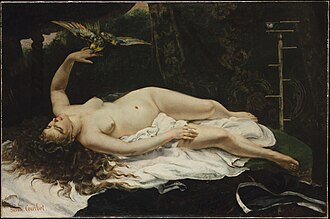 La Femme au perroquet - Gustave Courbet (1866)
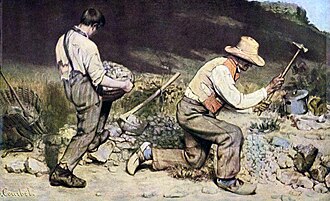 Les Casseurs de pierres - Gustave Courbet (1850)
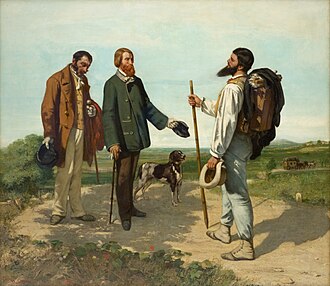 La Rencontre, ou Bonjour Monsieur Courbet - Gustave Courbet (1854)
.jpg) La Source - Gustave Courbet (1862)
La Source - Gustave Courbet (1862)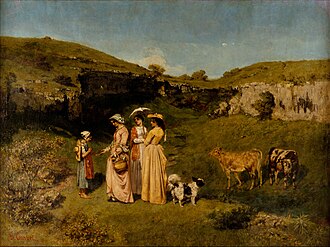 Les Demoiselles de village - Gustave Courbet (1850s)
Œuvres d'artistes liés
 Impression, soleil levant - Claude Monet (1872)
 Nymphéas - Claude Monet (1906)
 Le Déjeuner sur l'herbe - Édouard Manet (1863)
 Olympia - Édouard Manet (1863)
 La Nuit étoilée - Vincent van Gogh (1889)
.jpg) Terrasse du café le soir - Vincent van Gogh (1888)
Terrasse du café le soir - Vincent van Gogh (1888)