Le Sommeil
Gustave Courbet · 1866
%2C%20Paris%2C%20Petit%20Palais.jpg)
Two women lie asleep together on a bed, a broken pearl necklace scattered beside them. Courbet painted Le Sommeil in 1866 for a private collector; it drew a police report when shown in 1872 and was not allowed on public view until 1988.
The story behind the painting
Le Sommeil, known in English as The Sleepers or Sleep, and also as The Two Friends and Indolence and Lust, was painted by Courbet in 1866. It was commissioned by Halil Serif Pasha, an Ottoman diplomat and art collector who had lived in Paris since 1860. One of the models was Joanna Hiffernan, then the companion of the painter James Abbott McNeill Whistler. Whistler's relationship with Hiffernan ended soon afterwards, and his opinion of Courbet soured. The painting was inspired by Charles Baudelaire's poem Delphine et Hippolyte, from Les Fleurs du mal.
What to look for
The canvas, about 135 by 200 cm, shows two nude women asleep on a bed, entwined in an embrace; one is a redhead, the other a brunette, and Courbet works curves between them for colour contrast. A dark blue velvet curtain hangs behind, and a table at right holds a decorative flower vase. On a small wooden table in the foreground stand a coloured flacon, a clear crystal vase and a cup. A broken pearl necklace and a hairpin lie scattered on the bed. Beyond these few furnishings, nothing draws attention away from the two women.
Meaning and intent
Le Sommeil has been interpreted as a realist painting, showing the bodies in detail without glossing over their imperfections. The scattered pearls and hairpin hint at what came before the sleep. It was a private commission and, like some other works by Courbet such as L'Origine du monde, it was kept from public display for a very long time. When a picture dealer exhibited it in 1872, it became the subject of a police report.
Legacy
The Encyclopedia of Lesbian and Gay Histories and Cultures calls Le Sommeil a famous painting. After it was shown publicly, a number of contemporary artists took up the theme of female couples, and this repetition helped to lower the taboos around lesbian relationships. In 1955 Bernard Buffet painted his own version of Le Sommeil as a tribute to Courbet. The original is today in the collection of the Petit Palais, the Musee des Beaux-Arts de la Ville de Paris, where visitors can see it.
Le saviez-vous ?
- Painted in 1866 for the collector Halil Serif Pasha.
- Inspired by Baudelaire's poem Delphine et Hippolyte.
- The subject of a police report when shown in 1872.
- Now in the Petit Palais, Paris.
À propos de l'artiste
Gustave Courbet (1819-1877)
femme · scène de genre · nu · nudité · décubitus · couple · musée des Beaux-Arts de la ville de Paris
Autres œuvres de Gustave Courbet
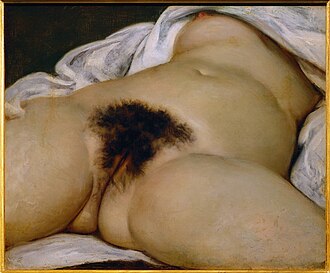 L'Origine du monde - Gustave Courbet (1866)
 Un enterrement à Ornans - Gustave Courbet (2020)
 L'Atelier du peintre - Gustave Courbet (1855)
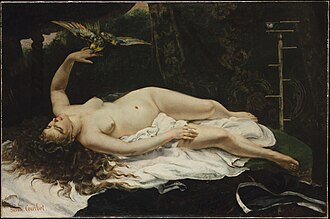 La Femme au perroquet - Gustave Courbet (1866)
 Les Casseurs de pierres - Gustave Courbet (1850)
 La Rencontre, ou Bonjour Monsieur Courbet - Gustave Courbet (1854)
 Demoiselles des bords de la Seine - Gustave Courbet (1857)
 Les Cribleuses de blé - Gustave Courbet (1850s)
Œuvres d'artistes liés
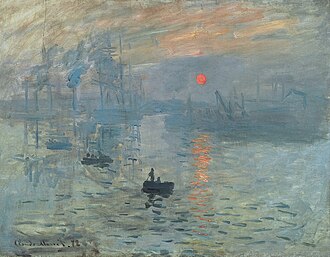 Impression, soleil levant - Claude Monet (1872)
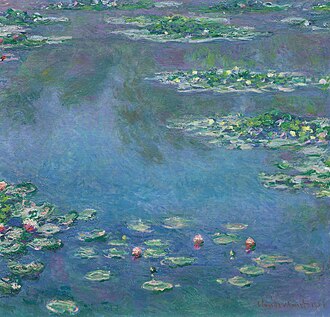 Nymphéas - Claude Monet (1906)
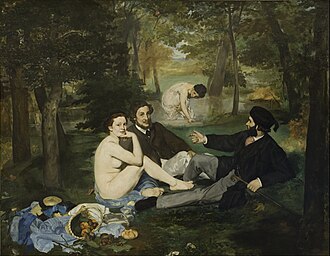 Le Déjeuner sur l'herbe - Édouard Manet (1863)
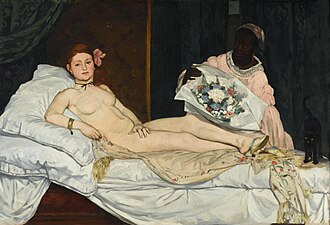 Olympia - Édouard Manet (1863)
 La Nuit étoilée - Vincent van Gogh (1889)
.jpg) Terrasse du café le soir - Vincent van Gogh (1888)
Terrasse du café le soir - Vincent van Gogh (1888)