Femme et enfant au balcon
Berthe Morisot · 1872
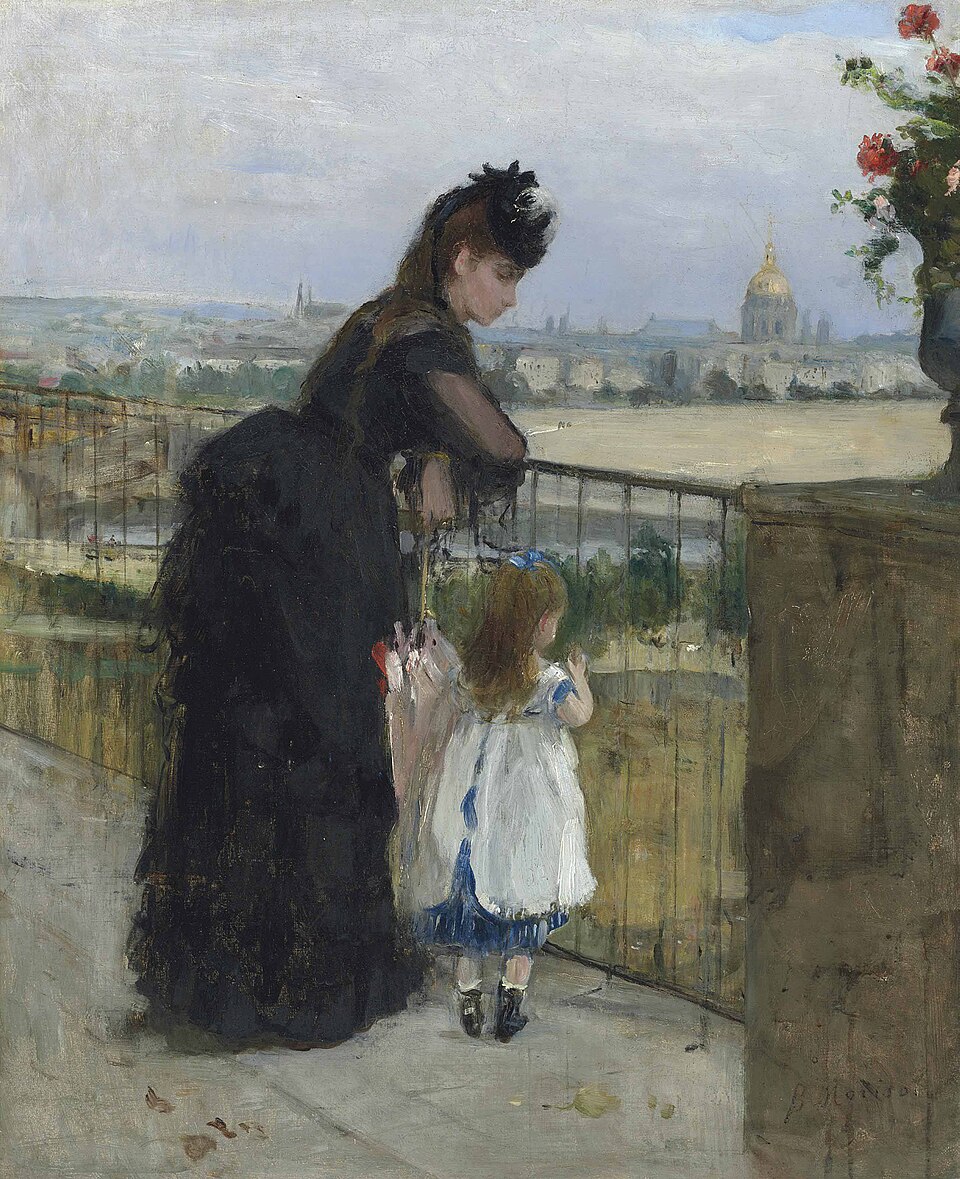
A woman in mourning black and a little girl lean at a railing high above Paris as evening falls. Berthe Morisot painted her sister and niece, and turned Manet's balcony into something gentler and her own.
The story behind the painting
In the 1870s Berthe Morisot's sister Edma lived with her husband Adolphe Pontillon in the family house on a hill in Passy, a former commune annexed to Paris in 1860. Morisot painted several portraits of her sister there. In this canvas of 1872, Edma appears dressed in black, in mourning for their father, beside her daughter Jeanne. Evening is falling as they look out from the terrace of a restaurant or hotel toward the newly opened Trocadero gardens. The Spanish Wikipedia gives 60 by 50 cm, Wikidata 61 by 50 cm.
What to look for
The Seine flows in the foreground, and the skyline of Paris stretches behind it with the dome of the Invalides and the towers of Notre-Dame. Edma shelters her child. Morisot invites us to follow the little girl's innocent gaze through the railing toward the gardens below. The figures stand in a natural pose, the brushwork is loose and the palette light. The picture seems painted from direct observation, based on an earlier watercolour study made outdoors. Like a stage set, the railing and the garden form a protective frame that still opens onto the wider world.
Meaning and intent
By turning her daughter's eyes toward the gardens at their feet, Edma seems to draw attention away from the distant city, which can be read as a place full of dangers to be shielded from; the big city was not considered proper ground for a respectable woman. The work typifies Morisot's attention to mothers and daughters and to the ups and downs of raising a child, a theme she returned to often. Stripped of pretension and painted from life, the scene is seen, as the source puts it, through female eyes.
Legacy
Morisot was undeniably inspired by The Balcony of 1868 to 1869 by her brother-in-law Edouard Manet, for which she herself had posed. Yet she showed a style of her own, shaped more strongly by Impressionism. Manet's balcony was built in the traditional way from separate posing sessions, and his figures look stiff and aware of being watched; Morisot's are relaxed. Manet later used a similar device in The Railway of 1873, where a girl looks through railings. The painting is now in the Artizon Museum in Tokyo, formerly the Bridgestone Museum of Art.
Le saviez-vous ?
- Painted in 1872 in Passy, Paris.
- Shows Morisot's sister Edma, in mourning, with her daughter Jeanne.
- Inspired by Manet's The Balcony, for which Morisot posed.
- Now in the Artizon Museum, Tokyo.
À propos de l'artiste
Berthe Morisot (1841-1895)
Autres œuvres de Berthe Morisot
 Le Berceau - Berthe Morisot (1872)
 Jour d'été - Berthe Morisot (1879)
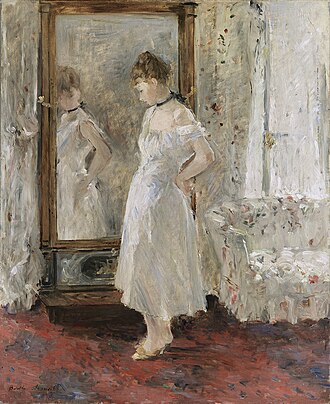 La Psyché - Berthe Morisot (1876)
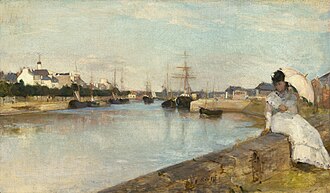 Vue du petit port de Lorient - Berthe Morisot (1869)
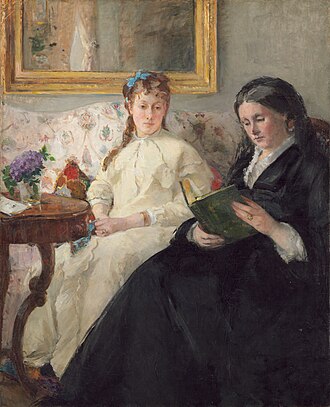 La Mère et la Sœur de l'artiste - Berthe Morisot
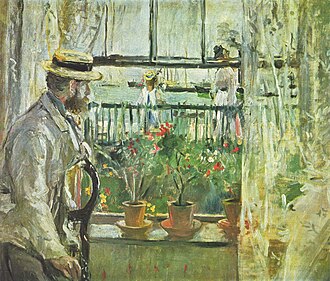 Eugène Manet à l'île de Wight - Berthe Morisot (1875)
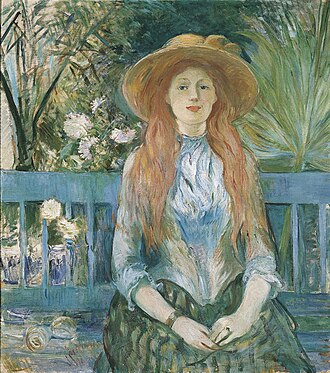 Jeune Fille dans un parc - Berthe Morisot (1893)
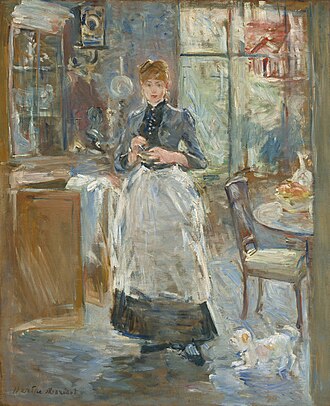 Dans la salle à manger - Berthe Morisot (1886)
Œuvres d'artistes liés
 Impression, soleil levant - Claude Monet (1872)
 Nymphéas - Claude Monet (1906)
 Le Déjeuner sur l'herbe - Édouard Manet (1863)
 Olympia - Édouard Manet (1863)
 Bal du moulin de la Galette - Pierre-Auguste Renoir (1876)
 Le Déjeuner des canotiers - Pierre-Auguste Renoir (1881)
 L'Absinthe - Edgar Degas (1875)
 La Famille Bellelli - Edgar Degas (1858)
 Le Canal du Loing - Alfred Sisley (1892)
 L'Abreuvoir à Marly-Le-Roi, gelée blanche - Alfred Sisley (1876)
 Rue de Paris, temps de pluie - Gustave Caillebotte (1877)
 Les Raboteurs de parquet - Gustave Caillebotte (1875)