The Veteran in a New Field
Winslow Homer · 1865
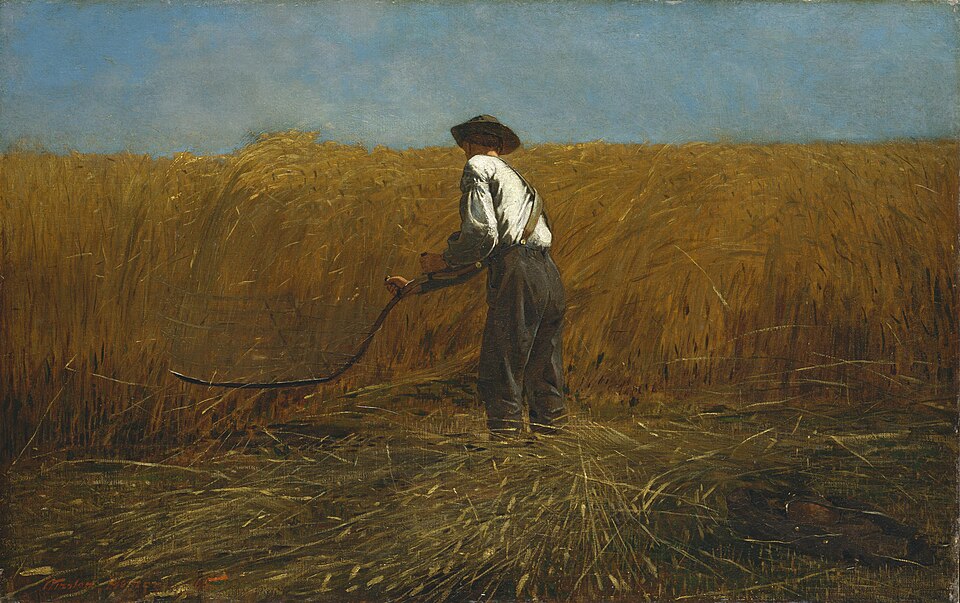
A man with his back to us swings a scythe through a golden field of wheat. Only a discarded jacket and canteen reveal that he has just come home from the American Civil War.
The story behind the painting
Winslow Homer finished The Veteran in a New Field in 1865, the final year of the American Civil War, the same year Abraham Lincoln was assassinated. It is one of several paintings Homer made on the war, after Home, Sweet Home and before Prisoners from the Front, painted the following year. Homer had accompanied a Union division while covering the war, and the jacket and canteen in the picture belong specifically to that division. The work is seen as a transitional painting in his career, moving towards simpler compositions with symbolic messages.
What to look for
This is among Homer's simplest compositions: a single figure in a field of grain, holding a scythe. He is a Rückenfigur, seen from behind, so his identity is hidden and he can stand for any Union soldier. The only evidence of his past lies in the lower right corner, in the cut wheat: a jacket and a canteen. Wikidata gives the canvas as 61.3 by 96.8 cm. The use of nature as symbol, the formality and the expressiveness were all new in Homer's work.
Meaning and intent
Scholars read many layers here. The scythe recalls the Grim Reaper, and the harvest echoes the huge loss of life in the war. Wheat was once placed on coffins, yet it was also a northern crop, used in patriotic images. The Bible's all flesh is grass gives the mowing a double meaning, while Isaiah's swords into plowshares suggests a call for peace. Nancy Rash has proposed that it is an elegy for Lincoln. Others compare the veteran to Cincinnatus, the Roman who left power to return to his farm. Some see hope and national rebirth, others melancholy and haunting memories.
Legacy
When it was first shown in 1865, reviews were generally negative. Critics said it was painted quickly and sloppily, especially the field and the suggested trees, and objected that harvesting grain properly needs a scythe and a cradle, while only a scythe appears. Homer may have simplified the scene on purpose, to put the symbolic themes first. Prisoners from the Front later became regarded as his greatest work of the period. The Veteran in a New Field was given by Adelaide Milton de Groot to the Metropolitan Museum of Art, where it remains.
Le saviez-vous ?
- Painted by Winslow Homer in 1865.
- The jacket and canteen identify a Union veteran.
- Interpreted by Nancy Rash as an elegy for Lincoln.
- Given to the Metropolitan Museum by Adelaide Milton de Groot.
À propos de l'artiste
Winslow Homer (1836-1910)
homme · Metropolitan Museum of Art
Autres œuvres de Winslow Homer
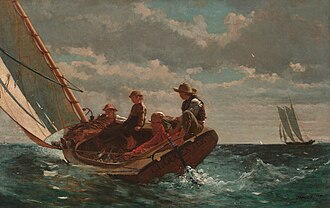 Le vent se lève - Winslow Homer (1873)
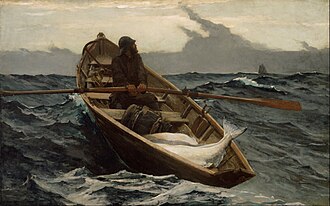 La Corne de brume - Winslow Homer (1885)
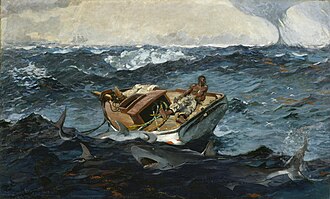 Le Gulf Stream - Winslow Homer (1899)
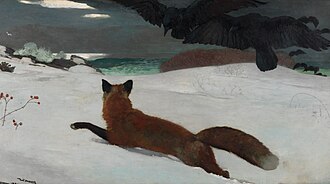 La Chasse au renard - Winslow Homer (1893)
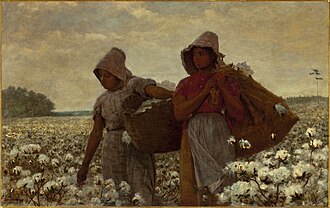 Cueilleuses de coton - Winslow Homer (1876)
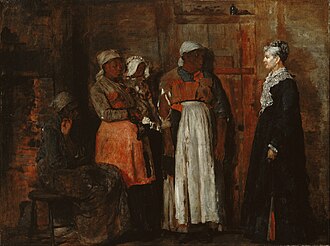 A Visit from the Old Mistress - Winslow Homer (1876)
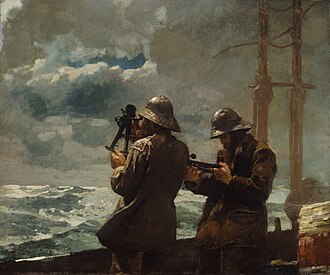 Eight Bells - Winslow Homer (1886)
 In Front of Yorktown - Winslow Homer (1860s)
Œuvres d'artistes liés
 L'Origine du monde - Gustave Courbet (1866)
 Un enterrement à Ornans - Gustave Courbet (2020)
 Le Déjeuner sur l'herbe - Édouard Manet (1863)
 Olympia - Édouard Manet (1863)
 La Nuit étoilée - Vincent van Gogh (1889)
 Terrasse du café le soir - Vincent van Gogh (1888)