Cueilleuses de coton
Winslow Homer · 1876
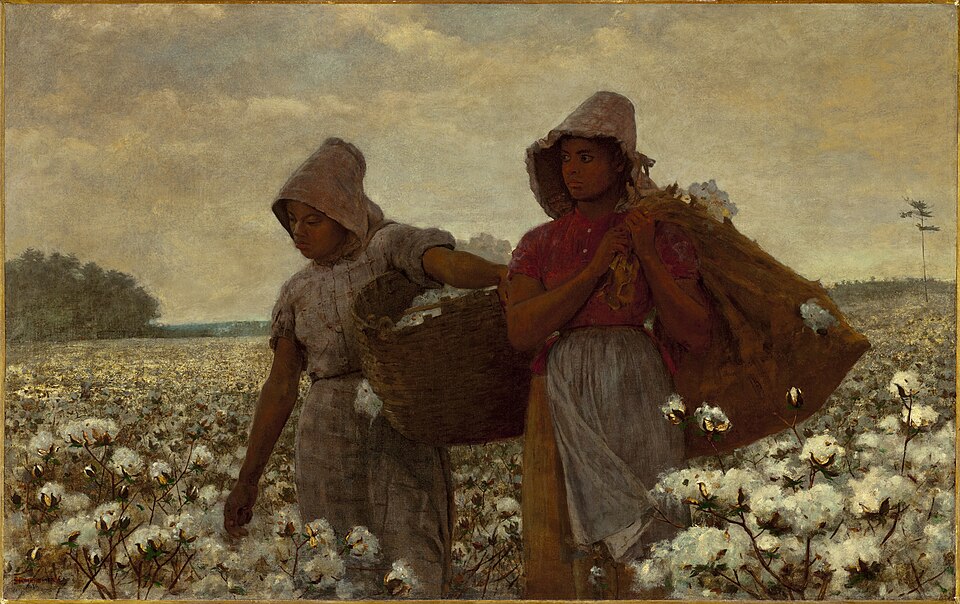
Two young Black women stand in a cotton field that runs to the horizon, their basket and sack nearly full. They picked cotton before the war and they are still picking it after. Homer painted them in 1876, as Reconstruction was ending.
The story behind the painting
Homer began as a lithographer's apprentice and Civil War artist-correspondent for Harper's Weekly. After the war he returned to Petersburg, Virginia, where he had spent time during the final siege, and from 1874 to 1876 he made studies of rural African American life. The source calls him the first American to paint African Americans consistently without condescension or sentimentality. In 1876 Federal troops were withdrawing from the South, and the hopes of the post-war years were giving way to racism and the coming Jim Crow laws.
What to look for
The palette is browns and silvery greys on a canvas about 24 by 38 inches. Seen from a low viewpoint, the women fill the canvas in cotton blouses and long skirts. Neither is picking: the one on the left, holding a bushel basket, stoops to brush a plant with her hand, while the one on the right, a sack across her shoulder, stands upright gazing into the distance. The light suggests early morning. The cotton hides their legs, and the darkly painted figures stand against a pale background, with a low blue-green mountain range, a forest on the left and a single tall pine on the right.
Meaning and intent
Writers have read the hidden legs as an illusion of being unable to move or escape, and the endless field as work that will never be finished. Yet the women look forward with thought and determination, and the horizon, moving from one tree to a forest, has been read as one hope becoming a united force for change. One historian argues Homer painted them as mixed race, which in his time was wrongly thought to limit their future. Another sees a gap between realistic detail and mysterious expressions, making inner consciousness itself the subject.
Legacy
Compared with the caricatures of the time, Homer's heroic workers recall Millet and Jules Breton, and the painting has been called his most monumental figure painting. It was first shown in 1877 at the Century Club, where Homer was a member, and was bought by a wealthy cotton spinner who took it to England, so for years it was little known in America. From 1911 to 1944 it belonged to Dr. Charles B. Guinn of Carthage, Missouri. It is now at the Los Angeles County Museum of Art.
Le saviez-vous ?
- Painted in 1876, as Reconstruction was ending.
- Based on Homer's studies of rural African American life, 1874 to 1876.
- First shown at the Century Club in 1877.
- Now at the Los Angeles County Museum of Art.
À propos de l'artiste
Winslow Homer (1836-1910)
scène de genre · double portrait · musée d'Art du comté de Los Angeles
Autres œuvres de Winslow Homer
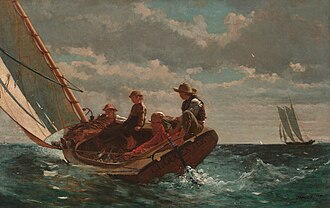 Le vent se lève - Winslow Homer (1873)
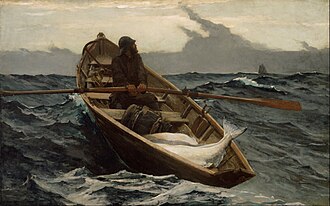 La Corne de brume - Winslow Homer (1885)
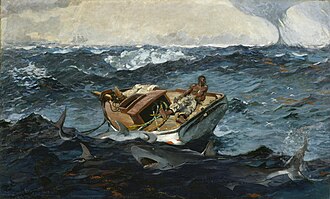 Le Gulf Stream - Winslow Homer (1899)
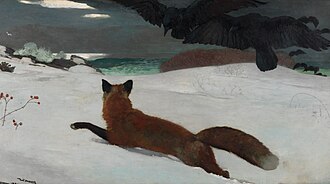 La Chasse au renard - Winslow Homer (1893)
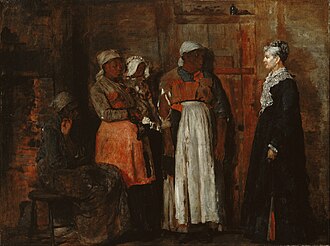 A Visit from the Old Mistress - Winslow Homer (1876)
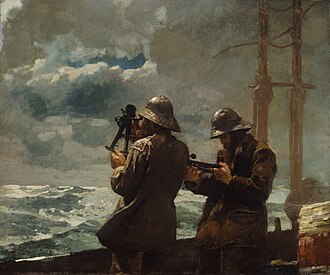 Eight Bells - Winslow Homer (1886)
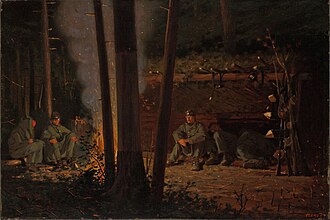 In Front of Yorktown - Winslow Homer (1860s)
 Droite et gauche - Winslow Homer (1909)
Œuvres d'artistes liés
 L'Origine du monde - Gustave Courbet (1866)
 Un enterrement à Ornans - Gustave Courbet (2020)
 Le Déjeuner sur l'herbe - Édouard Manet (1863)
 Olympia - Édouard Manet (1863)
 La Nuit étoilée - Vincent van Gogh (1889)
 Terrasse du café le soir - Vincent van Gogh (1888)