Chemin montant
Gustave Caillebotte · 1881
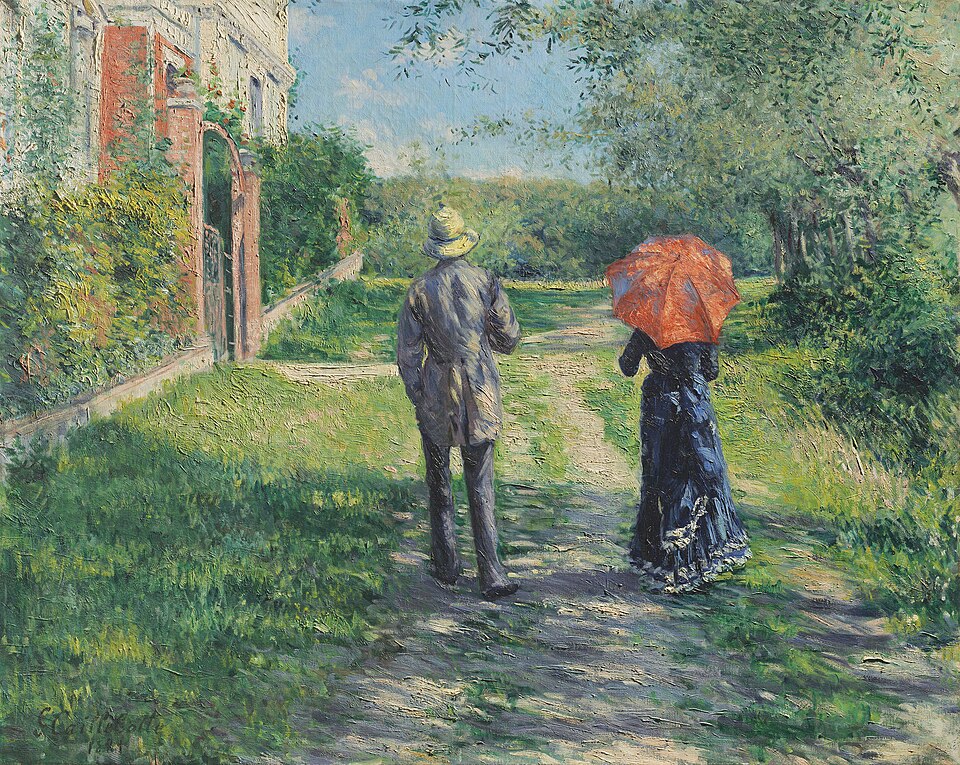
A couple walks away from us up a sunlit summer path beside a villa on the Normandy coast, her blue dress and red-orange parasol glowing against the green. Caillebotte showed it at the Impressionist exhibition of 1882.
The story behind the painting
Gustave Caillebotte painted The Uphill Path, Chemin montant, in 1881. The Caillebotte brothers spent their summers on the Normandy coast, that year at Villers-sur-Mer, near the fashionable resort of Trouville-sur-Mer, where they sailed and visited friends. The villa beside the path has been identified as the Villa Italienne. Caillebotte usually made many sketches before painting in his studio. The tall figure on the left resembles his brother Martial, with whom he lived until 1887. Some experts have seen in the young woman the young Charlotte Berthier, whom his family did not accept, but this is not confirmed.
What to look for
A couple, seen from behind, walks up a summer path along a villa whose entrance lies to the left. Trees line the path on the right, and it leads to a meadow and a wood beyond. A triangle of perspective closes on the wood above the man's yellow hat. Horizontal bands of shade and light create depth. The blue of the shadows returns in the clothes and above all in the woman's blue dress, while yellow patches echo the sunlight. Then follow a diagonal of red-orange accents: sunlit shutters, bricks, hollyhocks, and finally the round parasol.
Meaning and intent
The canvas, about 100 by 125 cm, marks a transition in Caillebotte's work, from the city strolls of earlier years to the study of nature. The family property at Yerres had been sold two years before, and in May 1881 the brothers bought land at Gennevilliers on the Seine, where they were building a country house. Only a few years later would Caillebotte turn seriously to marine painting. Here the walk itself is the subject: two people moving into light and summer, their faces hidden, so the viewer walks with them.
Legacy
At the Impressionist exhibition of 1882 the painting was noticed for its large size and its technique, and the humorous magazine Le Charivari even published a caricature of it. It belonged to Doris Schultz, an elegant friend of the brothers, then to her daughter Jeanne, and was not shown in public again until the 1994 retrospective at the Grand Palais that helped France rediscover Caillebotte. It was sold at Christie's in New York in 2003 and again in London in 2019, and is now at the Museum Barberini in Potsdam, part of the Hasso Plattner Collection.
Le saviez-vous ?
- Painted by Gustave Caillebotte in 1881.
- Set beside the Villa Italienne near Trouville-sur-Mer.
- Caricatured by Le Charivari at the 1882 Impressionist exhibition.
- Now at the Museum Barberini, Potsdam.
À propos de l'artiste
Gustave Caillebotte (1848-1894)
femme · homme · scène de genre · paysage · parapluie · Impressionisme - la collection Hasso Plattner
Autres œuvres de Gustave Caillebotte
 Rue de Paris, temps de pluie - Gustave Caillebotte (1877)
 Les Raboteurs de parquet - Gustave Caillebotte (1875)
 Vue de toits - Gustave Caillebotte (1878)
 Le Pont de l'Europe - Gustave Caillebotte (1876)
 Les Orangers - Gustave Caillebotte (1878)
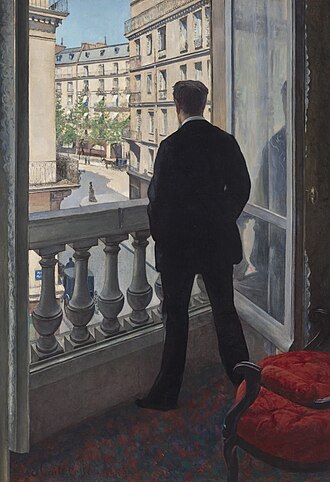 Jeune Homme à sa fenêtre - Gustave Caillebotte (1876)
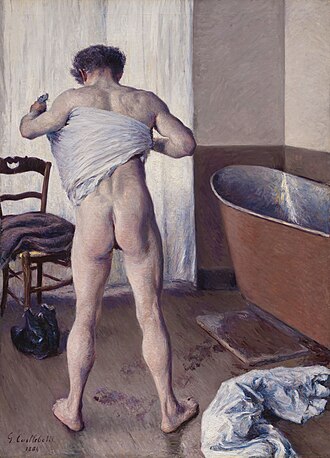 Homme au bain - Gustave Caillebotte (1884)
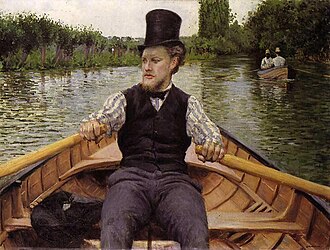 Partie de bateau - Gustave Caillebotte (1878)
Œuvres d'artistes liés
 Impression, soleil levant - Claude Monet (1872)
 Nymphéas - Claude Monet (1906)
 Le Déjeuner sur l'herbe - Édouard Manet (1863)
 Olympia - Édouard Manet (1863)
 Bal du moulin de la Galette - Pierre-Auguste Renoir (1876)
 Le Déjeuner des canotiers - Pierre-Auguste Renoir (1881)
 Le Berceau - Berthe Morisot (1872)
 Jour d'été - Berthe Morisot (1879)
 L'Absinthe - Edgar Degas (1875)
 La Famille Bellelli - Edgar Degas (1858)
 Le Canal du Loing - Alfred Sisley (1892)
 L'Abreuvoir à Marly-Le-Roi, gelée blanche - Alfred Sisley (1876)