Le Lapin
Édouard Manet · 1881
.png)
A dead rabbit hangs from a hook outside a closed window, framed by curtains and a climbing plant. Manet painted it in his last summers, already ill, with fast, broad strokes meant to be seen from across a room.
The story behind the painting
Manet completed The Rabbit in 1881, when his health was in decline, while spending the summer months at a villa in Versailles. It was conceived as one of four decorative panels, not long after he had proposed a series of panels for the meeting chamber of the Hôtel de Ville in Paris, a plan that came to nothing. The Rabbit and The Eagle Owl were the two central panels, both imagined as hunting trophies, while the outer panels showed a vine on a trellis and a corner of a garden. The work is sometimes also called The Hare.
What to look for
The canvas is tall and narrow, about 97.5 by 61 cm. A rabbit or hare hangs on a hook outside a closed house window, its body stretched by its own weight. Look at how few strokes describe the fur, and how the same quick, loose brushwork turns into the curtains behind the glass and the climbing plant that frames the animal on both sides. The picture is meant to be viewed from a distance, where these broad marks settle into texture and light. Up close you can follow the speed of the hand that made them.
Meaning and intent
Comparing it with Manet's own earlier Rabbit of 1866 shows how far he had travelled. That first picture follows the traditional French still life in the manner of Chardin, careful and detailed. The 1881 panel is casual and bold, much closer to the Impressionist style. Painted as decoration and as a trophy of the hunt, it is also a late work by an artist whose strength was failing, which gives the simple subject of a hanging animal an added quietness. The sources do not record Manet's own words about its meaning, so the picture speaks mainly through its handling.
Legacy
The work was submitted to the Paris Salon in 1882 but was not accepted. After Manet's death it was sold in the studio sale to the dealer Paul Durand-Ruel and later passed to the Paris firm Bernheim-Jeune. In 1917 the Welsh philanthropist Gwendoline Davies bought it, and in 1918 she exhibited it at the Victoria Art Gallery in Bath. When she died in 1951 she bequeathed her Impressionist collection to the National Museum of Wales, and The Rabbit has hung in Cardiff ever since. Its companion, The Eagle Owl, went to the Bührle Collection in Zurich.
Le saviez-vous ?
- Painted in 1881 at a villa in Versailles.
- One of four decorative panels; The Eagle Owl was its pair.
- Refused by the Paris Salon in 1882.
- Bequeathed by Gwendoline Davies to the National Museum of Wales in 1951.
À propos de l'artiste
Édouard Manet (1832-1883)
nature morte · fenêtre · Musée national du pays de Galles · suspension · lapin
Autres œuvres de Édouard Manet
 Le Déjeuner sur l'herbe - Édouard Manet (1863)
 Olympia - Édouard Manet (1863)
%20(33539037428).jpg) Un bar aux Folies Bergère - Édouard Manet (1882)
Un bar aux Folies Bergère - Édouard Manet (1882) Le Balcon - Édouard Manet (1868)
.jpg) La Musique aux Tuileries - Édouard Manet (1862)
La Musique aux Tuileries - Édouard Manet (1862).jpg) Le Fifre - Édouard Manet (1866)
Le Fifre - Édouard Manet (1866) Le Chemin de fer - Édouard Manet (1873)
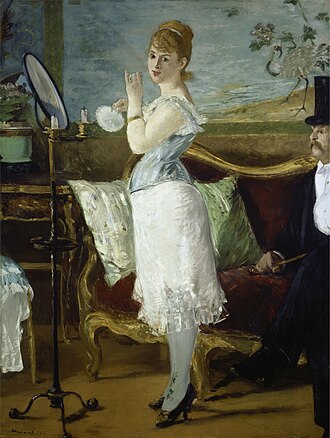 Nana - Édouard Manet (1877)
Œuvres d'artistes liés
 Impression, soleil levant - Claude Monet (1872)
 Nymphéas - Claude Monet (1906)
 Bal du moulin de la Galette - Pierre-Auguste Renoir (1876)
 Le Déjeuner des canotiers - Pierre-Auguste Renoir (1881)
 L'Absinthe - Edgar Degas (1875)
 La Famille Bellelli - Edgar Degas (1858)
 Le Pont Boieldieu à Rouen, temps mouillé - Camille Pissarro (1896)
 Rue Saint-Honoré, Après-midi, Effet de Pluie - Camille Pissarro (1897)
 Rue de Paris, temps de pluie - Gustave Caillebotte (1877)
 Les Raboteurs de parquet - Gustave Caillebotte (1875)
 Promenade au bord de la mer - Joaquín Sorolla (1909)
 Triste héritage - Joaquín Sorolla (1898)