The Holy Family with Saint John the Baptist
Michel-Ange Buronarroti · 1540
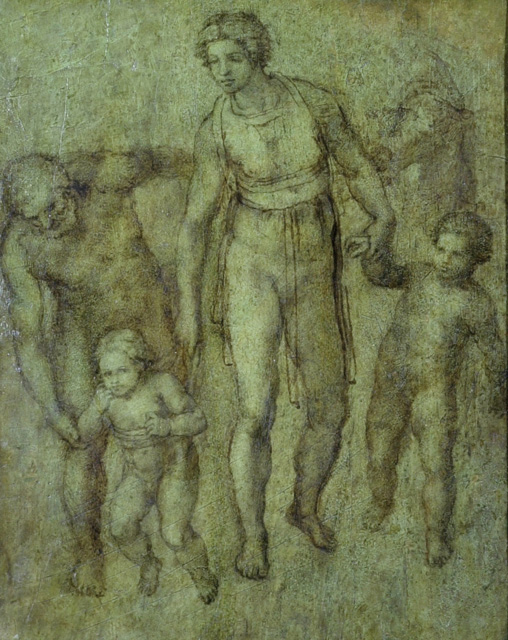
Mary strides forward, guiding the Christ Child on a walking strap and holding little John by the hand, while Joseph bends to steady the toddler. Only outlines were ever laid in, and scholars still argue whether the hand was Michelangelo's.
The story behind the painting
This picture was made around 1540, either in Michelangelo's closest circle or possibly by Michelangelo himself. It is a brown wash drawing with the brush on poplar wood, about 62 by 49.5 cm, and was never finished. The figures and composition are close to Michelangelo, to whom it was once attributed. Later researchers, when they noticed it at all, distanced themselves from it and treated it as a possible copy of a lost original design. The German article dates that lost design to the 1640s, which conflicts with the date of about 1540 given for the picture itself, so that figure may be a slip.
What to look for
Only the outer contours are laid in. Mary walks forward, leading the Christ Child at her feet with a walking strap, a leading rein for a child learning to walk, while with her other hand she holds the young John the Baptist walking beside her. Joseph bends over the Christ Child, giving extra support as he learns to walk. Look at the unfinished state itself: the bare lines show how the group was planned, and how the movement runs from Mary's stride down to the child's first steps.
Meaning and intent
The scene may show the Holy Family returning from Egypt. What makes it touching is how ordinary the moment is: a mother, a father and two small boys, one of them taking his first steps with help from both parents. The sacred story is told through a gesture every family knows. The unfinished lines leave the viewer to complete the figures, as if the image were still being thought through on the panel.
Legacy
Recent scholars have changed their minds again. The unfinished state and a panel only poorly prepared for painting are completely untypical of a later copy, and the drawing is of unusually high quality, so an attribution to Michelangelo himself is again being considered. The picture was in the royal collection in Naples, then belonged to William Young Ottley and afterwards to the painter Sir Thomas Lawrence. The Ashmolean Museum in Oxford acquired it in 1846, and it is kept there under inventory number A 66 C.
Le saviez-vous ?
- Made around 1540, unfinished, brown wash on poplar wood.
- About 62 x 49.5 cm.
- Attribution to Michelangelo himself is again being considered.
- In the Ashmolean Museum, Oxford, since 1846.
À propos de l'artiste
Michel-Ange Buronarroti (1475-1564)
art religieux · Jean le Baptiste · sainte Famille · Ashmolean Museum
Autres œuvres de Michel-Ange Buronarroti
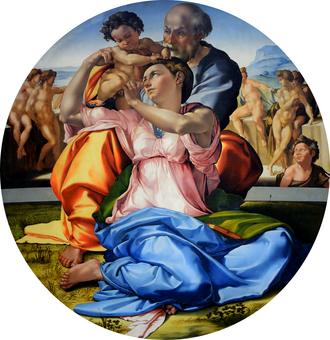 Tondo Doni - Michelangelo (1500s)
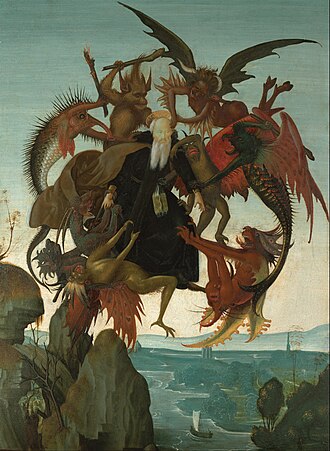 Le Tourment de saint Antoine - Michelangelo (1487)
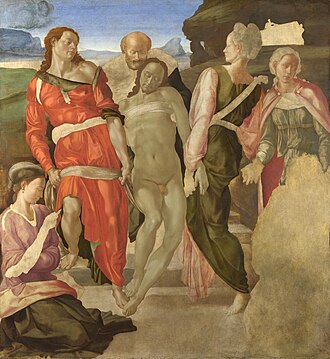 La Mise au tombeau - Michelangelo (1500s)
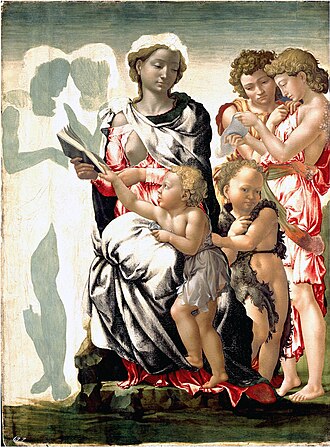 Madone de Manchester - Michelangelo (1494)
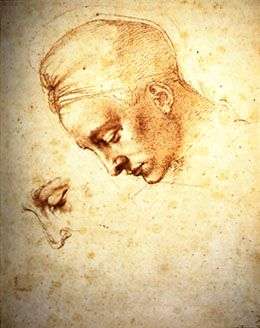 Léda - Michelangelo (1530)
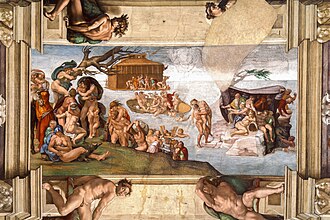 Le Déluge - Michelangelo (1508)
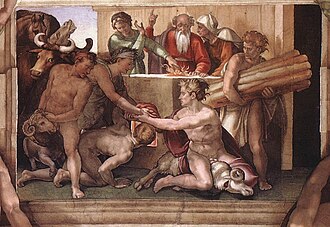 Le Sacrifice de Noé - Michelangelo (1508)
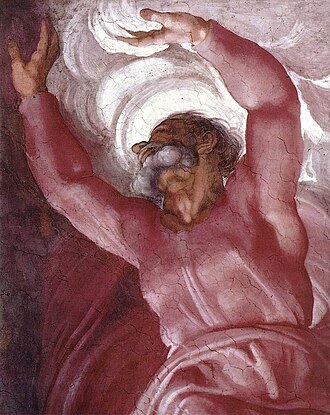 La Séparation de la lumière et des ténèbres - Michelangelo (1512)
Œuvres d'artistes liés
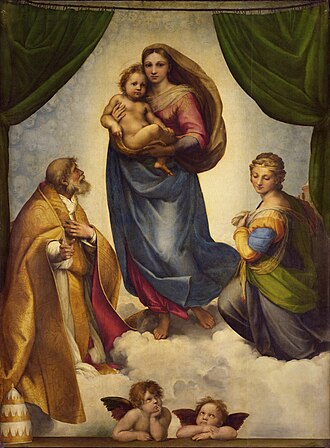 La Madone Sixtine - Raphael (1510s)
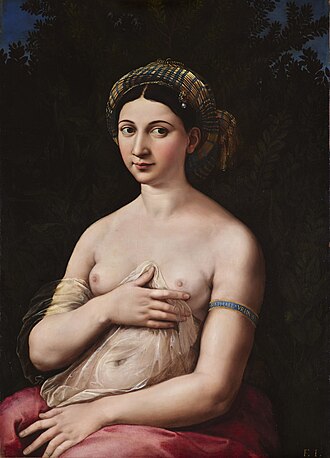 La Fornarina - Raphael
 Vénus d'Urbin - Titian (1538)
 L'Assomption de la Vierge - Titian (1510s)
 La Joconde - Leonardo da Vinci (1503-1519)
 La Dame à l'hermine - Leonardo da Vinci (1490)
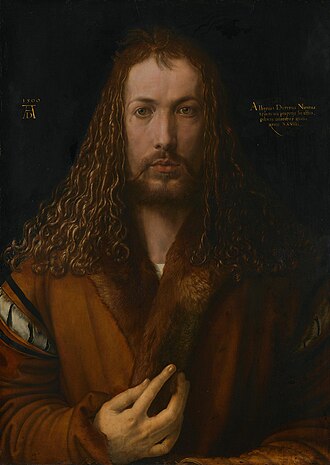 Autoportrait - Albrecht Dürer (1500)
 Adoration des mages - Albrecht Dürer (1504)
 La Naissance de Vénus - Sandro Botticelli (c. 1485)
 Le Printemps - Sandro Botticelli (1480s)
 Le Jardin des délices - Hieronymus Bosch
 La Nef des fous - Hieronymus Bosch (1500s)